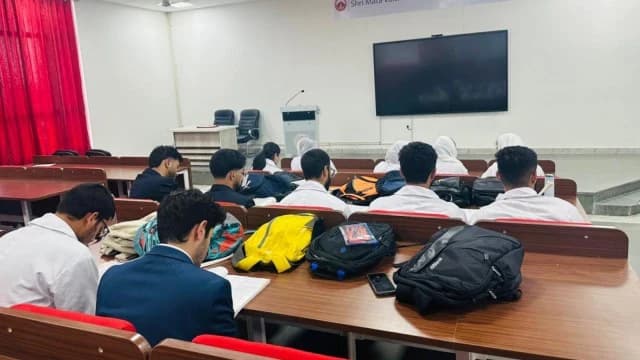
Even as right-wing Hindu organizations continue to agitate outside, the Shri Mata Vaishno Devi Institute of Medical Excellence is settling into the rhythms of an academic campus — with lectures underway, bhajans playing in common halls and students focused on their coursework, largely untouched by the controversy swirling beyond its gates.
More than a month after classes began, the protests over the composition of the first MBBS batch — 44 of the 50 selected students are Muslims from Kashmir — remain a distant murmur inside the campus, located 16 km from the Vaishno Devi shrine in Jammu’s Reasi district.

Inside, there are no visible signs of tension. Hymns to the Goddess echo through shared spaces, large portraits of Mata Vaishno Devi dominate the reception-cum-meeting hall, and students move between classrooms and hostels in what officials describe as a calm, closely regulated environment.
Of the 47 students who have finally joined, more than half are women. All 44 students from Kashmir took admission, while only three of the six candidates from Jammu who cleared the process have joined. Officials said the steep cost of the course — ₹4.95 lakh in annual tuition fees, over ₹50,000 in miscellaneous charges, and a one-time payment of ₹51,000 — led several families to opt instead for government medical colleges.
The protests, led by groups including the RSS-affiliated Bajrang Dal and the VHP, and backed by BJP Udhampur MLA R S Pathania, have demanded that admissions at the institute be restricted to Hindus, citing its association with the Vaishno Devi shrine. Officials, however, stressed that the college is not a minority institution and admissions are conducted solely on the basis of NEET scores through the J&K Board of Professional Entrance Examinations.
At Shri Mata Vaishno Devi University, of which the medical college is a constituent, nearly 2,800 students study across 16 departments. Only around 20% are Muslims from Kashmir, officials said, with the rest drawn from across the country and multiple communities.
“There have been no issues among students,” a senior official said. “They come from different religions, cultures, languages and food habits, and they study and live together.” Even an undertaking signed by students and parents agreeing not to cook or consume non-vegetarian food on campus has met with no resistance, officials added.
The medical institute currently operates from a six-storey building constructed within a year of Prime Minister Narendra Modi laying its foundation stone. A second building of similar size is nearing completion. The campus houses 150 faculty members, staff quarters for 700 employees, and hostels for students and nurses.
Departments include Anatomy, Physiology, Biochemistry, Pharmacology, Community Medicine, Forensics, Pathology and Microbiology, and the institute is attached to the Shri Mata Vaishno Devi Super Specialty Hospital.
Students attend classes both at the institute and the hospital. Speaking on condition of anonymity, several said that even when protesters gathered at the campus gates, their routines remained unaffected. “With entry and exit regulated by campus staff and villagers around us being extremely hospitable, it feels very secure,” one student said.
The institute enforces a uniform — uncommon at the college level in J&K — along with strict attendance rules and controls on leaving the campus. Students say they accept the discipline. “We are here to study and to serve people,” another student said.
As part of their training, students make mandatory fortnightly visits to Penthal village, about 3 km away, which has been adopted by the institute. Each student is assigned three families for regular medical check-ups throughout the MBBS course. “Whenever we go, they offer us tea or lunch,” said a female student from Kashmir.
On weekends, many Kashmiri students travel home on the Katra–Srinagar Vande Bharat train, making the round trip once a fortnight, officials said.
Protesters, however, insist their agitation is far from over. Colonel (retd) Sukhbir Singh Mankotia, president of the Shri Mata Vaishno Devi Sangharsh Samiti — an umbrella group of nearly 60 organizations including the VHP, Bajrang Dal and J&K Sanatan Dharam Sabha — linked the reluctance of Jammu-based students to join the institute to broader fears.

“Reports of doctors from Kashmir being involved in terror modules and allegations of ‘love jihad’ have created fear among parents,” Mankotia said. “I too would not want my daughter to study in an institute where most students are Muslims from Kashmir.”
Officials counter that the student composition mirrors a broader trend in J&K. Despite the Jammu region having more medical seats than Kashmir — about 900 compared to 675 — students from the Valley have increasingly filled a majority of seats in Jammu-based medical colleges in recent years. In engineering, the pattern is reversed, with students from Jammu opting in larger numbers.
For now, at the Vaishno Devi medical college, the contrast is stark: protests at the perimeter, and inside, a campus intent on learning, routine and coexistence.