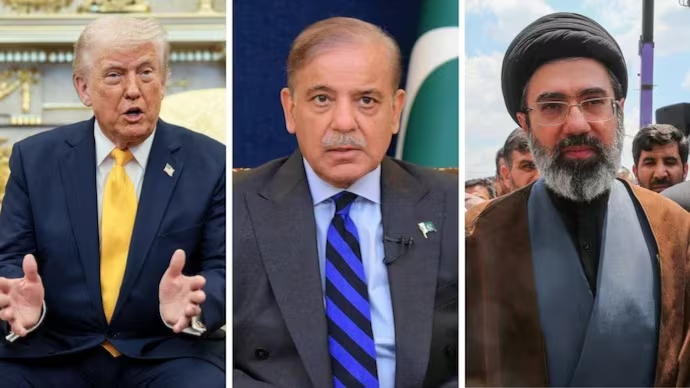
US President Donald Trump on March 25 reignited speculation over Pakistan’s potential role in brokering talks between Washington and Tehran after amplifying a post by Pakistan Prime Minister Shehbaz Sharif, who offered Islamabad as a venue for negotiations to end the escalating Middle East conflict.
In a message on X, Sharif said Pakistan was “ready and honored” to facilitate “meaningful and conclusive talks” between the US and Iran, subject to both sides agreeing to participate. He added that Islamabad “welcomes and fully supports” diplomatic efforts aimed at restoring regional stability.

The offer positions Pakistan as a potential neutral platform, leveraging its ties with both Washington and Tehran. Analysts say such backchannel facilitation could help bridge gaps at a time when direct engagement remains stalled, signaling a broader international push to de-escalate the crisis.
However, Islamabad’s diplomatic pitch comes even as it faces its own regional tensions. Pakistan remains locked in a conflict with neighboring Afghanistan following airstrikes earlier this year, a development that has drawn comparatively limited global attention amid the intensifying US-Israel-Iran confrontation.
Iran pushes back on Trump’s claims
Trump’s move also comes against the backdrop of rising global concern over economic disruptions linked to the Strait of Hormuz, a vital artery for global energy supplies. The conflict, now in its fourth week, has already triggered volatility in oil markets and supply chains.
Despite Trump’s assertion of “productive talks” and a temporary five-day pause in fighting, Iran has firmly denied that negotiations are underway, contradicting claims of imminent dialogue.
Iranian Parliament Speaker Mohammad Bagher Ghalibaf dismissed the US narrative, accusing Washington of attempting to “escape the quagmire” it faces alongside Israel.
Backchannel efforts intensify
Even as public positions harden, behind-the-scenes diplomacy appears to be gaining momentum. Reports indicate that countries such as Pakistan, Egypt and Turkey are quietly acting as intermediaries, seeking an off-ramp from a conflict that has sparked one of the most severe energy crises in recent history.
Possible formats for talks under consideration include meetings involving Iranian Foreign Minister Abbas Araghchi, US envoy Steve Witkoff and Jared Kushner, or a separate engagement between US Vice President JD Vance and Ghalibaf.
Iran’s Foreign Ministry spokesperson Esmaeil Baghaei acknowledged that messages are being exchanged through “friendly countries,” confirming indirect communication channels remain open. However, he emphasized that Tehran’s responses are guided by its “principled positions,” signaling no immediate shift toward formal negotiations.
Further hardening Iran’s stance, senior military adviser Mohsen Rezaei said the war would continue unless Tehran secures compensation, sanctions relief and guarantees against future US interference—underscoring the steep hurdles facing any potential diplomatic breakthrough.