


Nepal has shifted its approach from seeking post-disaster aid to demanding climate compensation, with Foreign Minister Shisir Khanal saying support for vulnerable countries should be treated as legal and moral liability.
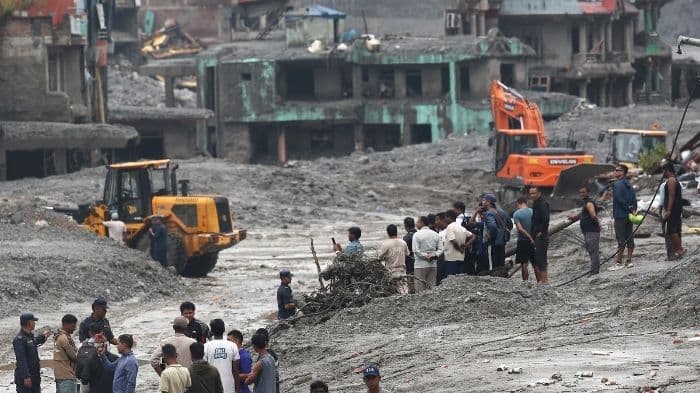
Nepal has sought climate-related compensation from major greenhouse gas emitters, including China, the US and India, following the devastating flash floods in the Rasuwa and surrounding northern districts, with the government describing such support as a matter of moral and legal liability rather than charity.
Foreign Minister Shisir Khanal said Nepal contributes virtually negligible greenhouse gas emissions but is facing severe consequences associated with global climate change, including rapid glacier melt and extreme mountain disasters.

Khanal said Nepal was changing its diplomatic approach from seeking aid to pursuing “justice and compensation” for climate-related losses.
He identified China, the US and India as the world's three largest greenhouse gas emitters and said they have a historical responsibility towards vulnerable countries such as Nepal.
The Foreign Minister said the Ministry of Finance had formally sent a climate compensation claim letter to international partners. He added that Nepal would raise the issue at international forums.
The move follows the deadly flash floods that struck the Bhotekoshi river basin on Aug 26. Nepal has also formally approached the board of the Fund for Responding to Loss and Damage for urgent assistance, saying the scale of the disaster has exceeded the country's immediate response capacity.
A letter jointly signed by Finance Minister Swarnim Wagle and Forests and Agriculture Minister Geeta Chaudhary said the disaster had caused widespread loss of life, displacement and destruction of homes and critical infrastructure.
It added that the full extent of the economic and non-economic losses was yet to be determined, while preliminary information indicated that the consequences were extensive.
Maheshwar Dhakal, joint secretary at Nepal's Ministry of Forests and a member of the Loss and Damage Fund's board, said this was the first time Nepal had sought assistance from the mechanism. He said the damage caused by the floods, along with the search, rescue, relief, rehabilitation and reconstruction requirements, had created a major challenge for the country.
Nepal has requested an immediate response rather than waiting for the board's next scheduled meeting in December, according to the report.
The government said the disaster affected a fragile transboundary mountain river system and demonstrated how extreme events in the Himalayan region can rapidly affect downstream areas.
The damage has implications for water, food, energy, health, infrastructure, ecosystems and human security, according to the letter.
Khanal also linked the issue to the wider threat posed by the disappearance of Himalayan glaciers, saying it could have implications for water security across South Asia. He said rivers including the Ganges and Trishuli support more than two billion people in the region.
Nepal, which is described as a least developed and highly climate-vulnerable mountainous country, has increasingly placed Himalayan climate risks at the centre of its international diplomacy.
The country's latest appeal comes amid the devastation caused by the flash floods and its efforts to secure financial support for the resulting losses and damage.

UNESCO flags India’s rural education gap: 59 girls for every 100 boys

UP Mission Shakti Campaign: 67,951 Students Participate in Women’s Safety Awareness Drive on Day 1

NMAT by GMAC 2026 Registration Deadline: Check Exam Dates, Retake Rules and Latest Update
Madurai Kamaraj University seeks grants for college struggling to pay salaries amid ₹2 crore annual deficit

IISc Study Challenges Chandrasekhar Limit, Finds White Dwarfs Could Grow Far Beyond Expected Mass
UNESCO flags India’s rural education gap: 59 girls for every 100 boys
Madurai Kamaraj University seeks grants for college struggling to pay salaries amid ₹2 crore annual deficit
IISc Study Challenges Chandrasekhar Limit, Finds White Dwarfs Could Grow Far Beyond Expected Mass

Surat medical college ragging case: Two senior doctors arrested after PG student’s death

IIIT Ranchi student death: NHRC to examine allegations of administrative negligence and delayed medical aid

UNESCO flags India’s rural education gap: 59 girls for every 100 boys
UP Mission Shakti Campaign: 67,951 Students Participate in Women’s Safety Awareness Drive on Day 1
NMAT by GMAC 2026 Registration Deadline: Check Exam Dates, Retake Rules and Latest Update
Madurai Kamaraj University seeks grants for college struggling to pay salaries amid ₹2 crore annual deficit
IISc Study Challenges Chandrasekhar Limit, Finds White Dwarfs Could Grow Far Beyond Expected Mass
UNESCO flags India’s rural education gap: 59 girls for every 100 boys
Madurai Kamaraj University seeks grants for college struggling to pay salaries amid ₹2 crore annual deficit
IISc Study Challenges Chandrasekhar Limit, Finds White Dwarfs Could Grow Far Beyond Expected Mass
Surat medical college ragging case: Two senior doctors arrested after PG student’s death
IIIT Ranchi student death: NHRC to examine allegations of administrative negligence and delayed medical aid
Copyright© educationpost.in 2026 All Rights Reserved.