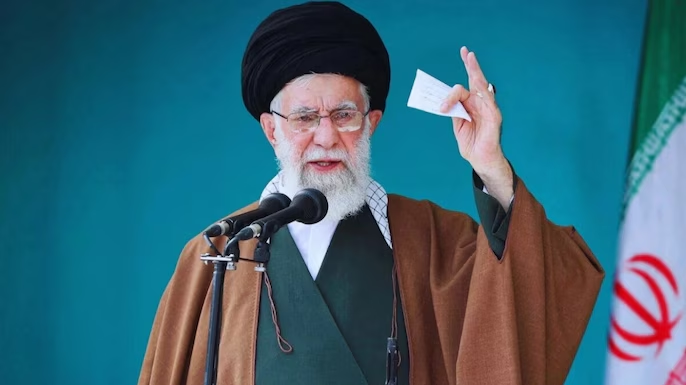
Iran was plunged deeper into turmoil on January 8 after Supreme Leader Ayatollah Ali Khamenei unleashed a furious attack on US President Donald Trump even as the country was rocked by its biggest wave of anti-government protests in years.
In a nationally broadcast address, Khamenei branded Trump “arrogant” and accused him of having his “hands stained with the blood of Iranians,” declaring that the American president himself would be “overthrown” just as Iran’s imperial rulers were toppled in the 1979 revolution.

He urged Trump to “focus on the problems in your own country” and accused Iranian protesters of “ruining their own streets to make the president of another country happy.”
The speech came as Iran’s two-week-long unrest escalated into a full-scale national uprising, driven by economic collapse, runaway inflation and the crashing value of the Iranian rial. What began on December 28 with a strike at Tehran’s historic Grand Bazaar has now spread to all 31 provinces, engulfing major cities and small towns alike.
Recent protests marked the largest mobilization yet, with streets, bazaars and transport hubs shutting down in open defiance of the government. Demonstrations rolled into January 9, even as authorities tried to choke off the flow of information by imposing an internet blackout and cutting international phone lines.
According to the Associated Press, at least 42 people have been killed in the violence so far. More than 2,270 protesters have been detained, the US-based Human Rights Activists News Agency reported, making this one of the bloodiest crackdowns in years.
The unrest has also spilled into direct clashes with the state. In Khorasan Razavi province, protesters attacked a police station in Chenaran, killing five people, according to provincial officials. Buses were set on fire in Mashhad, while state media said metro stations, fire trucks and public vehicles were torched by what it called “terrorist agents” backed by the United States and Israel.
Iran’s leadership has doubled down on that narrative, insisting the revolt is being driven by foreign forces. State television accused Washington and Tel Aviv of orchestrating the violence, even as unverified videos circulating online showed crowds chanting anti-government slogans around bonfires in city streets.
From exile, former Crown Prince Reza Pahlavi has urged Iranians to intensify the protests, calling on people to pour into the streets at 8 pm each night. Analysts say those calls helped fuel the latest surge. “What turned the tide of the protests was Reza Pahlavi’s calls for Iranians to take to the streets,” said Holly Dagres of the Washington Institute for Near East Policy.
Khamenei, however, made clear he would not yield. He dismissed demonstrators as “vandals” and “saboteurs” and warned that Iran would not tolerate “mercenaries for foreigners.” The Tehran prosecutor has already announced criminal cases against businesses, brands and social-media figures accused of backing what he called “anti-Iranian calls.”
Across the region, the fallout is growing. Several flights between Dubai and Iranian cities including Tehran, Shiraz and Mashhad were cancelled on January 9, while Turkish Airlines and Pegasus suspended or diverted services after unrest spread and airspace risks mounted.
From Washington, Trump has issued his own warning. The US president said Iran had been “told very strongly” that it would “pay hell” if security forces continue killing protesters, claiming the situation inside the country was “getting very bad” and that Khamenei was “looking to go somewhere.”
With the economy in free fall, communications cut and violence spiralling, Iran now faces one of the gravest crises of the Islamic Republic era — a confrontation that has pitted a defiant supreme leader against an enraged population, and dragged the United States into a dangerous new war of words.