The war between Iran and the US–Israel axis has entered its most volatile phase yet — transforming into an all-out oil and gas conflict, with critical energy infrastructure now directly in the line of fire.
In the past 24 hours, the conflict has sharply escalated as both sides began targeting fossil fuel production sites, signaling a strategic shift where energy itself has become a weapon of war.

The turning point came when Israel struck Iran’s South Pars gas field — the world’s largest — prompting swift retaliation from Tehran with missile strikes aimed at key gas facilities in Qatar and the UAE. The tit-for-tat attacks have raised fears of a prolonged global energy shock.
South Pars strike triggers global alarm
Until March 17, Washington and Tel Aviv had largely avoided hitting Iran’s core energy infrastructure. Even earlier US strikes on Kharg Island — which handles nearly 90% of Iran’s oil exports — were limited to military targets.
That restraint ended with the South Pars strike.
The scale of the risk is immense. South Pars holds an estimated 1,800 trillion cubic feet of natural gas — enough to meet global demand for 12–13 years. It is also central to Iran’s domestic energy needs, supplying nearly 80% of its electricity.
Crucially, the field is shared with Qatar, where it is known as the North Field — the backbone of global LNG supplies. Any disruption here reverberates across continents, including energy-dependent economies like India.
Markets reacted instantly. Oil and gas prices surged, reflecting fears that supply disruptions could stretch far beyond the immediate conflict zone.
Iran retaliates, targets Gulf energy hubs
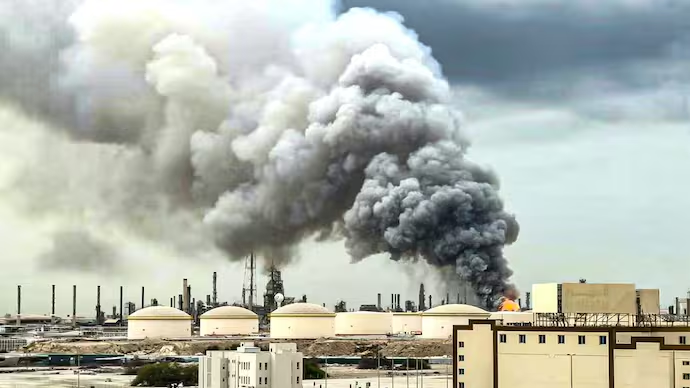
In response, Iran launched missiles at Qatar’s Ras Laffan LNG facility — a critical export terminal — and targeted the UAE’s Habshan gas facility and Bab field. While most strikes were intercepted, the message was clear: Gulf energy infrastructure is no longer off-limits.
The UAE condemned the attack as a “terrorist act” threatening global energy security, while Iran warned it could expand strikes to Saudi Arabia’s oil and gas assets.
Earlier, a drone strike had already forced a shutdown at Abu Dhabi’s Shah gasfield, which contributes about 8% of global granulated sulphur output — vital for fertilizer production.
India among worst-hit if disruption continues
The escalation carries serious implications for India, one of the world’s largest LNG importers.
Around 80–85% of India’s LPG supplies come from Qatar and Saudi Arabia. Any sustained disruption could strain fuel availability, impacting fertilizer production, city gas distribution, and CNG supply for transport.
Prices spike, long-term damage feared
The global fallout was immediate. Brent crude prices jumped to $110 per barrel, while benchmark gas prices rose by 6%. In the US, gasoline prices climbed to their highest levels since September 2023.
Energy experts warn the damage could be long-lasting. LNG infrastructure, once hit, can take years to repair — amplifying the risk of prolonged supply shocks.
Historical precedent underscores the danger. After the 2003 Iraq war, it took nearly two years for oil production to recover to pre-war levels.
Energy becomes the new battlefield
The latest strikes mark a decisive shift in the conflict’s trajectory. What began as a military confrontation has evolved into economic warfare, with energy systems at its core.
With no signs of de-escalation, the widening attacks on oil and gas infrastructure suggest the conflict is no longer regional in impact — it is global in consequence.
The message is unmistakable: this is no longer just a war of missiles and defense systems. It is a war for control over the world’s energy lifelines.




.jpg&w=256&q=75)





.jpg&w=256&q=75)
