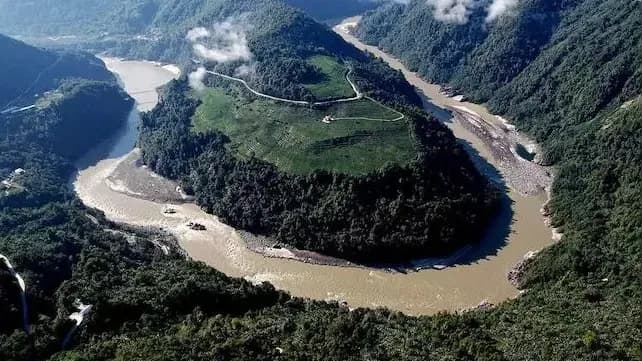
India has reiterated its concerns about constructing a hydropower project planned by China on the Yarlung Tsangpo River in Tibet, which falls as the Brahmaputra river in India and Jamuna in Bangladesh before falling into the sea.
The project is a warning of potential impacts on downstream countries like India and Bangladesh and India is calling for greater transparency.

“We have seen the information released by Xinhua on 25 December 2024 regarding a hydropower project on the Yarlung Tsangpo River in the Tibet Autonomous Region of China. As a lower riparian state with established user rights to the waters of the river, we have consistently expressed, through expert-level as well as diplomatic channels, our views and concerns to the Chinese side over mega projects on rivers in their territory,” said Ministry of External Affairs (MEA) spokesperson Randhir Jaiswal during a weekly press briefing.
“These have been reiterated, along with the need for transparency and consultation with downstream countries, following the latest report. The Chinese side has been urged to ensure that the interests of downstream states of the Brahmaputra are not harmed by activities in upstream areas. We will continue to monitor and take necessary measures to protect our interests,” Jaiswal added.
China’s project, the world’s largest hydropower dam, has raised alarm bells across the region. The proposed dam, to be constructed in the lower reaches of the Yarlung Tsangpo River, is expected to generate three times more energy than the Three Gorges Dam, currently the world’s largest hydropower plant. Chinese state media has described the initiative as a “safe project that prioritizes ecological protection,” touting its potential to bolster local prosperity and contribute to Beijing’s climate neutrality goals.
However, environmentalists, human rights groups, and neighboring countries have voiced concerns. Critics warn that the project could displace local communities in Tibet and wreak havoc on ecosystems downstream in India and Bangladesh. Experts also fear the dam’s strategic implications, with the potential for China to control or divert water flows critical to millions of lives and livelihoods downstream.
India’s northeastern states of Arunachal Pradesh and Assam, as well as Bangladesh, rely heavily on the Brahmaputra River, which originates as the Yarlung Tsangpo in Tibet.
China’s foreign ministry has previously asserted Beijing’s “legitimate right” to develop the river, emphasizing that downstream impacts are being taken into account. The project is going to displace or resettle 1.4 million people.
Adding to the complexity is the site’s location in an earthquake-prone zone. Reports suggest the project will require drilling at least four 20-kilometer-long tunnels through the Namcha Barwa mountain to divert the river’s flow, raising concerns about landslides and geological instability in one of the world’s deepest and most fragile canyons.
Activists have criticized the dams built in Tibetan areas as tools of exploitation and control by Beijing. The Tibetan Plateau, rich in biodiversity, has seen repeated crackdowns since China annexed the region in the 1950s, with waves of displacement and ecological disruption accompanying such mega-projects.





.webp&w=256&q=75)