


The Oct 28 meeting will bring together scientists, diplomats and research leaders to examine how major scientific facilities can sustain international cooperation amid political tensions. Young researchers will present examples of work conducted at the regional synchrotron.
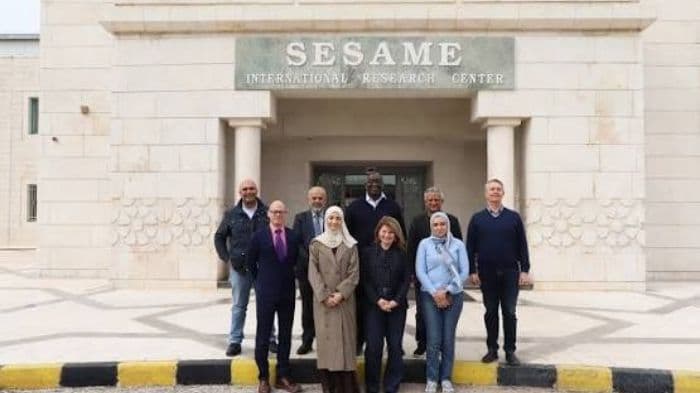
The European Commission will convene a symposium on science diplomacy at the Synchrotron-Light for Experimental Science and Applications in the Middle East (SESAME) facility in Jordan on Oct 28, bringing together scientists, diplomats and other stakeholders to discuss how research infrastructure can support international cooperation.
The one-day event is being organised by the European Commission in cooperation with SESAME, the United Nations Educational, Scientific and Cultural Organization (UNESCO) and the Union for the Mediterranean (UfM).

The discussions will examine how scientific facilities can build trust between countries, sustain collaboration during periods of political tension and contribute to research and technological competitiveness.
The symposium comes as the European Union develops its approach to international research cooperation under its recently adopted framework for science diplomacy. The event will also consider the future of SESAME and the role of large-scale research facilities in connecting scientific communities across borders.
SESAME brings regional researchers together
Located in Allan, Jordan, SESAME is an intergovernmental research facility that uses synchrotron light to support scientific experiments. Its research applications span fields including materials science, chemistry, biology and archaeology.
The facility is also an example of science diplomacy in practice. Its current members are Cyprus, Egypt, Iran, Israel, Jordan, Pakistan, Palestine and Türkiye, bringing researchers from across the region into a shared scientific organisation.
Synchrotron facilities generate intense beams of light that scientists can use to examine the properties and composition of materials. Researchers can apply the technology to questions ranging from the structure of biological samples to the analysis of historical artefacts and materials.
The symposium will explore how this shared infrastructure can support scientific collaboration even when political relations between participating countries are difficult. Young researchers will present examples of their work at SESAME, linking the broader discussion of science diplomacy to research carried out at the facility.
European Union advances science diplomacy framework
The meeting is taking place in the context of the European Strategy on Research and Technology Infrastructures, the Pact for the Mediterranean and the EU Framework for Science Diplomacy.
The framework sets out an approach for EU member states and European institutions to use scientific cooperation in international engagement. Research infrastructure is one part of this effort, providing a basis for researchers and institutions from different countries to work together on shared scientific questions.
The symposium will examine the contribution of such facilities to international cooperation and peacebuilding, as well as their role in strengthening competitiveness. Participants will also discuss how research infrastructure can support the movement of scientific knowledge and talent across borders.
Speakers listed by the organisers include Princess Sumaya bint El Hassan, president of Jordan’s Royal Scientific Society; Azmi Mahafzah, Jordan’s minister of education and human resources development; Maria Cristina Russo, deputy director-general for innovation, prosperity and international cooperation at the European Commission’s Directorate-General for Research and Innovation; and Khaled Toukan, director of SESAME.
Other speakers include Robbert Dijkgraaf, president of the International Science Council, and Karen Hallberg, secretary-general of the Pugwash Conferences on Science and World Affairs.

NASA compares 2026 El Niño with powerful 1997 event using satellite data
C-DAC, Bank of India join forces to build quantum-safe banking ecosystem
Supernova remnant reveals mysterious knots and clumps of gas in unprecedented detail
University of Johannesburg records second-largest rise in global research influence
IUCN launches global strategy to combat invasive species and protect biodiversity

Canada announces $813 million research boost to back 450-plus researchers
Abu Dhabi aims to bring 2,000 Emirati teachers into private schools within five years

Australian schools record thousands of student sexual misconduct reports as child safety concerns grow
Egypt insists international schools include Arabic, history in final scores
China’s Chery unveils AI companion robot designed to ease loneliness

NASA compares 2026 El Niño with powerful 1997 event using satellite data
C-DAC, Bank of India join forces to build quantum-safe banking ecosystem
Supernova remnant reveals mysterious knots and clumps of gas in unprecedented detail
University of Johannesburg records second-largest rise in global research influence
IUCN launches global strategy to combat invasive species and protect biodiversity
Canada announces $813 million research boost to back 450-plus researchers
Abu Dhabi aims to bring 2,000 Emirati teachers into private schools within five years
Australian schools record thousands of student sexual misconduct reports as child safety concerns grow
Egypt insists international schools include Arabic, history in final scores
China’s Chery unveils AI companion robot designed to ease loneliness
Copyright© educationpost.in 2026 All Rights Reserved.