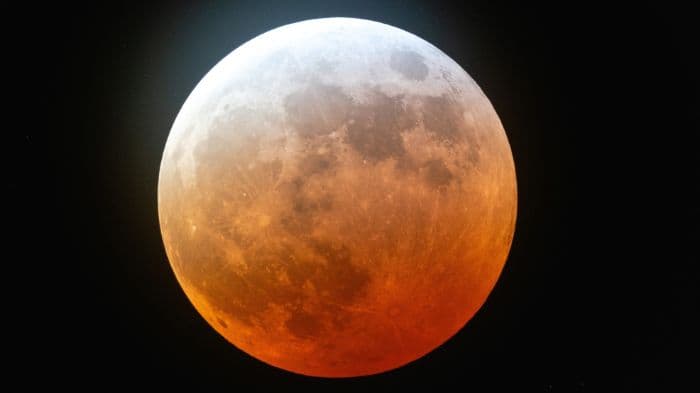
The total lunar eclipse on September 7 will last for around 82 minutes, with peak visibility across major Indian cities, turning the Moon a deep red shade.

Skywatchers across India are in for a celestial spectacle tonight as a total lunar eclipse, widely known as a Blood Moon, unfolds. This rare event will last approximately 82 minutes in totality, making it one of the longest such eclipses in recent years.
In India, the penumbral eclipse—the subtle initial phase—will begin at 8:58 PM IST, quickly followed by the moon entering Earth's umbral shadow at 11:00 PM IST. The period of totality, when the Moon turns a striking red hue, is expected to continue until 12:22 AM IST, after which the eclipse will gradually end by 2:25 AM IST.

This phenomenon will be visible across India, including cities like Delhi, Mumbai, Kolkata, Hyderabad, Pune, Bengaluru, Chennai, and Lucknow provided skies remain clear.
The dramatic red appearance is caused by Rayleigh scattering—sunlight passing through Earth's atmosphere filters out blue light, allowing red wavelengths to cast onto the Moon.
The eclipse's length and visibility make it stand out. Skywatching authorities note that the Moon's slow motion near apogee and its path through Earth's central shadow contribute to a notably prolonged totality of 82 minutes—a major highlight for astronomers and casual observers alike.
Additional details underscore the event's safe viewability: unlike solar eclipses, a lunar eclipse can be observed with the naked eye, with no protective eyewear needed, offering families and enthusiasts a readily accessible skywatching experience.
This lunar eclipse also enjoys broad global visibility, accessible to residents across Asia, Australia, Africa, and Europe, marking it as a truly international astronomical event.


Punjab Board Class 10, 12 exam 2027 forms open, fees and attendance rule announced

IIM Lucknow launches 11-month executive programme in brand management

Rajasthan Board to hold two Class 10 board exams from 2026-27, check details

IIT Bombay begins student welfare overhaul after suicide row

Francis Halzen wins 2026 Nobel Prize in Physics for high-energy neutrino research

Francis Halzen wins 2026 Nobel Prize in Physics for high-energy neutrino research

IISc at 254 in THE Rankings: What India’s Premier Research Institution’s Scores Actually Reveal

CBSE to screen inclusive education module for school staff on October 7

University of Toronto launches $100 million PhD scholarship programme

World Teachers’ Day 2026: India’s workforce grows, but staffing gaps remain as educators shape confidence and learning

Punjab Board Class 10, 12 exam 2027 forms open, fees and attendance rule announced

IIM Lucknow launches 11-month executive programme in brand management

Rajasthan Board to hold two Class 10 board exams from 2026-27, check details

IIT Bombay begins student welfare overhaul after suicide row

Francis Halzen wins 2026 Nobel Prize in Physics for high-energy neutrino research

Francis Halzen wins 2026 Nobel Prize in Physics for high-energy neutrino research

IISc at 254 in THE Rankings: What India’s Premier Research Institution’s Scores Actually Reveal

CBSE to screen inclusive education module for school staff on October 7

University of Toronto launches $100 million PhD scholarship programme

World Teachers’ Day 2026: India’s workforce grows, but staffing gaps remain as educators shape confidence and learning
Copyright© educationpost.in 2024 All Rights Reserved.
Designed and Developed by @Pyndertech