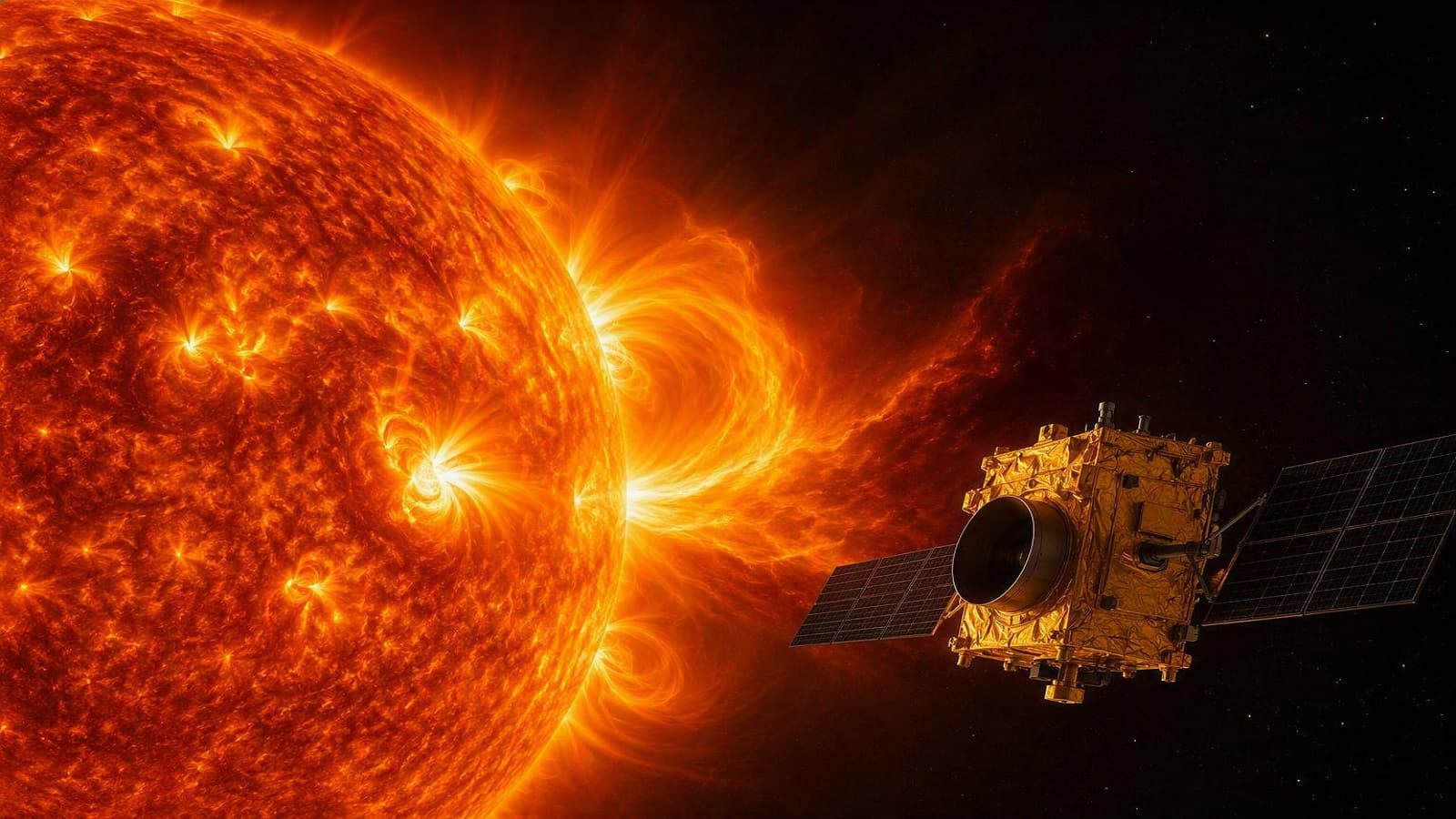
Observations from India's Aditya-L1 solar mission have provided crucial insights into one of solar physics' biggest mysteries: how the Sun's outer atmosphere remains millions of degrees hotter than its surface and retains that heat despite constantly losing vast amounts of energy through solar eruptions, according to Indian researchers. Scientists studying data from Aditya-L1, India's first dedicated solar observation mission, have reported findings that could help explain the long-standing mystery of why the Sun's corona remains far hotter than its visible surface. The findings, published in the Astrophysical Journal Letters, were led by Professor R. Ramesh of the Indian Institute of Astrophysics (IIA).
The study sheds new light on the processes that heat the Sun's outermost atmosphere and replenish energy lost during powerful solar eruptions. The temperature structure of the Sun has puzzled astrophysicists for decades. While temperatures in the Sun's core reach nearly 15 million degrees Celsius, the visible surface, known as the photosphere, is significantly cooler at around 5,500 degrees Celsius. Surprisingly, the corona, located much farther from the core, can reach temperatures of around 2 million degrees Celsius and occasionally soar to as high as 40 million degrees Celsius.

This apparent increase in temperature away from the heat source challenges conventional expectations and has remained one of the most enduring unsolved questions in solar science. The corona is also the birthplace of extreme solar weather events, including solar flares and coronal mass ejections (CMEs). During these eruptions, the Sun ejects enormous amounts of energy and charged particles into space. Such events can lead to spectacular auroras on Earth but can also disrupt power grids, communication networks, navigation systems and satellites through geomagnetic storms.
According to Prof. Ramesh, the Sun typically produces two to three CMEs each day during periods of low activity. During the peak phase of its 11-year solar cycle, that number can rise to ten or more daily eruptions. Scientists have long wondered how the corona manages to sustain its immense temperatures despite these frequent energy losses. If the lost energy were not replenished, the Sun would gradually cool, affecting the entire solar system.
Disclaimer: "This story has been published from a syndicated news feed. Only the headline and subtitle have been edited by EPN."