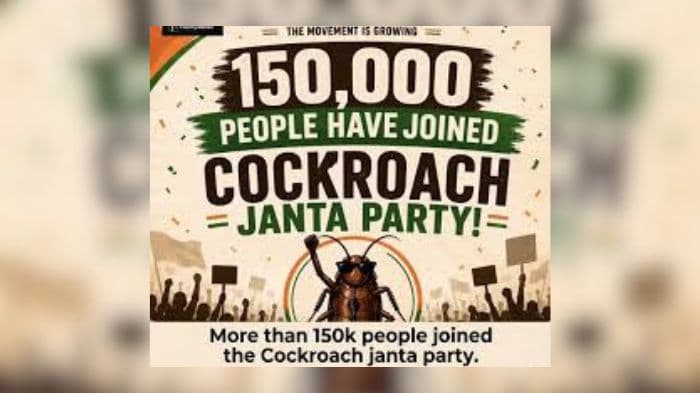
India’s political internet has found its newest obsession — and it comes with cockroaches, parasites and meme manifestos.
Over the past few days, phrases like “Cockroach Janata Party” (CJP) and “National Parasitic Front” (NPF) have exploded across social media platforms, transforming from niche internet satire into a mainstream political talking point. What started as a parody movement is now at the centre of a wider debate about political toxicity, digital tribalism and meme-driven discourse in India.

At the centre of the phenomenon is Abhijeet Dipke, the man credited with launching the satirical “Cockroach Janata Party” online.
Who is Abhijeet Dipke?
According to reports, Dipke is a former social media strategist associated with political communication campaigns and is currently studying public relations at Boston University. He reportedly created the “Cockroach Janata Party” as a satirical response to growing political polarisation and online hostility in India.
What Dipke may not have anticipated was how quickly the joke would spiral into a full-fledged internet movement.
Within days, the parody account reportedly attracted tens of thousands of followers, with users joining both ironically and seriously. Memes, fake manifestos, parody campaign posters and satirical slogans flooded X, Instagram and WhatsApp political groups.
The ‘cockroach’ trigger
The movement gained traction after controversy erupted around remarks linked to a Supreme Court hearing, where the term “cockroach” became part of political online discourse. Social media users rapidly appropriated the word, converting it into satire aimed at political opponents.
Soon, anti-establishment users began using “Cockroach Janata Party” as a parody political identity mocking majoritarian politics and aggressive online nationalism.
But the backlash came just as quickly.
Supporters from rival political ecosystems retaliated with their own counter-label — “National Parasitic Front” — aimed at opposition supporters, liberal commentators and activist groups. The internet battle escalated into a meme war almost overnight.
Meme politics is now mainstream politics
Earlier, political slogans and narratives were largely controlled by parties, spokespersons and television studios. Today, much of India’s political messaging emerges organically through meme pages, anonymous accounts, influencers and digital volunteer networks.
Political analysts say meme culture now shapes perception faster than traditional political speeches.
A phrase created as a joke can become a national talking point within hours if amplified through reels, short videos, hashtags and reaction posts.
That is precisely what happened with CJP.
What began as internet satire evolved into political symbolism, especially among younger social media users who increasingly consume politics through memes rather than conventional news debates.
Why the controversy matters
Experts tracking online political communication say the rise of phrases involving insects or parasites reflects how political discourse globally is becoming harsher and more dehumanising.
The concern is not just about humour or satire, but about how digital platforms reward outrage and emotional provocation.
Terms like “Cockroach Janata Party” and “National Parasitic Front” spread rapidly because they are provocative, visually meme-friendly and instantly polarising. Social media algorithms often amplify such emotionally charged content because it generates engagement.
The controversy has also shown how political identities online are increasingly performative. Many users adopted CJP branding less as an ideological commitment and more as participation in a viral internet moment.
The politics of virality
The speed at which the movement spread also underlined another shift: Indian politics is increasingly becoming entertainment-driven online.
Political creators now use humour, sarcasm and absurdism to shape narratives. Television debates frequently recycle internet trends, while politicians themselves increasingly respond to viral online culture.
In this environment, meme movements can quickly influence mainstream discourse, even if they begin as satire.
Whether “Cockroach Janata Party” survives as a long-term phenomenon remains uncertain. But its sudden rise has already revealed how India’s political language is changing in the social media era — faster, sharper and far more meme-driven than




.avif&w=256&q=75)