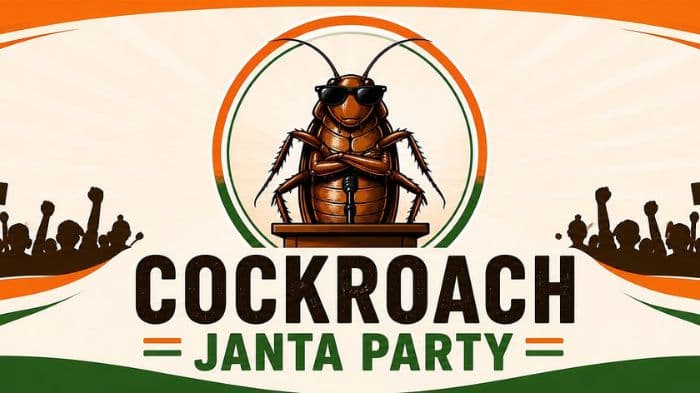
India’s newest youth-driven political conversation did not emerge from a student union or protest march. It emerged from Instagram memes featuring cockroaches.
Over the past week, the “Cockroach Janta Party” (CJP) has transformed from a niche parody page into one of the country’s fastest-growing internet movements, drawing millions of followers across platforms and triggering a wider debate around youth frustration, censorship and digital political expression.

The movement’s rise has coincided with growing anger among students and young job-seekers over unemployment, competitive exam pressure and repeated allegations of paper leaks in recruitment and entrance examinations.
How the movement began
The CJP phenomenon began after remarks by Supreme Court judge Justice Surya Kant during hearings linked to unemployment-related issues triggered backlash online. The term “cockroach” quickly became a meme symbol among sections of young internet users, who began reclaiming it through parody political graphics, campaign-style posters and satirical slogans.
Within days, Instagram pages associated with the movement began attracting massive engagement, particularly among Gen Z users.
The movement’s founder, Abhijeet Dipke, positioned the page as a platform reflecting youth frustration around jobs, exams and governance issues. What initially appeared to be internet satire soon started intersecting with real political conversations.
NEET controversy pushes CJP into mainstream political debate
The movement gained further traction after Dipke publicly demanded the resignation of Union Education Minister Dharmendra Pradhan over alleged irregularities linked to NEET 2026.
The demand connected the movement directly to one of the country’s most politically sensitive issues: trust in India’s examination system.
Concerns around exam integrity have intensified over the past few years following multiple allegations of paper leaks and recruitment irregularities across states. NEET controversies, recruitment exam cancellations and delays in government hiring processes have repeatedly triggered outrage among students and aspirants.
According to data from the Centre for Monitoring Indian Economy (CMIE), youth unemployment in India has remained significantly higher than the national average in recent years, particularly among educated young people. Government recruitment delays and intense competition for limited jobs have further amplified anxiety among aspirants.
Against that backdrop, CJP’s satire began resonating beyond meme culture.
Account restrictions and allegations of crackdown
The movement’s rapid growth also triggered scrutiny and restrictions online.
Last week, the Cockroach Janta Party’s X account was withheld in India following what the platform described as a “legal demand”. Dipke later claimed that pages linked to the movement were facing hacking attempts and reporting campaigns. While authorities have not publicly detailed the nature of the legal request, the account restriction significantly increased public attention around the movement.
For many supporters, the restrictions reinforced the perception that online criticism and satire around unemployment and governance issues were making authorities uncomfortable.
The Indian government has not officially described CJP as a threat, nor has it issued a detailed public response specifically addressing the movement. However, the withholding of accounts and growing political attention around the page have contributed to perceptions among supporters that the movement is being targeted.
Why Gen Z is relating to it
The movement’s popularity appears closely tied to broader frustrations among young Indians.
India has one of the world’s largest youth populations, but employment generation remains a major political and economic challenge. Government data and labour surveys have repeatedly shown concerns around youth unemployment, underemployment and job insecurity, particularly among graduates and first-time job seekers.
At the same time, competitive examinations increasingly dominate the lives of millions of students. Allegations of paper leaks, cancelled exams, delayed recruitment cycles and limited government vacancies have contributed to growing distrust among aspirants.
CJP’s content taps directly into that environment.
Its memes frequently reference unemployment, exam stress, inflation, political messaging and bureaucratic systems using internet humour familiar to younger audiences. Rather than functioning like a traditional political organisation, the movement spreads through reels, screenshots, comment sections and viral templates.
That format itself is significant.
Unlike earlier youth-led political movements in India that relied heavily on campus mobilisation, unions or street protests, CJP reflects a generation that increasingly communicates political frustration online first.
A new form of internet-driven political expression
At present, the Cockroach Janta Party remains an online movement without formal political structure, electoral ambitions or organised street mobilisation.
But its rapid growth has demonstrated how quickly internet satire can evolve into a larger political conversation when it connects with existing public frustration.
The movement has also highlighted the changing nature of political engagement among younger Indians. Meme pages, parody accounts and digital communities are increasingly becoming spaces where political anger, economic anxiety and distrust in institutions are expressed publicly.
Whether CJP sustains its momentum or fades like many internet trends remains uncertain.
However, its rise has already revealed something larger about India’s current political climate: a significant section of Gen Z is using digital culture not just for entertainment, but also to process and express frustration around jobs, exams and governance.
And increasingly, those conversations are happening online long before they reach traditional political spaces.