


Union Home Minister Amit Shah visits beneficiaries of the historic rehabilitation initiative ensuring permanent settlement like homes, financial aid, essential facilities and development for displaced tribals.
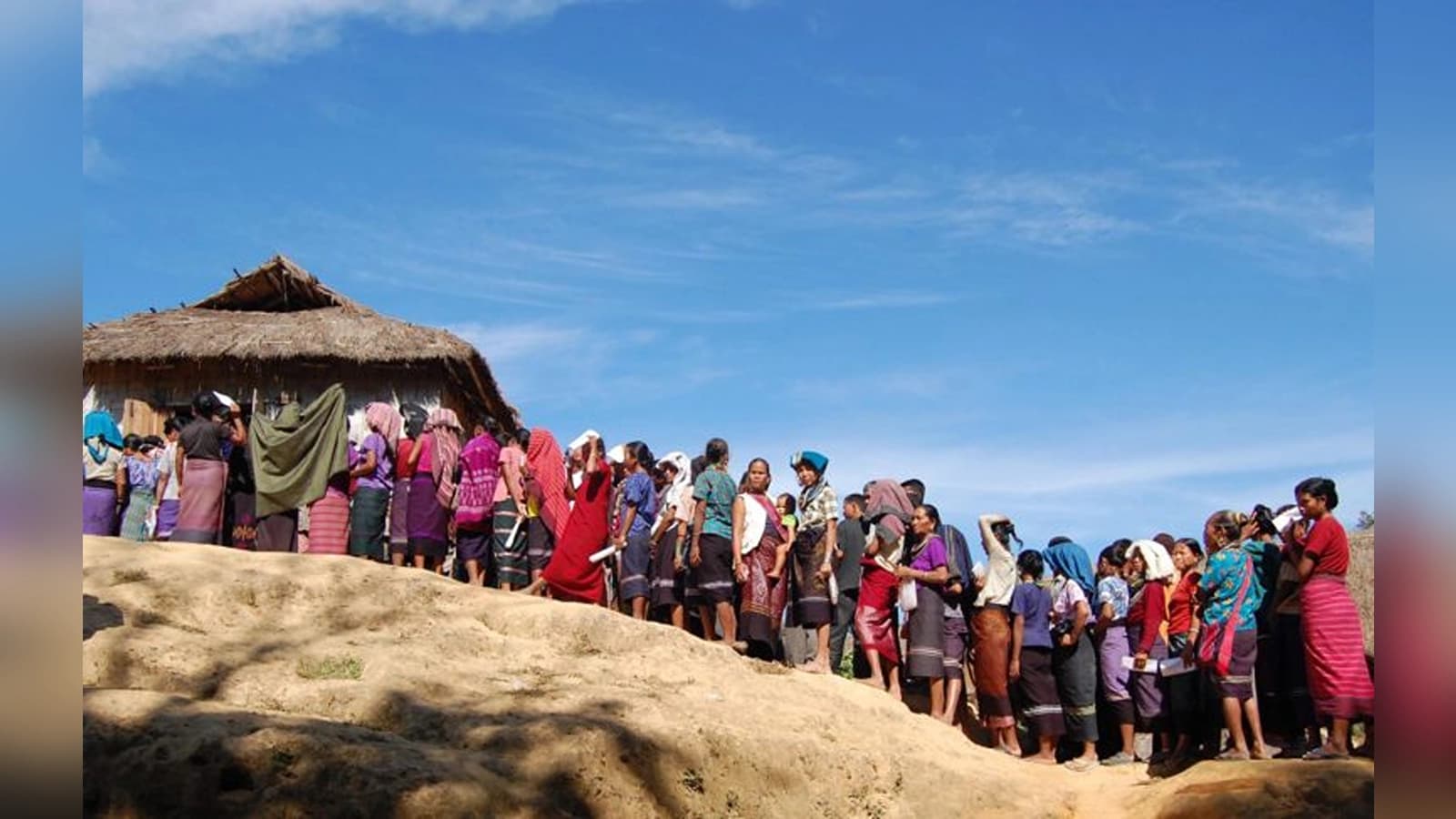
Bru migrants at a camp in Kanchanpur (Image source: Twitter/PTI)
Tripura has successfully resettled over 37,500 Bru tribal refugees who fled ethnic violence in Mizoram in the late 1990s and 2009 as a move toward addressing long-standing issues of displacement.
The rehabilitation program, with a financial outlay of ₹821 crore provided by the Union Home Ministry, aims to offer permanent settlement and ensure holistic development for the affected families.

Union Home Minister Amit Shah visited some of the resettled families in Tripura on Dec 22, emphasizing the government's commitment to resolving their issues.
The rehabilitation initiative follows a quadripartite agreement signed on January 16, 2020, between the central government, the states of Tripura and Mizoram, and Bru tribal representatives.
The displaced Bru tribals, originally from Mizoram’s Mamit, Lunglei, and Kolasib districts, migrated to Tripura’s North Tripura district in waves following ethnic violence between the Bru and Mizo communities.
A total of 12 resettlement sites across four districts—North Tripura, Dhalai, Gomati, and South Tripura—have been identified for establishing permanent colonies.
Officials confirmed that 754 acres of land have been allocated for constructing these colonies.
While 11 sites are already functional, work on the final site, Kala Lawgang in South Tripura, is expected to be completed by the end of this financial year.
Each resettled family is entitled to a comprehensive development package, including financial aid, land for housing, and monthly subsistence allowances.
Highlights of the package include a one-time financial assistance of ₹ 4,00,000 per family (in fixed deposit), ₹ 1,50,000 for house construction, ₹ 5,000 monthly cash support for two years, free ration, and free transportation to their new homes. All cash assistance is provided via the Direct Benefit Transfer (DBT) system.
To date, ₹693.13 crore of the allocated budget has been disbursed, with ₹ 406.42 crore transferred directly to beneficiaries.
Infrastructure development in these colonies includes power lines, solar streetlights, roads, tubewells, schools, healthcare centers, and fair-price shops.
Despite efforts to repatriate some families to Mizoram in eight phases, 6,935 families, comprising 37,584 individuals, opted to stay in Tripura.
What Is Section 163 of BNSS and Why Has It Been Imposed in Delhi? Explained

Yale University president apologises after hot mic captures remarks about student activists

Emirati AI researcher wins MBZUAI fellowship for Oxford research
NYU Abu Dhabi welcomes 24 UAE students to 2026–27 Sheikh Mohamed bin Zayed Scholars Program
IIT Kharagpur Launches Free AI Tutor, Online GATE-JAM Preparation Platform for Students
What Is Section 163 of BNSS and Why Has It Been Imposed in Delhi? Explained
Emirati AI researcher wins MBZUAI fellowship for Oxford research
IIT Kharagpur Launches Free AI Tutor, Online GATE-JAM Preparation Platform for Students
.jpg&w=256&q=75)
Sorbonne Abu Dhabi study detects 83 vertebrate taxa along urban coastline
UNESCO flags India’s rural education gap: 59 girls for every 100 boys

What Is Section 163 of BNSS and Why Has It Been Imposed in Delhi? Explained
Yale University president apologises after hot mic captures remarks about student activists
Emirati AI researcher wins MBZUAI fellowship for Oxford research
NYU Abu Dhabi welcomes 24 UAE students to 2026–27 Sheikh Mohamed bin Zayed Scholars Program
IIT Kharagpur Launches Free AI Tutor, Online GATE-JAM Preparation Platform for Students
What Is Section 163 of BNSS and Why Has It Been Imposed in Delhi? Explained
Emirati AI researcher wins MBZUAI fellowship for Oxford research
IIT Kharagpur Launches Free AI Tutor, Online GATE-JAM Preparation Platform for Students
Sorbonne Abu Dhabi study detects 83 vertebrate taxa along urban coastline
UNESCO flags India’s rural education gap: 59 girls for every 100 boys
Copyright© educationpost.in 2026 All Rights Reserved.