


From Karnataka’s decision to revive campus polls after nearly four decades to student protests at Aligarh Muslim University and Jamia Millia Islamia, the demand for elected student representation is gaining attention. But the rules governing campus politics, concerns over violence and the powers of university administrations remain central to the debate.
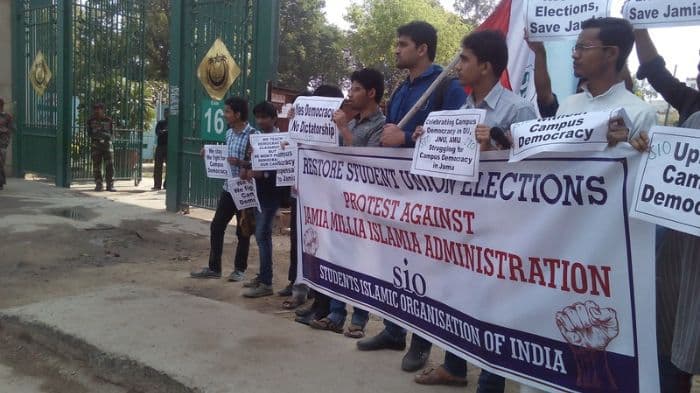
Student-union elections are once again becoming a point of contention at Indian universities. In Karnataka, the state government has ordered the revival of campus polls after nearly four decades. At Aligarh Muslim University (AMU), elections have been announced after weeks of student protests.
Meanwhile, students of Jamia Millia Islamia (JMI) are on hunger strike demanding the return of a union that was dissolved in 2006.

The three campuses offer a look at a wider issue in higher education: the place of student unions in university life. While students see elected unions as a way to raise campus concerns and hold administrations accountable, universities have to address questions around how elections are conducted and how student bodies function.
The push to revive student-union elections comes amid a long-running debate over campus politics. Elections have been discontinued at several universities over the years, with concerns about violence and disruption cited as reasons.
Student organisations, however, argue that elected unions give students a formal channel to raise grievances with university administrations.
The recent developments in Karnataka, AMU and Jamia bring this debate back into focus, as universities and students grapple with the question of how student representation should work on campus.
Karnataka moves to revive campus elections after 37 years
In September 2026, Karnataka approved the reintroduction of student-union elections, ending a suspension that dates back to 1990.
The first phase covers government, aided and private colleges under the relevant state departments. The government's stated framework seeks to conduct elections without candidates contesting under political-party banners.
The guidelines also regulate campaigning. Posters and banners are prohibited, with A5-sized leaflets permitted, while social media campaigning is allowed subject to restrictions on messages intended to create hatred or hostility among students. Reported eligibility conditions include at least 75% attendance in the previous academic year and no criminal record.
The revival follows consultations with student organisations and the state's earlier decision to consider restarting campus polls. However, questions remain about how the framework will operate in practice, including the participation of politically affiliated student organisations and the arrangements for elections at universities.
The distinction matters because student groups can have political affiliations even when candidates are barred from contesting under a political party's banner.
AMU announces elections after student protests
At Aligarh Muslim University, students had been demanding the restoration of elections that had not been held since 2018.
The university announced on Oct 9 that elections for the 2026–27 academic session would take place on Nov 5, following weeks of protests and a 19-day hunger strike by postgraduate student Yasir Fahad.
The election process is scheduled to begin with the publication of voter lists on Oct 26, followed by nominations and scrutiny before polling. The announcement brought the immediate agitation to an end.
Students at Jamia Millia Islamia demanding a union
At Jamia Millia Islamia, students began a hunger strike on Oct 12, demanding the restoration of an elected students' union. The university dissolved its union in 2006 amid concerns about campus violence and disruption to academic activities.
The administration maintains that students already have channels of representation through elected subject associations in departments and centres. It has also raised concerns about maintaining campus order if a university-wide union is restored.
Protesting students argue that departmental associations cannot replace a common elected body capable of raising issues affecting the entire university.
The dispute escalated on Oct 17, when the university took disciplinary action against three protesting students, including rustication for one student and suspension for two others.
The administration maintained that protests should be held at Gate 18, the designated protest site, and said demonstrations near Gate 7 were disrupting academic activities. On Oct 18, the university also shut the Dr Zakir Husain Library and the Old Library, citing security concerns.
Saurabh, secretary of the Jamia unit of the All India Students’ Association, questioned the administration’s response to the protests, asking, “The university is made up of its students. Then on what basis has the administration shut down the campus?”
The university has also argued that student representation is available through elected representatives in subject associations across its departments and centres. Protesters, however, are seeking a university-wide elected union.
Maharashtra and Odisha also move towards campus polls
In Maharashtra, where student elections have remained suspended since 1993, the state government set up a 12-member committee in September 2026 to recommend a framework for restoring polls.
Headed by former Mumbai University Vice-Chancellor Suhas Pednekar, the panel has been tasked with proposing measures for peaceful and transparent elections, including safeguards against external political interference.
Meanwhile Odisha government resumed student-union elections on Oct 15 after an eight-year gap, with polling held across 346 state-run colleges and 13 universities. Results were declared in 153 colleges on the day of polling, while counting continued at some institutions.
The elections were last held in 2017, and their suspension had been linked to campus disturbances and concerns about maintaining a peaceful academic environment.
What rules govern student-union elections?
The 2006 Lyngdoh Committee report, prepared at the direction of the Supreme Court, remains an important reference point for student-union elections in India.
Its recommendations address eligibility, campaign expenditure, the election schedule and the conduct of candidates. The framework seeks to make campus elections more transparent and limit the use of money and muscle power.
The Supreme Court has issued directions based on the committee's recommendations. In a September 2026 order concerning Delhi University elections, the Delhi High Court also addressed concerns about violence and violations of election rules, underscoring the continuing challenge of ensuring orderly campus polls.
There is no single centrally maintained record of student-union elections across all universities. In a written answer to Parliament in August 2025, the Union Ministry of Education said central universities are autonomous institutions governed by their respective laws and regulations, and that implementation of the Lyngdoh Committee recommendations rests with individual universities.
This means that the restoration of elections can depend on the institution's rules, the applicable government framework and decisions by the relevant authorities.
Why student representation matters
An elected student union can provide a common platform for raising concerns about fees, hostels, academic facilities, admissions and other campus-wide issues. Elections can also give students experience of campaigning, collective decision-making and accountability.
But holding elections alone does not guarantee effective representation. Universities must also ensure that the process is fair, that students can campaign without intimidation and that elected representatives have meaningful channels to engage with administrators.
The current developments show different stages of this debate. Karnataka is implementing a revival framework, AMU has announced elections following a protest, and Jamia's demand remains unresolved. Whether these developments lead to more regular and effective student representation will depend on how universities implement election rules and respond to students' grievances.
The revival of student-union elections at Indian universities: Explained

El Niño raises food-production risks as WMO flags uneven rainfall outlook for South Asia

EU research groups seek greater say in €175 billion Horizon Europe programme

NSF opens bioengineering funding call with awards of up to $50 million a year

A whale’s death inspired him at four, now 11-year-old is set for Earth Medal
A whale’s death inspired him at four, now 11-year-old is set for Earth Medal
Prof. Ajay Kumar Sood named International Science Council Fellow for 2026
2.6 million Afghan girls have lost five years of education, says UNICEF

Riyadh, Diriyah extend remote learning as security concerns persist
.jpg&w=256&q=75)
From Class 8 to hospital owner: Rajasthan Police expose alleged fake doctor registration

The revival of student-union elections at Indian universities: Explained
El Niño raises food-production risks as WMO flags uneven rainfall outlook for South Asia
EU research groups seek greater say in €175 billion Horizon Europe programme
NSF opens bioengineering funding call with awards of up to $50 million a year
A whale’s death inspired him at four, now 11-year-old is set for Earth Medal
A whale’s death inspired him at four, now 11-year-old is set for Earth Medal
Prof. Ajay Kumar Sood named International Science Council Fellow for 2026
2.6 million Afghan girls have lost five years of education, says UNICEF
Riyadh, Diriyah extend remote learning as security concerns persist
From Class 8 to hospital owner: Rajasthan Police expose alleged fake doctor registration
Copyright© educationpost.in 2026 All Rights Reserved.