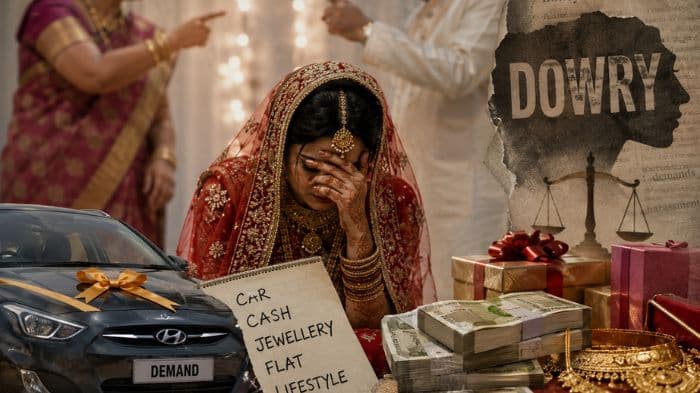
Twisha Sharma was educated, employed and lived in one of India's fastest-growing urban centres. Deepika Nagar belonged to a family that had reportedly spent lavishly on her wedding. Mansi had built a social media following and a public identity of her own. Yet all three are now at the centre of investigations involving allegations of dowry harassment.
Their stories have revived an uncomfortable question: in an India that prides itself on rising education levels, growing female workforce participation and expanding opportunities for women, why does dowry continue to appear in police complaints, courtrooms and death investigations?

The question is particularly striking because these cases do not fit the stereotype often associated with dowry violence. The women were not living in an India untouched by education, technology or economic opportunity.
They were part of a generation that grew up in a rapidly changing country, one that prides itself on expanding access to higher education, increasing female enrolment in universities and greater participation of women in professional life.
Yet the allegations emerging from their deaths sound remarkably familiar.
According to the National Crime Records Bureau's Crime in India 2023 report, 6,156 women lost their lives in dowry death cases during the year, while 15,489 cases were registered under the Dowry Prohibition Act.
The figures suggest that despite decades of legislation and rising levels of education and economic mobility, dowry-related violence continues to claim lives across the country.
The cases that brought the issue back into focus
The death of Twisha Sharma in Bhopal became one of the most discussed cases in recent months. Her family alleged that she was subjected to harassment after marriage. The case drew national attention because one of the accused and her mother-in-law is former judge Giribala Singh. The investigation was subsequently handed over to the Central Bureau of Investigation (CBI), and the matter remains under probe.
In Greater Noida, Deepika Nagar's death sparked protests and demands for action. Her family alleged that she faced repeated pressure over dowry demands, including demands for a vehicle and cash. Police registered a case and arrested members of her matrimonial family.
In Lucknow, a newly married woman was found hanging at her matrimonial home. Relatives alleged that she had been harassed over demands for a car. Police registered a dowry death case and launched an investigation.
A similar allegation surfaced in Kanpur after the death of social media influencer Mansi. Her family accused her husband and in-laws of subjecting her to dowry-related harassment and making demands for a vehicle. The allegations are being investigated by police.
An old practice in a changing society
India's relationship with dowry has always been complicated.
Legally, the practice has been prohibited for more than six decades. Socially, however, it continues to exist in various forms.
What has changed is the way it often manifests itself. While the form of dowry may have evolved, the underlying pressures surrounding marriage have not disappeared.
In many contemporary cases, demands are not always described as dowry. They may be framed as expectations related to cars, property, wedding expenses, financial support, gifts or maintaining a particular lifestyle after marriage.
As incomes have risen and aspirations have grown, marriages themselves have become larger and more expensive. Wedding celebrations that once involved families and communities have increasingly become displays of social status.
The result is a contradiction. Economic progress has transformed many aspects of Indian life, but expectations surrounding marriage have often evolved rather than disappeared.
The pressure that often stays behind closed doors
One of the assumptions frequently made in discussions about social reform is that education automatically weakens regressive practices.
The recent cases challenge that belief.
The women at the centre of these investigations were not disconnected from modern institutions. They were educated, digitally connected and, in some cases, financially independent.
Yet education alone does not necessarily alter power dynamics within families or marriages.
Women's rights activists have long argued that dowry-related harassment persists because it is sustained not only by economic demands but also by social expectations.
Families often encourage reconciliation before confrontation. Complaints may remain within households rather than reaching police stations. Many women face pressure to preserve a marriage even when they report distress to relatives.
As a result, warning signs can remain hidden until a crisis occurs.
The marriage economy
India's economic transformation has also transformed the business of marriage. Weddings have become larger, costlier and more visible, fuelled by rising incomes, social media and a growing culture of display.
In this environment, the line between celebration and expectation can become blurred. Families may no longer speak openly of dowry, but disputes reported to police frequently involve allegations linked to cars, cash, property, wedding expenses or post-marriage financial demands.
The result is a troubling contradiction: as India grows wealthier and more modern, the economic stakes attached to marriage appear to have grown as well.
Investigations continue
At present, all four cases remain at different stages of investigation. Police and central agencies are examining allegations, collecting evidence and recording witness statements. Courts have not yet delivered final judgments in these matters.
However, taken together, the cases have renewed public focus on a crime that continues to surface across the country despite decades of legal reforms and awareness campaigns.
For investigators, courts and policymakers, the challenge remains not only securing justice in individual cases but also addressing the social conditions that allow dowry-related violence to persist.