


BJP wins the most wards, but a close vote share and strong Independent showing make the verdict more complex.
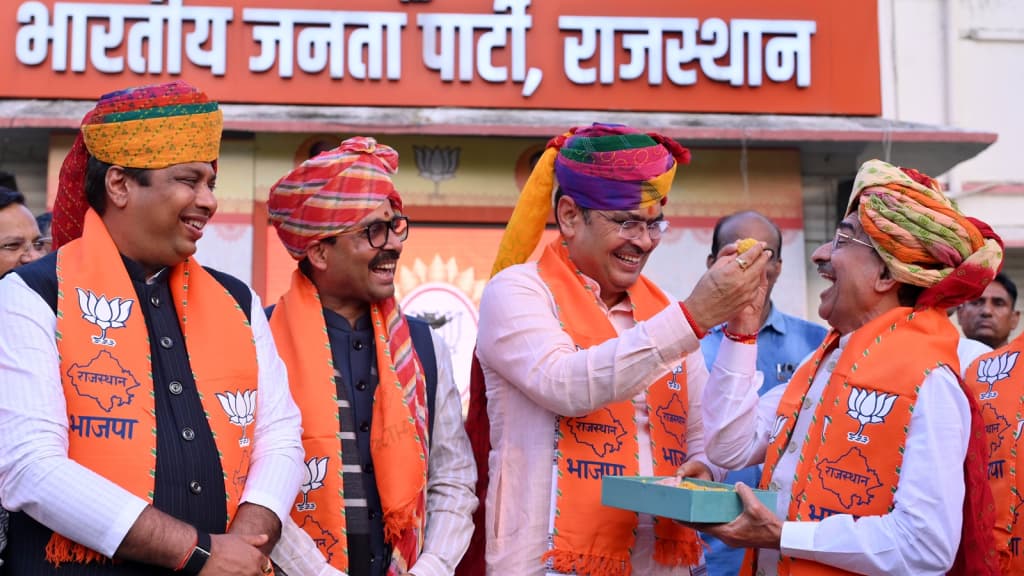
The Bharatiya Janata Party has emerged as the largest party in Rajasthan’s urban local body elections, but the results offer a more fragmented picture than a straightforward victory for the ruling party.
Of the 10,244 wards across 309 urban local bodies, results were declared for 10,235. The BJP won 4,179 wards, compared with 3,613 for the Congress and 2,273 for Independents. Smaller parties, including the Rashtriya Loktantrik Party, Aam Aadmi Party, CPI(M), BSP and Bharat Adivasi Party, also won seats.

The BJP’s lead was significant in terms of seats, but considerably narrower in terms of votes. The party polled about 35.18 per cent of the vote against 34.24 per cent for the Congress — a difference of just 0.94 percentage points. Independents collectively secured 27.38 per cent, underlining the extent to which voters moved beyond the two principal parties in several urban areas.
The distribution of control over urban bodies further illustrates the mixed nature of the verdict. The BJP secured clear majorities in 86 of the 309 local bodies, while the Congress crossed the majority mark in 46. In the remaining bodies, neither party secured an outright majority, leaving Independents and smaller parties in a position to influence the formation of boards.
A fragmented urban mandate
The results were particularly notable in the municipal corporations.
The BJP secured clear majorities in Udaipur and Bhilwara and emerged as the largest party in Jaipur and Kota. The Congress secured a clear majority in Bikaner, while Ajmer and Pali produced strong performances for the Opposition. Jodhpur witnessed a closely fought contest, while Bharatpur emerged as one of the strongest examples of the independent vote cutting across the two major parties.
Bharatpur was particularly striking. Independents won 36 of the 65 wards, compared with 20 for the BJP and seven for the Congress. The result came from the home region of Chief Minister Bhajan Lal Sharma and highlighted the importance of local candidates, factional dynamics and dissatisfaction with party nominations.
The BJP also faced setbacks in areas associated with prominent party leaders. In Pali, the Congress won 29 of the 65 wards against the BJP’s 21, with Independents taking 15. In Jhalawar, the Congress won 29 of the 45 seats, while the BJP secured 13, although the BJP won the Jhalrapatan municipality in the same region.
For the Congress, however, the results were far from a statewide breakthrough. While it improved its position in several important urban centres, the party remained behind the BJP in the overall ward tally.
Independents emerge as a major factor
Perhaps the clearest feature of the election was the strength of Independents.
With 2,273 wins, Independents accounted for more than one-fifth of the declared wards. In several places, their presence prevented either BJP or Congress from securing a majority and turned post-poll negotiations into an important part of the local political equation.
Many of these candidates were reportedly rebels or leaders who failed to secure party tickets. With more than 38,000 candidates contesting the 10,245 seats, managing local rebellions across hundreds of urban constituencies was a formidable challenge for both major parties.
The outcome also opened space for smaller parties. The AAP secured a majority in the Baran Municipal Council, while CPI(M) emerged in a position to form the board in Nokha Municipality. These results point to pockets where voters were willing to move beyond the traditional BJP-Congress contest.
Questions over the BJP government
The results have nevertheless prompted questions about the performance and political management of the Bhajan Lal Sharma government, particularly because the BJP traditionally has a strong presence in Rajasthan’s urban centres.
Critics of the government have pointed to delays in decision-making and reversals on some contentious issues. The Congress has also sought to turn several government decisions and administrative controversies into a political narrative against the ruling party.
The cancellation of the 2021 Sub-Inspector examination, questions surrounding the conduct of local body elections and various policy decisions have been cited by the Opposition as examples of administrative uncertainty. These remain contested political interpretations rather than conclusions established by the election results themselves.
The government, meanwhile, has highlighted its organisational mobilisation and the involvement of senior BJP leaders in the campaign. Chief Minister Sharma, state BJP president Madan Rathore, ministers and Union ministers campaigned extensively, while the Congress's campaign was comparatively less centrally driven.
Delimitation becomes another fault line
The Congress has also questioned the delimitation exercise carried out ahead of the elections.
State Congress president Govind Singh Dotasra alleged that the reorganisation of wards disadvantaged his party and claimed that the Congress would have performed substantially better without what he described as an unfair exercise. The BJP has rejected such criticism.
The allegation is significant because the BJP-Congress vote-share difference was less than one percentage point, even though the BJP finished 566 wards ahead of the Congress. That gap illustrates how constituency-level contests, candidate selection, delimitation and the distribution of votes can produce markedly different outcomes from statewide vote share.
A test of local leadership
The results have also exposed the limits of relying solely on the influence of senior leaders.
The BJP's setbacks in Bharatpur, Pali and Jhalawar, alongside the Congress's gains in Ajmer and other urban centres, suggest that local factors remained important. Candidate credibility, rebel candidates, caste and community equations, civic issues and organisational strength all shaped contests that were often decided constituency by constituency.
At the same time, the BJP's overall ward tally and its clear majorities in several important urban bodies demonstrate that the ruling party retains substantial organisational strength.
For Chief Minister Sharma, the results therefore present a mixed political message: the BJP remains the largest force in Rajasthan's urban landscape, but the strength of Independents, the narrow vote-share gap with Congress and losses in some politically significant areas show that the urban electorate cannot be treated as a uniformly loyal bloc.
What comes next
The significance of the civic results will ultimately depend on what follows.
Rajasthan has a long history of alternating governments, and the urban local body elections are only one part of the state's wider political landscape. The next major test will come in the panchayati raj elections, where the political terrain and voter priorities could be different.
For the BJP, the immediate task is to consolidate its urban gains while addressing local organisational grievances and the concerns raised by the results in several key constituencies. For the Congress, the challenge is to convert its gains in selected urban pockets into a broader organisational revival.
The civic verdict, therefore, does not deliver a simple political message. The BJP has won the largest share of wards and remains the dominant party numerically. But the unusually strong showing by Independents, the near-even vote share between the two major parties and the number of hung civic bodies have produced a more fractured mandate — one that leaves considerable room for local political equations to shape what happens next.
The revival of student-union elections at Indian universities: Explained

El Niño raises food-production risks as WMO flags uneven rainfall outlook for South Asia

EU research groups seek greater say in €175 billion Horizon Europe programme

NSF opens bioengineering funding call with awards of up to $50 million a year

A whale’s death inspired him at four, now 11-year-old is set for Earth Medal
A whale’s death inspired him at four, now 11-year-old is set for Earth Medal
Prof. Ajay Kumar Sood named International Science Council Fellow for 2026
2.6 million Afghan girls have lost five years of education, says UNICEF

Riyadh, Diriyah extend remote learning as security concerns persist
.jpg&w=256&q=75)
From Class 8 to hospital owner: Rajasthan Police expose alleged fake doctor registration

The revival of student-union elections at Indian universities: Explained
El Niño raises food-production risks as WMO flags uneven rainfall outlook for South Asia
EU research groups seek greater say in €175 billion Horizon Europe programme
NSF opens bioengineering funding call with awards of up to $50 million a year
A whale’s death inspired him at four, now 11-year-old is set for Earth Medal
A whale’s death inspired him at four, now 11-year-old is set for Earth Medal
Prof. Ajay Kumar Sood named International Science Council Fellow for 2026
2.6 million Afghan girls have lost five years of education, says UNICEF
Riyadh, Diriyah extend remote learning as security concerns persist
From Class 8 to hospital owner: Rajasthan Police expose alleged fake doctor registration
Copyright© educationpost.in 2026 All Rights Reserved.