


The flexible sensor system uses movement data and machine learning to analyse exercise patterns, with trials underway in strength training, tennis and swimming.
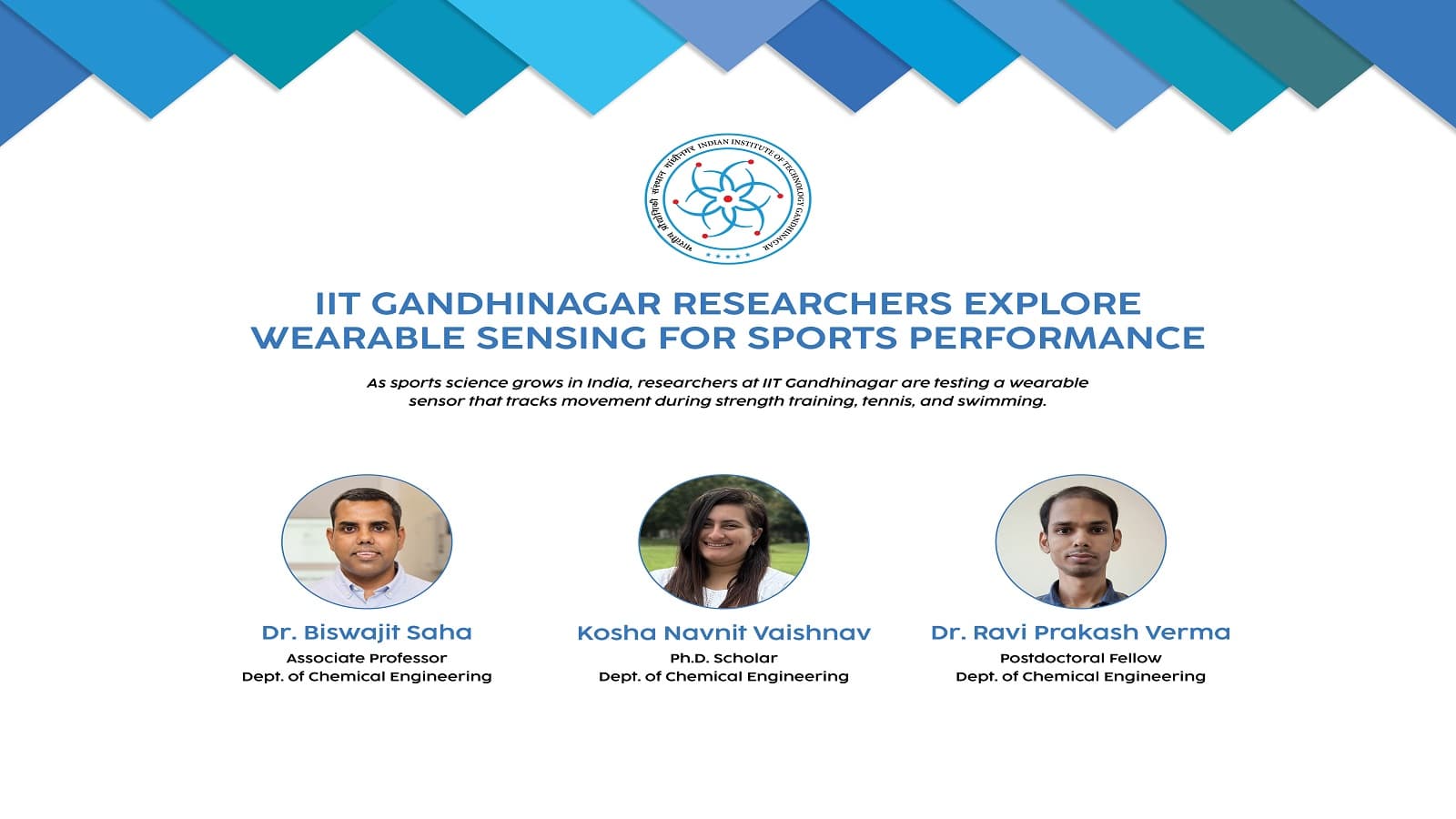
Researchers at the Indian Institute of Technology Gandhinagar (IITGN) are developing a wearable sensor system designed to help trainers assess movement patterns during exercise and sports. The technology combines flexible sensor patches, electronic data collection and machine learning to compare movements with reference patterns recorded from experienced athletes and trainers.
The research could offer an additional way to evaluate exercise techniques, particularly in gyms and training facilities where coaches cannot continuously monitor every participant. The prototype is being tested in real training environments, while the research team works towards further validation and potential commercial applications.

According to IIT Gandhinagar, the technology is currently at Technology Readiness Level (TRL) 5, indicating that the prototype is undergoing validation in a relevant environment. A patent filing is also in progress.
The sensor patches are designed to be attached to selected areas of the body. They use a technique called piezoresistive sensing, in which changes in mechanical deformation affect a material's electrical resistance.
As a person moves, the flexible patch deforms along with the skin and surrounding tissue. These changes generate electrical signals that can be measured and processed by an electronic system.
The collected data is transmitted to a mobile device through Bluetooth. A machine-learning model then analyses the signals and compares them with reference data gathered from experienced practitioners, including coaches, fitness trainers and athletes competing at state and national levels.
The system is intended to help identify differences in movement timing, signal strength and consistency across repeated exercises. Such measurements could provide trainers with additional information when evaluating exercise execution and sports performance.
Dr Biswajit Saha, Associate Professor in IITGN's Department of Chemical Engineering, said the team began exploring the technology to address the difficulty of monitoring every repetition in busy gyms and training centres.
The IITGN research team is evaluating the wearable system in strength training and other physical activities, including tennis and swimming.
According to the institute's press communique, the study has monitored 50 individuals involved in weightlifting and strength training. The team has also collected movement data associated with tennis, swimming and other physical activities from 30 trainees.
These trials are intended to help researchers refine the system's interpretation of movement signals and develop a broader reference database for different exercises and sporting activities.
Kosha Navnit Vaishnav, a PhD scholar in the Department of Chemical Engineering, said the team aims to use comparisons with experienced practitioners' movement patterns to provide trainers with additional information for assessing performance.
However, the researchers acknowledge that movement assessment requires context. Differences between two people's movements do not automatically indicate incorrect technique, as body proportions, mobility, fatigue and individual movement habits can affect how an exercise is performed.
The system is therefore being developed as a supplementary assessment tool rather than a replacement for professional coaching.
The sports-focused project builds on the research group's earlier work on flexible sensors for monitoring human movement and physiological signals.
In 2024, a study published in Sensors and Actuators B: Chemical explored a stretchable sensor integrated into a textile bandage. According to the institute, the device was tested over 50,000 repeated cycles and demonstrated antibacterial activity against Escherichia coli.
Another study, published in ACS Applied Nano Materials in 2024, examined a stretchable, printable sensor designed to monitor physiological signals and physical activity.
The group's subsequent work, published in IEEE Sensors Journal, explored the integration of sensor technology into a wearable mask to monitor breathing patterns.
These studies illustrate the range of wearable sensing applications investigated by the researchers and provide context for the team's current efforts to adapt flexible sensor technology to sports and exercise monitoring.
The sports sensor combines its hardware, data acquisition and signal analysis components into a single platform. The team is continuing to refine the system and validate its performance in practical training settings.
IITGN has stated that the project's current research findings have not yet been published. Consequently, independent assessment of the sports sensor's accuracy, reliability and effectiveness remains pending.
The researchers are seeking partnerships with fitness centres, strength-training facilities, sports academies, personal trainers and athletes to support additional testing and product development. They are also looking for industry collaborations and government funding to advance the technology towards commercial use.
Dr Ravi Prakash Verma, a postdoctoral fellow in IITGN's Department of Chemical Engineering, said the framework is intended to complement conventional coaching by providing quantitative information that may be difficult to assess consistently through observation alone.
The project comes amid wider efforts to strengthen sports infrastructure, coaching and performance assessment in India. The government's Khelo India programme includes sports technology, sports science, athlete development and coach training among its focus areas. <a href="https://www.kheloindia.gov.in/about/khelo-india-mission">Official Khelo India programme details</a>.
Wearable sensing technologies could contribute to this ecosystem by helping trainers collect and interpret movement data during practice. Their practical value, however, will depend on further testing, the quality of reference data and the ability to interpret differences across individuals and sporting disciplines.
For IIT Gandhinagar, the next stage involves improving the prototype, expanding its validation and establishing partnerships that could support its development into a commercially viable sports assessment tool.
.jpg&w=256&q=75)
From Class 8 to hospital owner: Rajasthan Police expose alleged fake doctor registration

ENTOD Pharmaceuticals Partners with DPGU and BNCP to Advance Pharmaceutical Research
IIT Kanpur Concludes Samanvay 2026, Announces Gates Foundation Partnership on Affordable Diagnostics

Who will lead Keralam's universities? Government begins steps to appoint permanent VCs
OILF, Rangeet Expand SEEK Curriculum to 180 Schools Across Mumbai
From Class 8 to hospital owner: Rajasthan Police expose alleged fake doctor registration
Who will lead Keralam's universities? Government begins steps to appoint permanent VCs
%20(1)%20(1).jpeg&w=256&q=75)
Why does cracking JEE Advanced depend on coaching? IIT Kanpur Director calls for a revamp
.jpg&w=256&q=75)
NEET-PG 2026 answer key row: Supreme Court seeks NBEMS response on missing question papers
.png&w=256&q=75)
42 Iraqi universities feature in QS Arab Region University Rankings 2027

From Class 8 to hospital owner: Rajasthan Police expose alleged fake doctor registration
ENTOD Pharmaceuticals Partners with DPGU and BNCP to Advance Pharmaceutical Research
IIT Kanpur Concludes Samanvay 2026, Announces Gates Foundation Partnership on Affordable Diagnostics
Who will lead Keralam's universities? Government begins steps to appoint permanent VCs
OILF, Rangeet Expand SEEK Curriculum to 180 Schools Across Mumbai
From Class 8 to hospital owner: Rajasthan Police expose alleged fake doctor registration
Who will lead Keralam's universities? Government begins steps to appoint permanent VCs
Why does cracking JEE Advanced depend on coaching? IIT Kanpur Director calls for a revamp
NEET-PG 2026 answer key row: Supreme Court seeks NBEMS response on missing question papers
42 Iraqi universities feature in QS Arab Region University Rankings 2027
Copyright© educationpost.in 2026 All Rights Reserved.