Sri Lanka hosts Asia-Pacific conference to examine ethics of education in the AI age
The four-day Colombo gathering will bring together educators, researchers and policymakers to examine moral values, responsible AI use and the future of education.
Written by: Amin Masoodi4 Min Read · Updated:
As artificial intelligence increasingly transforms classrooms, universities and learning practices, educators across the Asia-Pacific region are set to deliberate on a growing challenge: how to ensure technological advancement does not come at the expense of moral values, integrity and human responsibility.
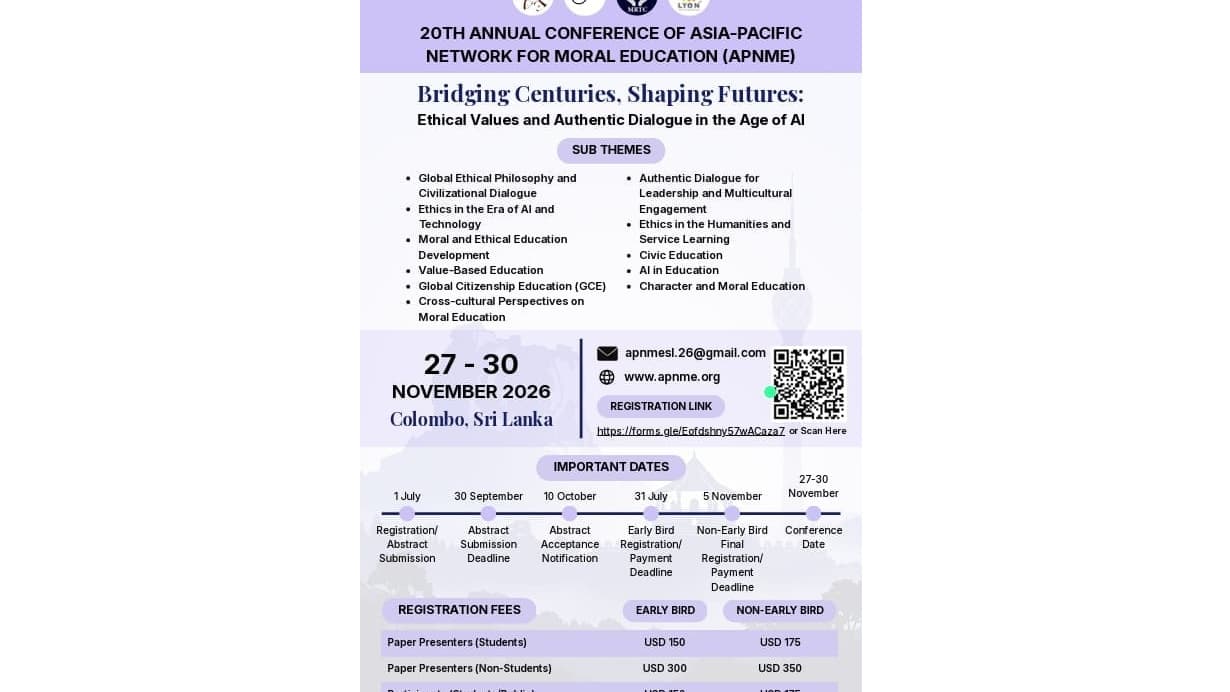
Colombo will host the 20th Annual Conference of the Asia-Pacific Network for Moral Education (APNME 2026) from November 27 to 30, bringing together educators, researchers, policymakers and students from across the region and beyond. Themed 'Bridging Centuries, Shaping Futures: Ethical Values and Authentic Dialogue in the Age of AI', the international gathering will explore how education systems can preserve essential human values while adapting to rapid technological change.
The conference comes at a time when AI tools can generate essays, solve mathematical problems, summarise academic texts and create digital content within seconds. While these technologies offer new opportunities to expand access to knowledge and support teaching, their growing use has also raised concerns over academic dishonesty, misinformation, algorithmic bias and students' dependence on automated systems.
The central concern is whether learners are developing the ability to think independently, exercise sound judgement and take responsibility for their actions, rather than simply relying on machines to produce answers. Educators argue that technological tools cannot replace the human responsibility of teaching honesty, fairness, compassion and accountability. These values must be cultivated through classroom practices, institutional policies and the conduct of teachers and educational leaders.
Moral education, therefore, is increasingly being viewed not as a standalone academic subject but as an essential dimension of teaching and learning across disciplines and educational institutions.
Two decades of promoting moral education
Established in 2006 as an informal group of educators concerned about moral development and values-based learning, APNME has evolved into an international network of teachers, researchers and practitioners working in moral, citizenship and values education.
Over the past two decades, the network has expanded its reach beyond Asia and the Pacific, attracting participation from Africa, Europe and the Americas.
Its annual conferences are hosted in different countries to encourage international academic exchange and strengthen cooperation on moral and ethical education. The 19th edition was held in Kuala Lumpur, Malaysia, last year. Sri Lanka's selection as host of the 20th conference also marks the network's two-decade journey and recognises the country's contribution to regional discussions on education and values.
The event is being organised with the support of the Sri Lanka Association for the Advancement of Education, the Multidisciplinary Research and Training Centre and the Lanka Youth Organisations Network. Academics from the University of Colombo and other Sri Lankan universities are contributing to the organisation, review and presentation of conference papers.
Tradition and technology in dialogue
A major focus of the conference will be the relationship between traditional moral philosophies and the challenges emerging from modern technologies.
Across the Asia-Pacific, societies have historically drawn on religious, philosophical and cultural traditions to shape ethical conduct, responsible citizenship and social harmony. In Sri Lanka, Buddhist, Hindu, Islamic and Christian teachings, alongside family and community traditions, have influenced values such as respect, compassion, care for others and harmony with nature.
The challenge, participants will examine, is to connect these established principles with the demands of an increasingly digital world rather than treating tradition and technological progress as opposing forces. Authentic dialogue across cultural, religious, generational and academic differences will also feature prominently in the discussions, particularly in a region characterised by considerable social and cultural diversity.
AI ethics and global citizenship on agenda
The conference programme will cover a broad range of subjects, including global ethical philosophy, dialogue between civilisations, moral and ethical education, value-based learning and global citizenship education.
Other discussions will examine cross-cultural approaches to moral education, ethical leadership, multicultural engagement, humanities education, service learning, civic education and the role of AI in teaching and learning. Character development and the integration of moral principles into education systems will also form part of the deliberations.
Unlike conventional academic gatherings focused primarily on paper presentations, APNME conferences aim to encourage substantive exchanges among researchers, teachers and policymakers. The platform is expected to provide Sri Lankan academics, particularly young researchers and educators, with opportunities to present their work, exchange experiences with international counterparts and establish lasting academic partnerships.
Sri Lanka's education reforms in focus
The conference also comes at an important juncture for Sri Lanka, where ongoing discussions on education reform have brought questions about curriculum development, teaching practices and the responsible integration of AI into classrooms to the forefront.
With students increasingly accessing AI-powered tools, educational institutions face mounting pressure to establish clear ethical guidelines governing their use in learning, assignments and assessments. Such guidance is needed across all levels of education, from primary schools to postgraduate research, to ensure that technological assistance strengthens learning rather than undermines independent thinking and academic integrity.
The discussions are also expected to have implications beyond educational institutions. Integrity, fairness and accountability remain fundamental to public administration, business and community life. Ultimately, the conference seeks to reinforce the principle that education must develop responsible and compassionate individuals alongside academically qualified and technically skilled graduates.
While the Colombo gathering may not resolve every ethical challenge associated with artificial intelligence, it will provide an international platform to examine how education can prepare future generations to use technology responsibly without losing sight of their shared human values.
Also read