China researchers develop new framework to assess physical education in primary schools
44-indicator evaluation model moves beyond fitness scores to examine teaching quality, sports facilities, staffing and institutional support across schools.
Written by: Amin Masoodi4 Min ReadUpdated:
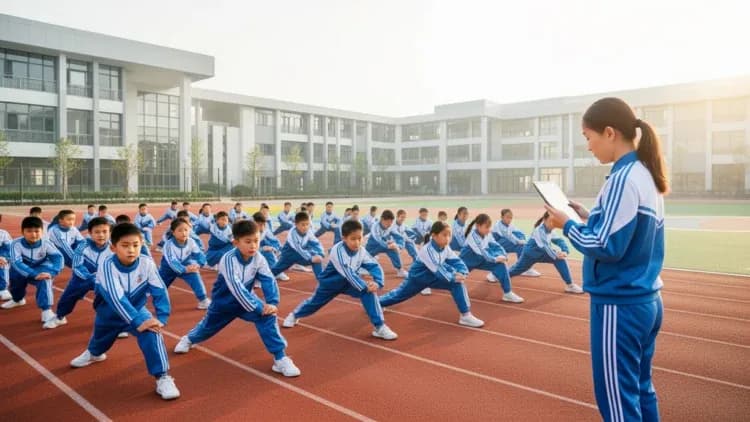
Researchers in China have developed a comprehensive evaluation framework to assess how physical education is delivered in primary schools, shifting the focus from pupils’ fitness scores to the wider institutional conditions that shape sports education.
The framework, developed by Yepeng Qiu and Mingchen Sun of Chongqing Normal University, offers a structured approach to examining school-level performance across teaching practices, resource allocation, sports infrastructure and student development. The researchers say conventional assessments often concentrate on students’ physical performance while overlooking factors such as the availability of qualified physical education teachers, safe sports facilities, administrative support and the effective implementation of the curriculum.
The new model seeks to address these gaps by examining physical education as a coordinated institutional responsibility rather than measuring its effectiveness through student outcomes alone. The study, titled Development and preliminary appraisal of an evaluation framework for primary school physical education in China was published in Frontiers in Sports and Active Living.
The framework is built around 44 indicators grouped into four major areas and 13 sub-dimensions. It draws on the Context, Input, Process and Product (CIPP) evaluation model developed by education theorist Daniel Stufflebeam. The four assessment areas cover the institutional environment, resources available to schools, implementation of physical education programmes and the benefits delivered to pupils.
Four pillars of the evaluation framework
The first component, Environmental Foundations, examines whether schools create a supportive culture for physical activity, recognise pupils' sporting needs and establish clear objectives for physical education.
The second, Resource Allocation, assesses the adequacy of sports funding, availability and safety of playgrounds and sports facilities, the presence of specialist teachers, their professional competence and the effectiveness of administrative arrangements. The third, Process Implementation, focuses on how physical education is delivered in classrooms and on playing fields. It considers curriculum implementation, the diversity of physical activities, protected exercise time, age-appropriate teaching content and teacher-pupil interaction.
The final component, Outcome Benefits, evaluates pupils' physical development, motor skills, sporting values and behavioural changes. It also considers feedback and satisfaction among teachers, students and parents.
Assessment covers 42 schools across five provinces
To test the framework, the researchers conducted a field assessment involving 668 educators from 42 primary schools across five Chinese provincial jurisdictions: Henan, Shaanxi, Chongqing, Sichuan and Yunnan.
The research team received 668 valid responses from 729 invited educators, representing a completion rate of 91.6%. The field assessment recorded an overall reliability score of 0.970 across all 44 indicators, suggesting a high degree of internal consistency in the evaluation instrument.
The researchers also examined whether individual teachers' assessments could be combined to produce reliable school-level evaluations. Their statistical analysis indicated strong agreement among respondents and supported the aggregation of teacher feedback at the institutional level.
The framework's development involved several stages. Researchers initially identified 76 potential indicators through an examination of curriculum standards, physical education policies and existing academic literature. They subsequently consulted 26 specialists, including university researchers, school administrators, physical education teachers and education policy experts, through interviews and a three-round Delphi consultation process.
Following these consultations, the initial list was refined to 44 indicators considered more relevant, practical and suitable for evaluating physical education in primary schools. A separate stakeholder survey involving 822 valid responses recorded an overall acceptance rate of 88.9%, indicating broad support for the proposed assessment framework among education professionals.
The researchers also combined expert assessments with statistical weighting techniques to determine the relative importance of the four evaluation domains. The implementation of physical education programmes received the highest composite weight, at 0.3343, followed by resource allocation at 0.2285, outcome benefits at 0.2261 and environmental foundations at 0.2111.
Researchers caution against treating scores as definitive measures
Despite the encouraging findings, the researchers stressed that the framework should not be interpreted as a definitive measure of teaching quality or pupils' physical health.
They described it as a formative evaluation tool that can help schools examine their institutional strengths and weaknesses, identify gaps in provision and compare performance across different educational settings. The study also acknowledged limitations in its research design, particularly its reliance on purposively selected schools rather than a nationally representative sample. Differences in the number of educators surveyed at individual schools could also affect the wider interpretation of results.
The researchers said further studies would be necessary to establish whether the framework's assessments correspond with independently measured educational and health outcomes. Future validation, they indicated, should incorporate direct classroom observations, assessments of pupils' motor skills and objective measures of physical fitness.
The framework nevertheless offers a potential mechanism for strengthening accountability and improving the delivery of physical education in primary schools. By bringing institutional resources, teaching practices and student development into a single assessment system, it highlights the importance of creating school environments where physical activity is treated as an integral part of children's education.