South Korea faces pressure to overhaul exam system as AI cheating exposes flaws
AI-powered cheating exposes weaknesses in the CSAT, intensifying calls for a rethink of university entrance assessments.
Written by: Amin Masoodi4 Min Read · Updated:
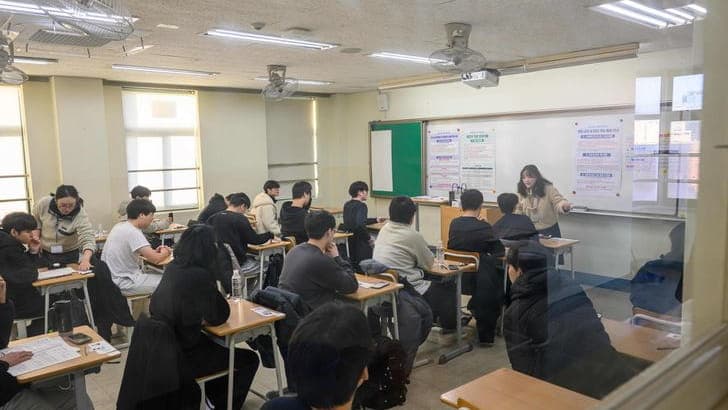
South Korea’s decades-old examination system is facing mounting pressure for a fundamental overhaul as artificial intelligence-powered cheating exposes vulnerabilities in traditional methods of assessing students.
The growing controversy has intensified debate over the future of the College Scholastic Ability Test (CSAT), the country’s highly competitive university entrance examination, with policymakers exploring alternatives to its long-standing multiple-choice format.
President Lee Jae Myung called for a swift review of the national testing system last Friday, accelerating discussions on introducing written-response questions and essay-based assessments to evaluate students’ knowledge, reasoning and independent thinking. However, education experts caution that changing the format alone will not eliminate the threat of AI-assisted misconduct, raising difficult questions about how examinations can remain credible in an era when technology can generate answers within seconds.
The National Education Commission presented a reform proposal to the president in August, recommending consideration of absolute grading alongside written-response and essay-based questions. The commission has since been gathering public feedback, including through consultations with its citizen participation committee.
The urgency surrounding the debate has increased following incidents involving students allegedly using AI-enabled smart glasses to gain an unfair advantage in university entrance examinations. In October, students were caught using such devices during essay-based admission tests at Yonsei University and the University of Seoul, highlighting the growing difficulty of securing examination halls against sophisticated electronic technology.
Moon Hyung-nam, a professor at Sookmyung Women’s University and president of the Korea AI Education Association, said generative AI had evolved beyond simply selecting answers from multiple-choice questions. He pointed out that modern AI systems can also explain their reasoning and produce written responses, making conventional essay-based examinations vulnerable to the same technological manipulation.
Consequently, replacing objective questions with descriptive answers may not provide the safeguard that policymakers are seeking.
Grading presents another major obstacle
Apart from examination security, the proposed shift towards subjective assessments presents a significant challenge in evaluating answers fairly and consistently.
Song Ki-chang, chancellor of Sungsan Hyo University and an honorary professor at Sookmyung Women’s University, questioned whether manually assessing written responses would be practical given the enormous number of students taking the CSAT annually. While automated assessment could ease the administrative burden, he warned that AI-based grading might favour familiar and conventional responses over originality and independent thinking. Such an approach could undermine the very purpose of introducing essay-based examinations, which are intended to assess creativity, analytical ability and critical thinking.
Song cautioned that students might eventually begin structuring their responses to satisfy the preferences of AI grading systems rather than demonstrating genuine understanding or developing their own arguments. This, he argued, could make education increasingly dependent on artificial intelligence instead of encouraging independent intellectual development.
Universities may get greater admission powers
Some education specialists believe the controversy offers an opportunity to reconsider the fundamental purpose of South Korea’s national entrance examination.
Park Joo-ho, president of Daelim University and a former education professor at Hanyang University, said policymakers must first establish whether the CSAT is intended to measure students’ understanding of the school curriculum or determine admission to universities.
He argued that clarifying this distinction should form the foundation of any meaningful examination reform. One proposal gaining attention is to transform the CSAT into a basic qualification examination while allowing individual universities greater autonomy in selecting students through their own admission assessments.
Song suggested that continued reliance on a single national examination to determine university admissions may no longer be sustainable, making institution-led assessments a possible alternative. Kim Won-jung, head of admissions strategy at Daesung Academy, one of South Korea’s major college preparatory institutes, also supported giving universities a greater role in assessing prospective students.
He described the qualification-based approach, combined with university-administered assessments, as a potentially realistic response to the growing challenges posed by AI-assisted cheating. However, the proposed shift could bring its own complications, particularly by increasing competition for admission and creating greater demand for private tutoring and coaching.
Kim acknowledged that additional private education demand would likely emerge under almost any admissions arrangement, arguing that the possibility of increased tutoring should not prevent authorities from addressing the weaknesses of the existing system. Song similarly maintained that no examination framework could be entirely free of shortcomings, making it more important to minimise its weaknesses than to pursue an unattainable perfect model.
As South Korea confronts the growing intersection of artificial intelligence and academic assessment, the debate is increasingly moving beyond examination security to the broader question of what national testing should achieve. The challenge for policymakers will be to protect academic integrity while ensuring that future assessments reward genuine knowledge, independent reasoning and creativity rather than technological advantage.
Also read