


The four-year collaboration will focus on vanadium flow batteries, AI-based monitoring, vanadium recycling and improved cooling systems to enhance efficiency, reduce costs and support long-duration energy storage.
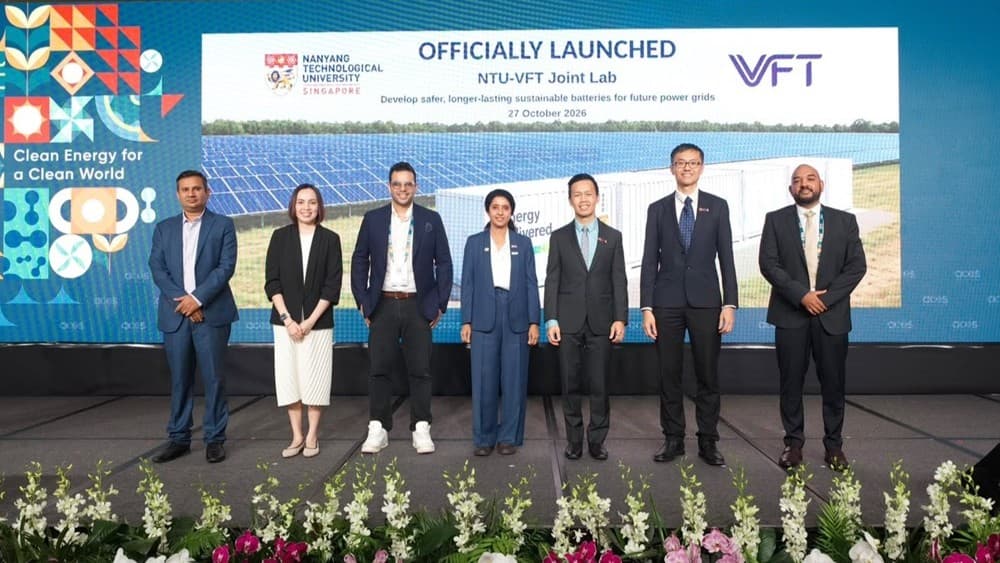
Nanyang Technological University, Singapore (NTU Singapore) and energy storage company VFT have launched a S$15 million joint research laboratory to develop safer, more durable and cost-effective batteries for renewable electricity storage and future power grids.
The NTU-VFT Joint Lab, established through NTU’s Energy Research Institute @ NTU (ERI@N), will focus on advancing vanadium redox flow batteries (VRFBs). These batteries use non-flammable, water-based liquids to store energy, reducing the risk of fires compared with conventional lithium-ion batteries.

The technology is designed for large-scale energy storage, an increasingly important requirement as power grids integrate intermittent renewable sources such as solar and wind.
Flow batteries can store surplus electricity when renewable generation is high and release it when demand rises or generation falls, helping maintain a stable and reliable power supply.
The joint laboratory was launched at the Asia Clean Energy Summit, held as part of Singapore International Energy Week 2026.
Professor Madhavi Srinivasan, executive director of the Energy Research Institute @ NTU (ERI@N), said, "As the global energy transition accelerates, safe and efficient energy storage will become increasingly important to keeping electricity supplies stable and reliable. By combining NTU’s deep expertise in materials science, AI, energy technologies and sustainability with VFT's industry experience, we aim to develop safer, longer-lasting and sustainable batteries to power our future energy grid.”
“VFT's journey shows how NTU's research can translate into real-world applications. What began as a spin-off from NTU working on their first generation of energy storage systems, has evolved into a company developing commercial energy-storage systems. We are glad to be working together with VFT once again to develop the next generation of energy storage solutions and drive further innovation,” Srinivasan added.
Dr Vidal Bharath, chief executive officer of VFT, said, “The challenge is no longer simply generating more renewable energy. Power systems also need safe, reliable and affordable ways to store that electricity for use when renewable generation falls or demand rises.”
“By combining NTU's research capabilities with VFT’s experience in developing and deploying flow batteries, we aim to overcome the technical and cost barriers to wider adoption of new energy-storage technologies and accelerate commercial deployment,” added.
Joint lab to advance long-duration energy storage technologies
Founded in 2018, VFT is a spin-off from NTU based on technology developed at ERI@N. The company raised US$20.5 million in 2025 to expand the manufacturing and deployment of its flow-battery systems.
Unlike lithium-ion batteries, which store energy within battery cells, vanadium redox flow batteries store energy in liquid electrolytes held in external tanks. Their storage capacity can be expanded by increasing the size of these tanks, making the technology suitable for storing and supplying electricity over extended periods.
Researchers at the NTU-VFT Joint Lab will work on developing more powerful and efficient flow batteries. Their research will include improvements to battery stacks and cooling systems to manage heat and enhance overall performance.
The team will also investigate methods of recovering and recycling vanadium from industrial waste and alternative sources. These efforts could help lower production costs while improving the sustainability of battery materials.
Other research areas will include improving power conversion and control systems to increase energy efficiency. Researchers will also explore the use of artificial intelligence to monitor battery performance, identify faults and predict maintenance requirements.
Four-year collaboration to support commercial energy storage
The four-year collaboration, valued at S$15 million, is supported under Singapore's Research, Innovation and Enterprise 2025 plans.
It aims to generate new intellectual property, prototypes and technologies that can be progressively tested and validated before being incorporated into commercial energy-storage systems.
The research partnership will combine NTU's capabilities in materials science, artificial intelligence, energy technologies and sustainability with VFT's industry experience in developing and deploying flow-battery systems.
Alongside technological development, the joint laboratory is expected to strengthen Singapore's research and development capabilities and talent pool in long-duration energy storage.
The work is intended to support the country's transition toward cleaner and more resilient power systems, as reliable storage technologies become increasingly important to integrating renewable electricity into the grid.

Karnataka LKG, UKG Admission 2026-27: 581 Government Schools Approved for Pre-Primary Classes

IIT Gandhinagar to Organise Amalthea 2026 on October 31 and November 1; Check Key Attractions

Indian Students Prioritise Post-Study Jobs While Planning to Study Abroad: IDP Report

Kashmir’s accession dispute and the beginning of the 1947 invasion

Promotion Must Be Based on Service Rules and Eligibility
NTU Singapore, VFT launch joint research lab to develop safer batteries for renewable energy storage

ULLAS 2026: Will B.Ed. Students' Academic Credits Depend on Adults Passing Literacy Tests?

Earth’s life story may not have begun with comets, new study finds

Can India's Biggest Examinations Become Leak-Proof?

Less juggling for parents? Singapore to unite kindergarten learning and after-school care by 2030

Karnataka LKG, UKG Admission 2026-27: 581 Government Schools Approved for Pre-Primary Classes
IIT Gandhinagar to Organise Amalthea 2026 on October 31 and November 1; Check Key Attractions
Indian Students Prioritise Post-Study Jobs While Planning to Study Abroad: IDP Report
Kashmir’s accession dispute and the beginning of the 1947 invasion
Promotion Must Be Based on Service Rules and Eligibility
NTU Singapore, VFT launch joint research lab to develop safer batteries for renewable energy storage
ULLAS 2026: Will B.Ed. Students' Academic Credits Depend on Adults Passing Literacy Tests?
Earth’s life story may not have begun with comets, new study finds
Can India's Biggest Examinations Become Leak-Proof?
Less juggling for parents? Singapore to unite kindergarten learning and after-school care by 2030
Copyright© educationpost.in 2026 All Rights Reserved.