


In a race against melting glaciers, scientists create a subterranean sanctuary to preserve irreplaceable climate records for future generations.
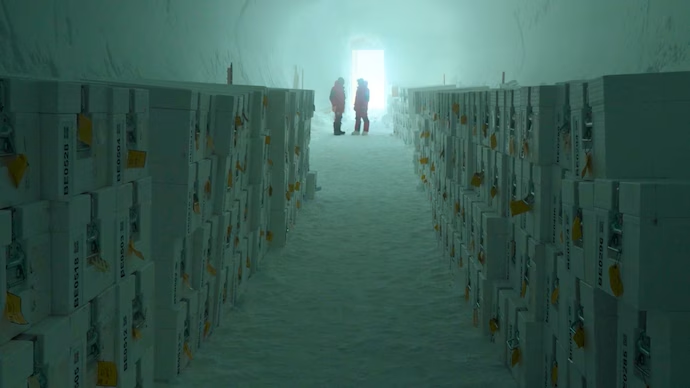
In a landmark effort to safeguard Earth’s vanishing climate memory, scientists have unveiled the world’s first global ice archive beneath the pristine Antarctic surface. Nestled near the Concordia research station on the icy Antarctic Plateau, this groundbreaking underground vault serves as a secure refuge for precious ice cores extracted from glaciers around the world—natural time capsules that hold centuries of invaluable climate data.
As glaciers retreat at an alarming pace due to global warming, the loss of these frozen records threatens to erase vital clues about Earth’s atmospheric past. The newly established ice vault, chilled to a relentless minus 52°C inside a protective snow cave, ensures the long-term preservation of these fragile samples.

The initial shipment—1.7 tonnes of ice harvested from Mont Blanc in France and Grand Combin in Switzerland—was painstakingly transported over 50 days in refrigerated containers from Italy to Antarctica, underscoring the urgency and complexity of this mission.
Led by the Ice Memory Foundation, a coalition of European research institutes founded in 2015, the project has already secured ice cores from 10 glacier sites worldwide, with ambitious plans to expand. Since 2000, glaciers have lost about five percent of their ice volume globally, highlighting the critical need to rescue these irreplaceable archives before they vanish forever.
Beyond preserving environmental history, the vault’s strategic location under the French-Italian Concordia Station ensures the neutrality and universal accessibility of the samples. Governed by international treaty, this icy fortress stands as a beacon of scientific collaboration, guaranteeing future researchers—using yet-to-be-invented technologies—unfettered access to decipher Earth’s climate secrets, helping humanity understand how and why the planet’s climate has transformed over millennia.
This Antarctic ice vault is more than a scientific repository—it’s a frozen time capsule for the future, a testament to humanity’s resolve to protect the legacy of our planet in the face of climate crisis.

Facing risk of losing ancient knowledge, China establishes rare disciplines school

From smart classrooms to surveillance concerns: Why China's Nanjing University rolled back AI feature

Screen time concerns shape Japan's digital textbook policy, printed books to remain primary
Black holes: Where space, time and the laws of physics break down
Santa Barbara City College in US sees sharp fall in international student enrolment
Facing risk of losing ancient knowledge, China establishes rare disciplines school
From smart classrooms to surveillance concerns: Why China's Nanjing University rolled back AI feature
Screen time concerns shape Japan's digital textbook policy, printed books to remain primary

From admissions to employment, J&K brings private universities under 25% domicile quota

After NEET paper leak row, NTA moves to expand examination center network

Facing risk of losing ancient knowledge, China establishes rare disciplines school
From smart classrooms to surveillance concerns: Why China's Nanjing University rolled back AI feature
Screen time concerns shape Japan's digital textbook policy, printed books to remain primary
Black holes: Where space, time and the laws of physics break down
Santa Barbara City College in US sees sharp fall in international student enrolment
Facing risk of losing ancient knowledge, China establishes rare disciplines school
From smart classrooms to surveillance concerns: Why China's Nanjing University rolled back AI feature
Screen time concerns shape Japan's digital textbook policy, printed books to remain primary
From admissions to employment, J&K brings private universities under 25% domicile quota
After NEET paper leak row, NTA moves to expand examination center network
Copyright© educationpost.in 2026 All Rights Reserved.