


The initiative will combine skills assessments, professional training, industry partnerships and workforce research, with courses covering artificial intelligence, digital infrastructure, energy transition and emerging career requirements.

The Singapore Institute of Technology (SIT) has established a new school to help individuals manage career transitions, upgrade their skills throughout their working lives and enable companies to prepare their workforces for changing industry requirements.
Announced during the main session of SIT's Convocation 2026 on Oct 12, the SIT School of Lifelong Learning and Career Development, known as SITLearn, will bring together skills assessment, continuing education, career development, industry partnerships and applied workforce research under one integrated framework.

The school aims to go beyond delivering courses by helping individuals identify their existing capabilities, address skill gaps and plan their professional development.
For businesses, it will provide a coordinated approach to assessing workforce needs, developing employee capabilities and evaluating the impact of training.
Bernard Nee, SIT's deputy president for industry and community and dean of SITLearn, said the integration of these functions, combined with an emphasis on applied learning, distinguishes the new school from conventional continuing education providers.
Nee noted that Singapore already has several providers offering continuing education and training, but many have traditionally focused on delivering courses and work-study degree programs.
“Looking at the changing landscape and the shortening lifespan of skills, we think that that is insufficient, which is why we have set up the CET (continuing education and training) school,” he said.
Although SIT has already been conducting training at its existing facilities and at client premises, the institute is also developing a dedicated SITLearn hub at its Punggol campus. The facility is expected to be ready in the first half of 2027.
The initiative comes as technological advances and longer working lives change the way individuals and organizations approach professional development.
SIT said both workers and employers increasingly need ways to assess current capabilities, identify areas requiring improvement and build the skills needed to respond to evolving workplace demands.
For individuals, SITLearn will offer a personalized pathway that begins with identifying their skills and extends to career development and progression. The support will also be available to adult learners enrolled in selected longer-term continuing education and training (CET) programs.
For businesses, the school will connect workforce assessments with targeted training and capability development, allowing enterprises to take a more structured approach to preparing employees for emerging professional requirements.
SITLearn's integrated model: Skills assessment, training and career development
SIT has identified several components that will form the foundation of SITLearn's integrated approach.
These include skills assessment and validation, industry-oriented education programs, closer links between learning and employment, and research to evaluate the quality and effectiveness of adult education.
The first component focuses on identifying and validating the skills individuals already possess before determining what additional training they may need.
While formal courses allow learners to acquire skills and demonstrate their qualifications through certificates, employees can also develop valuable capabilities through practical workplace experience. Such skills may not always be formally documented or recognized.
“So skills assessment makes (these) skills visible,” said Nee.
SITLearn is developing assessment tools and frameworks in collaboration with industry partners and public agencies.
The initiative is intended to help individuals and employers better understand existing capabilities and use the findings to guide decisions about training and workforce development.
The school is already working with more than 40 organizations across sectors including hospitality, health care and social services. These collaborations involve projects related to artificial intelligence readiness and workforce capability development.
According to Nee, the experience gained through these partnerships will help the school build a broader collection of assessment tools that can be adapted to different industries and professional requirements.
“As we go into more and more sectors, we build a portfolio of tools that can be applied to different use cases,” Nee said.
The assessment process is intended to establish a clearer connection between the skills employees have acquired, the capabilities their employers require and the training needed to bridge any gaps.
New CET programs to address AI, digital infrastructure and energy transition
The second component of SITLearn's model involves developing education and training programs in response to emerging workforce and industry requirements.
The school will offer a range of learning options, including specialist certificates, stackable micro-credentials, postgraduate programs and shorter continuing education modules.
These formats are intended to accommodate learners with different professional backgrounds, career goals and training needs.
Among the newer offerings are programs focused on artificial intelligence capabilities, AI governance and responsible adoption. Other areas include digital infrastructure for green data centers and the assessment, management and mitigation of emerging risks associated with the energy transition.
The program portfolio reflects the growing demand for skills linked to technological change, sustainability and the management of new industry risks.
By aligning course development with emerging market needs, SITLearn aims to help workers and organizations respond to changes in the skills required across different sectors.
Course fees will vary according to the type of program, its duration and the level of specialization involved.
The range of formats and price points is intended to accommodate different learning requirements, from short professional courses to more extensive programs that allow participants to develop specialized expertise.
SITLearn's courses will be delivered by a combination of university professors and industry partners. This approach is designed to connect academic instruction with practical knowledge and current workplace requirements.
Industry professionals to contribute to teaching and mentoring
SITLearn will work with companies to bring experienced professionals into teaching and mentoring roles through its Corporate Adjunct Professorship Scheme.
Under the scheme, the school collaborates with businesses to identify employees who can contribute to education while continuing their industry careers. These professionals will help mentor and coach learners, bringing direct workplace experience into the classroom.
Nee said involving industry practitioners would help ensure that teaching remains connected to real-world developments and the practical challenges faced by businesses.
He also noted that participating companies view teaching as an important avenue for the professional development of senior leaders.
The involvement of industry professionals is expected to strengthen the link between academic learning and workplace application.
Learners will have opportunities to engage with people who understand the practical demands of their fields, while companies can contribute their expertise to developing future-ready employees.
Strengthening the connection between education and employment
The third component of SITLearn's approach focuses on bringing learning closer to employment and expanding opportunities for industry exposure.
The school plans to involve industry partners in different aspects of its model, with the aim of ensuring that programs remain aligned with changing workforce requirements. SIT said it would continue expanding its network of partners to strengthen these connections.
Through these collaborations, SITLearn intends to make continuing education more responsive to the needs of employers and working professionals.
Industry participation will complement the school's skills assessment, training and career development functions, helping learners connect what they study with the capabilities required in professional settings.
The approach also reflects the institute's emphasis on applied learning, with education programs designed to address practical challenges rather than focus solely on course delivery.
For enterprises, the model is intended to support a more coordinated process, beginning with identifying workforce capability gaps and continuing through employee training and the assessment of results.
Research initiative to measure the quality of adult learning
The fourth component of SITLearn's model involves research into adult education, with an emphasis on developing evidence-based approaches to improving learning quality and outcomes.
SIT is leading a national research project in collaboration with the Institute for Adult Learning and other research partners to develop the Digital Adult Learning Quality Index.
The proposed framework will assess the quality, impact and value of digital continuing education and training courses delivered through live-online, self-paced and hybrid formats.
The project aims to establish evidence-based benchmarks that can support more informed decisions about course design, quality assurance and learning outcomes.
Such benchmarks could help education providers and other stakeholders evaluate whether digital courses are delivering the intended benefits to adult learners.
By incorporating research into its broader model, SITLearn intends to combine training delivery with methods for assessing the effectiveness of learning. The research component will complement the school's focus on skills assessment, industry collaboration and career development.
Together, these elements are designed to create a system in which training is informed by demonstrated skill gaps, programs respond to industry needs and learning outcomes can be evaluated using evidence.
Singapore minister highlights AI skills and applied learning at SIT Convocation 2026
The announcement of SITLearn was made during the institute's Convocation 2026 ceremony, where Minister for Digital Development and Information Josephine Teo discussed the opportunities and challenges associated with artificial intelligence.
Teo also outlined how graduates could apply their practical problem-solving abilities and academic training as they enter or progress through their working lives.
Her first recommendation was to focus on building solutions that work by applying existing knowledge and continuing to develop professional expertise.
“As AI enters more industries and physical systems, it will become even more important that you have in-depth knowledge and the ability to apply it to unexpected situations.”
Teo emphasized that as AI becomes more widely integrated into industries and physical systems, workers will need a strong understanding of their fields and the ability to respond to situations that may not have been covered by their formal training.
Her second recommendation was to continue learning, particularly how to work effectively with AI. She encouraged graduates to become “AI bilingual,” combining technological capabilities with knowledge of their respective industries.
The concept emphasizes that familiarity with AI tools alone may not be sufficient. Professionals will also need the subject-specific expertise required to apply these tools appropriately in real-world settings.
Teo's third point was that human judgment becomes increasingly important as technology grows more capable. She urged graduates to understand the limitations of AI and retain the foundational knowledge needed to evaluate its outputs and applications.
“Remember that empathy, ethics and an understanding of context will always matter.”
She also addressed AI safety, noting that the field continues to evolve. However, she said people can already exercise judgment by testing systems carefully and implementing appropriate safeguards.
Her remarks highlighted the importance of combining technical proficiency with critical thinking, ethical awareness and an understanding of the context in which AI is used.
Lifelong learning and workforce readiness in an AI-driven economy
SITLearn's establishment reflects the institute's approach to continuing education as a process that extends beyond obtaining qualifications or completing individual training courses.
The school will combine skills assessment, education programs, career development, industry partnerships and workforce research to support individuals and employers as professional requirements change.
For workers, the model is intended to help identify existing capabilities, determine which skills need to be developed and connect learning with career progression.
For businesses, it will provide a structured approach to understanding workforce needs and building the capabilities required to adapt to technological and economic changes.
The institute is also investing in dedicated infrastructure for the initiative, with the SITLearn hub at the Punggol campus expected to be completed in the first half of 2027.
Alongside the launch, SIT's plans for industry-led teaching, specialized training programs and research into digital adult learning quality are intended to strengthen the connection between education and employment.
At the convocation, Teo's emphasis on continuous learning, practical expertise and human judgment underscored the importance of combining technological skills with deep industry knowledge as AI changes the nature of work.
Singapore Management University’s Executive MBA enters global top 50 in Financial Times ranking

NUS launches clinical psychology program to expand Singapore’s mental healthcare workforce
DGT Partners with Medhavi Skills University to Expand Industry-Linked ITI Training
IIM Ahmedabad Opens Admissions for Second Batch of Blended MBA in Business Analytics and AI
Wits researchers develop light-powered neural network to decode complex signals
Singapore Management University’s Executive MBA enters global top 50 in Financial Times ranking
NUS launches clinical psychology program to expand Singapore’s mental healthcare workforce
Wits researchers develop light-powered neural network to decode complex signals
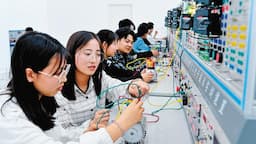
How China is expanding vocational education through undergraduate degrees, industry partnerships and financial aid

Singapore Institute of Technology launches new school for lifelong learning and career development

Singapore Management University’s Executive MBA enters global top 50 in Financial Times ranking
NUS launches clinical psychology program to expand Singapore’s mental healthcare workforce
DGT Partners with Medhavi Skills University to Expand Industry-Linked ITI Training
IIM Ahmedabad Opens Admissions for Second Batch of Blended MBA in Business Analytics and AI
Wits researchers develop light-powered neural network to decode complex signals
Singapore Management University’s Executive MBA enters global top 50 in Financial Times ranking
NUS launches clinical psychology program to expand Singapore’s mental healthcare workforce
Wits researchers develop light-powered neural network to decode complex signals
How China is expanding vocational education through undergraduate degrees, industry partnerships and financial aid
Singapore Institute of Technology launches new school for lifelong learning and career development
Copyright© educationpost.in 2026 All Rights Reserved.