Nobel Prize Medicine 2026: Deisseroth, Hegemann and Nagel win for discovery behind light-controlled brain cells
Their discoveries enabled researchers to activate or silence selected neurons with light, revealing neural circuits linked to memory, emotions, behavior and neurological disorders in living brains worldwide today.
Pragya Kumari08 October 2026 04:39
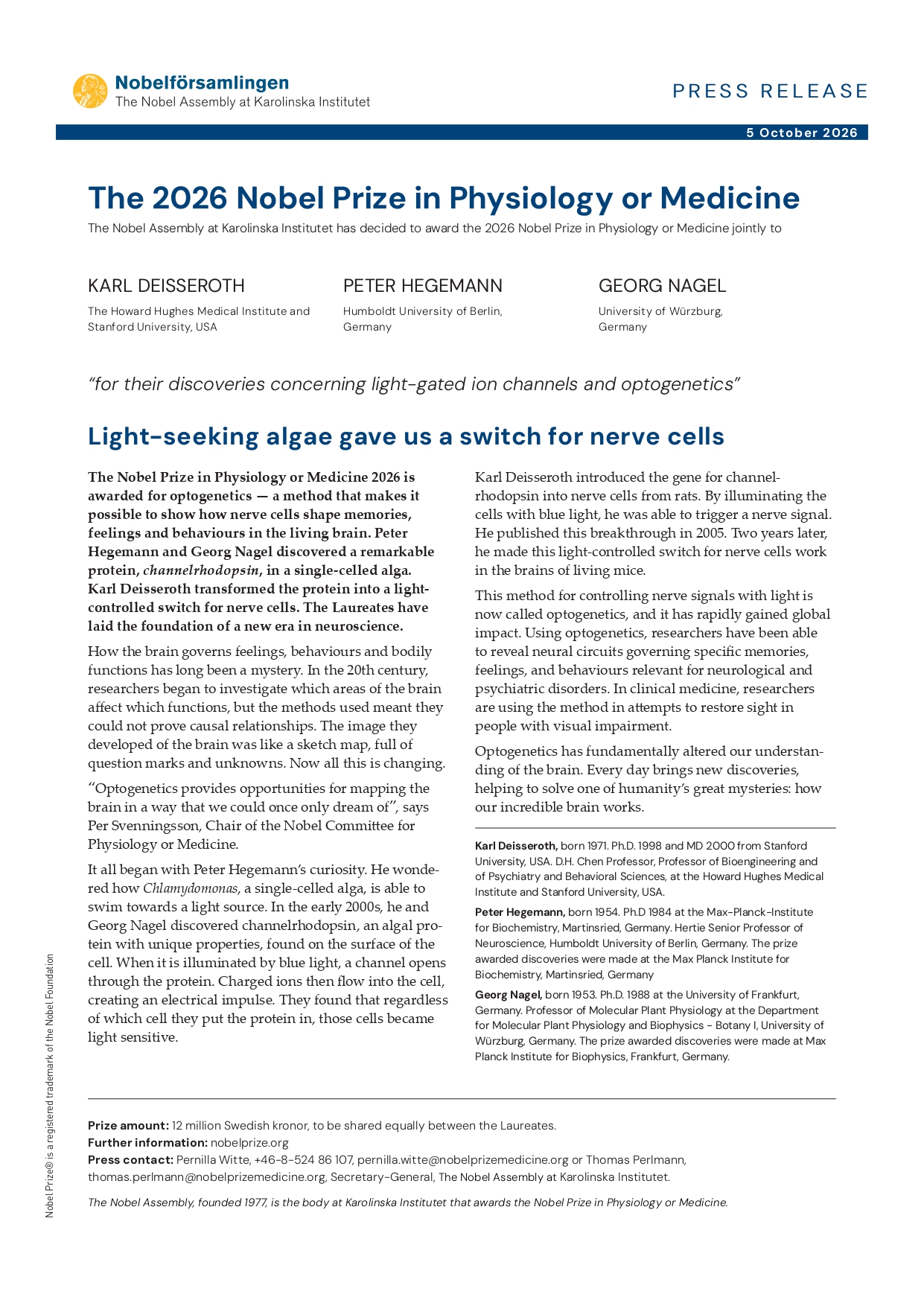
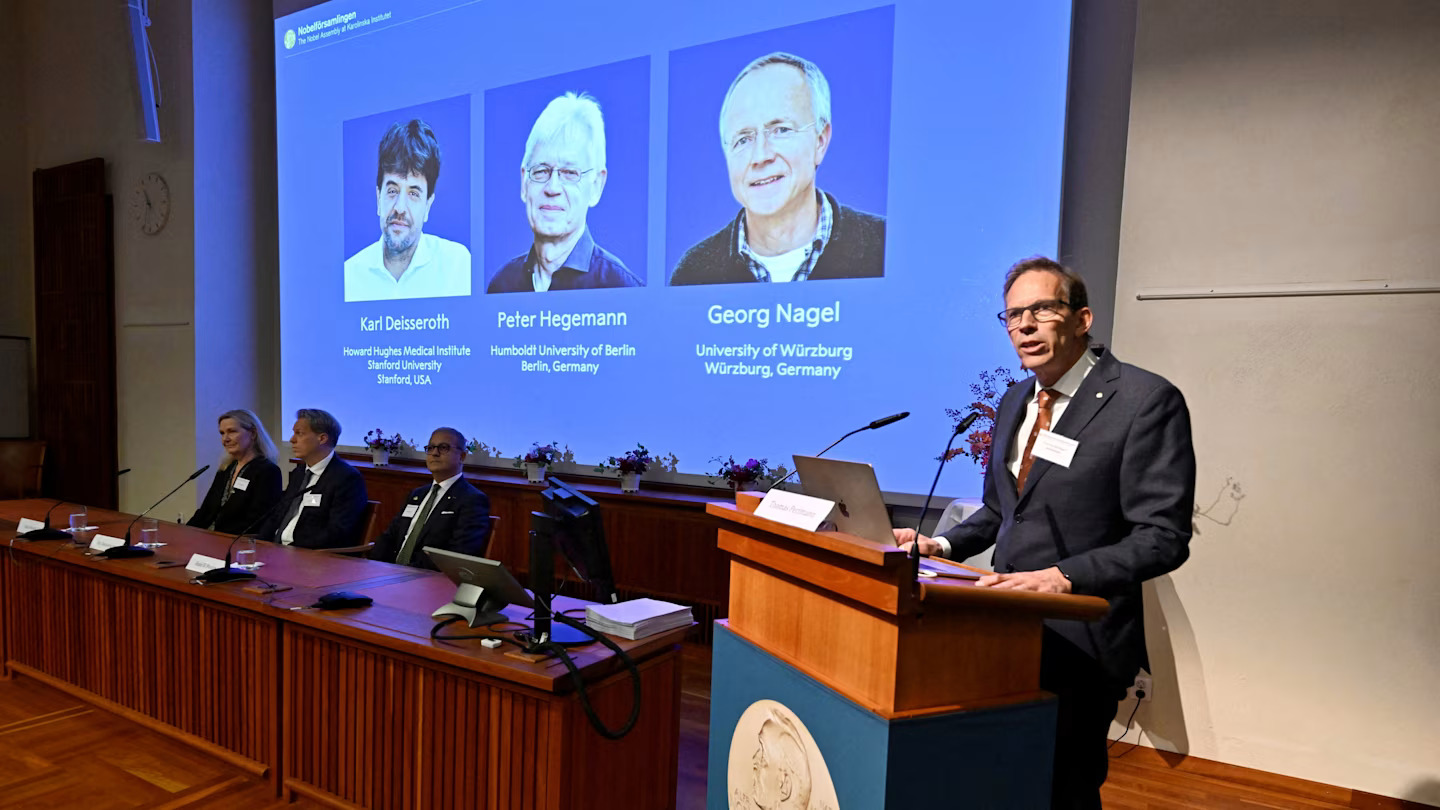
The 2026 Nobel Prize in Physiology or Medicine has been awarded jointly to Karl Deisseroth of the Howard Hughes Medical Institute and Stanford University, Peter Hegemann of Humboldt University of Berlin, and Georg Nagel of the University of Würzburg for their discoveries concerning light-gated ion channels and optogenetics.
The Nobel Assembly at Karolinska Institutet announced the award on Oct 5, recognizing discoveries that made it possible to use light to control individual nerve cells and study how specific neural circuits influence memory, emotions and behavior in living brains.
The laureates’ work has established optogenetics as a powerful method in neuroscience, giving researchers a way to activate or silence selected neurons with light and observe the resulting changes in brain activity and behavior.
The Nobel Assembly said the technique has opened a new era in neuroscience and is now being used in laboratories around the world to investigate the brain.
“Optogenetics provides opportunities for mapping the brain in a way that we could once only dream of,” said Per Svenningsson, Chair of the Nobel Committee for Physiology or Medicine.
Understanding how the brain controls feelings, behavior, and bodily functions has remained one of the central challenges of neuroscience.
During the 20th century, researchers began identifying brain regions associated with particular functions, but available methods often could not establish direct cause-and-effect relationships.
Scientists could identify areas that appeared to be involved in certain processes, but they had limited ability to selectively control individual nerve cells and determine how specific neural circuits produced particular responses.
The discoveries by Hegemann, Nagel and Deisseroth changed that. Their work provided scientists with a way to manipulate defined populations of neurons with light, allowing them to investigate the relationship between neural activity and functions such as memory, emotions and behavior in living animals.
Who are the 2026 Nobel Medicine laureates?
Karl Deisseroth was born in 1971 and received his PhD from Stanford University in 1998 and his MD from the same university in 2000. He is the D.H. Chen Professor and a professor of bioengineering and psychiatry and behavioral sciences at Stanford University and the Howard Hughes Medical Institute in the United States.
Peter Hegemann was born in 1954 and received his PhD in 1984 from the Max Planck Institute for Biochemistry in Martinsried, Germany. He is Hertie Senior Professor of Neuroscience at Humboldt University of Berlin. The discoveries recognized by the prize were made at the Max Planck Institute for Biochemistry in Martinsried.
Georg Nagel was born in 1953 and received his PhD from the University of Frankfurt in 1988. He is Professor of Molecular Plant Physiology in the Department for Molecular Plant Physiology and Biophysics at the University of Würzburg, Germany. The prize-recognized discoveries were made at the Max Planck Institute for Biophysics in Frankfurt.
The three scientists are 54, 71 and 73 years old, respectively. Deisseroth is based at Stanford University in California, while Hegemann and Nagel are based at universities in Germany.
Thomas Perlmann, secretary of the medicine committee, said he was able to reach all three laureates by phone after the announcement.
Nobel Prize money and ceremony
The 2026 Nobel Prize in Physiology or Medicine carries a prize amount of 12 million Swedish kronor, to be divided equally among the three laureates. The amount is approximately $1.2 million.
The Nobel Prize in Physiology or Medicine is one of the awards established under the will of Swedish inventor and industrialist Alfred Nobel. The Nobel Prizes recognize contributions considered to have provided the greatest benefit to humankind.
The medicine prize was announced at the Karolinska Institutet in Stockholm, marking the beginning of Nobel week.
The laureates will receive their Nobel medals at the Nobel Prize ceremony in Stockholm on Dec 10, the anniversary of Alfred Nobel's death. The awards will be followed by the traditional Nobel banquet.
How optogenetics began
The research began with Peter Hegemann’s interest in how Chlamydomonas, a single-celled green alga, detects and moves toward light.
Hegemann investigated the molecular mechanisms that allow the microorganism to sense light and, in the early 2000s, worked with Georg Nagel to identify a remarkable light-sensitive protein called channelrhodopsin.
Channelrhodopsin is located on the surface of the algal cell. When exposed to blue light, the protein opens a channel through the cell membrane, allowing electrically charged ions to flow into the cell. This movement of ions generates an electrical impulse.
The researchers found that introducing the protein into other types of cells could make those cells responsive to light. The discovery provided the key biological component needed to develop a method for controlling cellular activity using light.
Ion channels are proteins embedded in cell membranes that regulate the movement of charged particles, or ions, into and out of cells. In nerve cells, the movement of ions is central to determining whether a neuron becomes active and sends a signal.
The discovery of light-sensitive ion channels therefore created a new possibility: researchers could potentially use light to control the electrical activity of nerve cells with much greater precision than earlier techniques allowed.
Deisseroth turns discovery into a neural switch
Karl Deisseroth and his collaborators then adapted the light-sensitive protein for use in nerve cells.
By introducing the gene responsible for channelrhodopsin into rat neurons, Deisseroth demonstrated that blue light could be used to trigger nerve signals. He published this breakthrough in 2005.
Two years later, he demonstrated that the light-controlled system could be used in the brains of living mice. By delivering light to neurons containing the light-sensitive protein, researchers could control the activity of selected nerve cells in living animals.
This approach became known as optogenetics, combining genetic methods with light-based control of neural activity.
The technique gave neuroscientists an unprecedented way to study specific neural circuits. Rather than simply observing which parts of the brain became active during a particular behavior, researchers could manipulate selected neurons and then examine what happened.
Optogenetics and the study of the brain
Optogenetics has rapidly become an important tool for investigating how neural circuits control memories, feelings and behaviors.
Researchers have used the technique to identify circuits involved in specific types of memory and emotional responses, as well as behaviors relevant to neurological and psychiatric disorders.
By combining light-sensitive proteins with genetic techniques and precisely delivered light, scientists can target particular groups of neurons and influence their activity while monitoring the resulting effects.
The Nobel Assembly said the method has fundamentally changed the way researchers investigate the brain, providing a means to move beyond simply mapping brain activity toward testing how individual neural circuits contribute to specific functions.
The technique has also attracted interest in clinical research. Scientists are investigating whether optogenetic approaches could eventually help restore sight in people with visual impairment and contribute to new approaches for treating neurological conditions.
From algae to modern neuroscience
The Nobel-winning discoveries connect research in microbiology and membrane biology with neuroscience.
Hegemann's studies of how microorganisms sense light provided the initial insight into light-sensitive proteins. Nagel helped characterize these proteins and establish their ability to function as light-controlled ion channels.
Deisseroth subsequently helped transform that biological discovery into a practical method for controlling neurons in living animals.
Together, their research created a bridge between the study of light-sensitive microorganisms and the investigation of complex neural circuits in the mammalian brain.
The Nobel Assembly said the discoveries have enabled scientists to reveal how nerve cells shape memories, emotions and behaviors in a living brain and have provided a new way to investigate some of the most complex questions in neuroscience.