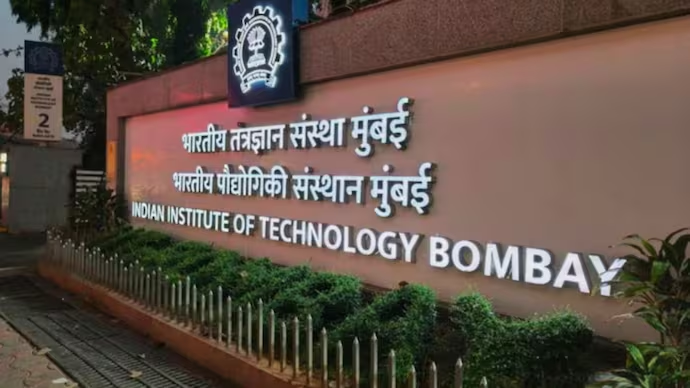
IIT Bombay proposes new exam protocol after student’s death
Interim recommendations would allow students accused of cheating to complete their papers, record their version and receive support after leaving the exam hall.
EPN Desk08 October 2026 05:11
The Indian Institute of Technology Bombay has proposed a new procedure for dealing with suspected cheating and unfair means during examinations, with a key change aimed at preventing students from being left alone immediately after a misconduct incident is recorded.
Under the interim recommendations, an invigilator who detects suspected cheating would confiscate the material in question, document the incident and allow the student to continue writing the examination with a fresh answer booklet. The invigilator would not decide the disciplinary outcome, which would be left to the institute’s Disciplinary Action Committee.
The recommendations were prepared by an eight-member committee comprising four faculty members and four students. The committee was constituted after the September 18 death by suicide of second-year BTech student Sahil Wakode and presented its interim report at a special meeting of the IIT Bombay Senate on Wednesday.
Students to get a chance to explain
The proposed process also gives students an opportunity to record their version of what happened after the examination.
The incident would be documented through a prescribed form completed by the invigilator. The student would then be allowed to submit a separate account in the presence of additional staff members.
Another significant recommendation is that the institute’s Quick Response Team (QRT) helpline should be alerted once the student leaves the examination hall. The move is intended to ensure that students involved in a suspected misconduct case have access to immediate support rather than being left to deal with the situation alone.
IIT Bombay puts stricter cheating penalties on hold
The Senate has also decided to temporarily return to the examination misconduct rules introduced in 2015, putting the stricter penalties brought in this July on hold.
Under the July rules, a student caught carrying a mobile phone into an examination could receive an FR, or “fail and repeat”, grade and face a semester-long suspension. Under the earlier 2015 framework, carrying a phone attracted a one-grade penalty, while using one could result in an FR grade.
The review follows student protests after Wakode was allegedly found using a mobile phone during a mid-semester examination on September 18. He died by suicide later that day, prompting renewed debate among students over the handling of examination misconduct and the availability of support mechanisms.
Tighter controls proposed inside exam halls
Alongside changes to misconduct procedures, the committee has recommended tighter controls inside examination buildings.
Mobile phones, smartwatches, earphones and other electronic devices would be prohibited, along with bags, books and notes. CCTV monitoring of examination halls has also been proposed.
Only one student would be permitted to leave the hall at a time for a bio-break, while entry would be closed 30 minutes after the examination begins. The committee has also proposed discontinuing routine physical frisking.
What IIT Bombay is proposing
Issue
Proposed rule
Suspected cheating
Student can continue the examination with a fresh answer booklet
Student's version
Student gets an opportunity to record their account
Disciplinary action
Decision handled by the Disciplinary Action Committee
Student support
QRT helpline alerted after the student leaves the hall
Penalties
2015 rules temporarily restored; stricter July rules put on hold
Electronic devices
Phones, smartwatches and earphones banned
Exam monitoring
CCTV monitoring proposed
Bio-breaks
One student at a time allowed out
Late entry
No entry after 30 minutes
Frisking
Routine physical frisking proposed to be discontinued
Status
Interim recommendations; final rules yet to be issued
The recommendations are not yet final. Senate members broadly considered the committee’s report but also suggested changes. A final set of guidelines is expected after those suggestions are examined.
The proposed framework marks a shift in emphasis: suspected examination misconduct would still trigger disciplinary proceedings, but the immediate response inside and outside the examination hall would place greater weight on documentation, due process and student support.