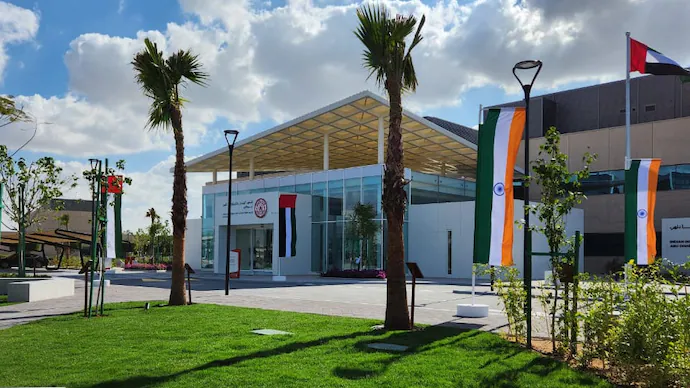
Enrollment at India’s first overseas IIT campus is set for a sharp expansion, as the IIT Delhi Abu Dhabi campus prepares to significantly scale up its student intake in the next academic year.
Shantanu Roy, Executive Director of IIT Delhi Abu Dhabi, said the campus currently has 182 students and is expected to grow to about 400 next year.

He said IIT Delhi in India has a total student strength of around 12,000. Roy was speaking during an interaction with visiting Indian media at the Abu Dhabi campus.
Explaining the distinct context in which the international campus operates, Roy said, “This is in a different geography and is being aligned with the priorities of the United Arab Emirates. India is a much bigger country, with a much larger population; the economic expanse is large.”
He said the academic focus reflects the UAE’s broader economic shift. “This is, of course, the Middle East, which has had a history of largely being a fossil fuel-based economy, but the UAE is expanding and diversifying a lot. So, the whole education innovation ecosystem that is being set up here is in alignment with that diversification,” Roy said.
Roy also highlighted the global nature of the student body. “But of course it’s a smaller country, with a very small population and geography, and has a large international student strength. That’s because the UAE, being at the crossroads of the world, is connected with Europe and Asia. So, we have diversity in the student population,” he said.
According to Roy, the Abu Dhabi campus focuses on areas aligned with national priorities such as energy, sustainability, Artificial Intelligence, and smart materials. He stressed that these areas are also central to IIT Delhi’s work in India.
“It is not to say that this is not being done in the Delhi campus, because all these areas are of great importance to India as well. It is not like this campus is not aligned with the Delhi campus. We are actually one institution and not two different institutions. I think that’s very important to understand at the outset,” Roy said.
He added, “We are actually one global institution with three campuses. This (Abu Dhabi) is our first international campus.”
Roy traced the campus’s growth since its launch. “In the beginning, in the first semester, we started with 17 students. We had only one master’s program. Within six months, we started two undergraduate programs with around 50 students enrolled then,” he said.
The expansion plan includes regular additions to academic offerings. “We are starting a new undergraduate program every year, maybe a new master’s program every year, and possibly some growth on the PhD front every year,” Roy said.
On the role of Artificial Intelligence in education and research, Roy said AI is already integrated into IIT Delhi’s curriculum, including specialized master’s programs.
“The curriculum we are offering here (Abu Dhabi campus) is, by and large, the same curriculum, except for some customization specific to the Middle East requirement. A requirement for accreditation of branch campuses is that you maintain the ethos of the parent campus,” Roy said.
“As far as curricula are concerned, we are very closely aligned. It is not like if you go to IIT Delhi in Delhi, you get a different training from what you get in Abu Dhabi. You get more or less the same training, except there is some local contextualization in terms of courses that are compulsory in all the universities in the UAE,” he said.
Roy said both India and the UAE are placing strong emphasis on AI-driven innovation. “That said, the UAE is largely focused on innovation in AI. Not that India is not. India is also focused, but so is the UAE,” he said.
He also spoke about collaboration with Mohamed bin Zayed University of Artificial Intelligence.
“We are closely aligned with Mohamed bin Zayed University of Artificial Intelligence (MBZUAI), which offers specialized AI degree programs for local and international students. We are starting a master’s program in AI, which is already offered at IIT Delhi,” Roy said.
Addressing infrastructure plans, Roy said the current facility is temporary. “This is not our permanent campus. This is a transit campus. It may have very good infrastructure, but it’s still a transit campus. The permanent campus is still some years away,” he said.
He said sustainability would be a key consideration for the permanent campus. “But as and when that happens, we’ll get to obviously the best standards internationally, globally, in buildings, and so on, as well as sustainability, which will be another big aspect of how we plan that campus and make it as sustainable as possible.”
Located in Khalifa City, the IIT Delhi Abu Dhabi campus was inaugurated on Sept 2, 2024, following an agreement between India and the UAE.
Undergraduate admissions are conducted through JEE Advanced and the Combined Admission Entrance Test.
Roy said one-third of students are admitted through JEE Advanced, while CAET is meant for UAE residents, including expatriates who have lived in the country for five years.