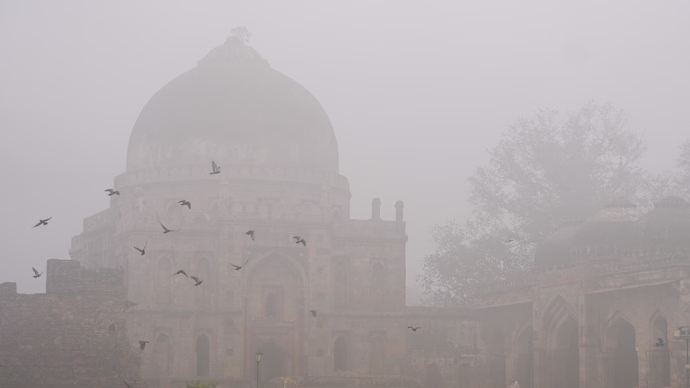
Grey skies, biting cold and suffocating air combined to deliver a harsh winter blow to the Delhi-National Capital Region, with air quality hovering dangerously close to the “severe” category on December 21 even as dense fog disrupted daily life across north India.
Data from the Central Pollution Control Board showed Delhi’s Air Quality Index at 390 on December 21 morning — a marginal improvement from 398 a day earlier, but still firmly in the “very poor” zone and threatening to slip into severe territory.

Several parts of the capital recorded alarmingly higher pollution levels. Chandni Chowk emerged as one of the worst-hit areas with an AQI of 455, followed closely by Wazirpur at 449, Bawana at 446, Rohini at 444 and Anand Vihar at 438.
Neighboring cities fared little better. Gurugram posted an AQI of 354, Noida 352 and Ghaziabad 334 — all categorized as very poor — while Faridabad recorded a “poor” reading of 283.
The pollution spike coincided with Delhi’s first cold wave of the season. The capital logged its coldest December day so far on Saturday, with the maximum temperature plunging to 16.9 degrees Celsius — nearly five degrees below normal. Thick cloud cover and a persistent grey haze kept sunlight at bay for much of the day.
Weather conditions also hit air travel. At least 129 flights were cancelled at Delhi airport on Saturday due to dense fog, according to PTI. Airport authorities said operations had normalized by December 21.
The India Meteorological Department issued an orange alert for Delhi, forecasting dense to very dense fog during night and early morning hours. Temperatures are expected to hover around 23 degrees Celsius during the day and dip to about 9 degrees Celsius at night.
The IMD also warned of reduced visibility across Uttarakhand, Uttar Pradesh and Haryana till December 21 morning, with isolated fog likely in Punjab and Haryana between December 25 and 27, and in western Uttar Pradesh on December 26 and 27.
Delhi Environment Minister Manjinder Singh Sirsa cautioned that an approaching western disturbance could further worsen weather conditions and pollution levels. In a video message, he warned of strict action against polluting industries and violations of the construction ban, noting that complaints had been received despite restrictions being in force.
Stage IV of the Graded Response Action Plan has been implemented since December 13. The measures include a blanket ban on construction and demolition, curbs on open burning, restrictions on non-BS VI vehicles entering the city, denial of fuel to vehicles without valid pollution certificates, and a work-from-home mandate for 50% of employees in government and private offices.