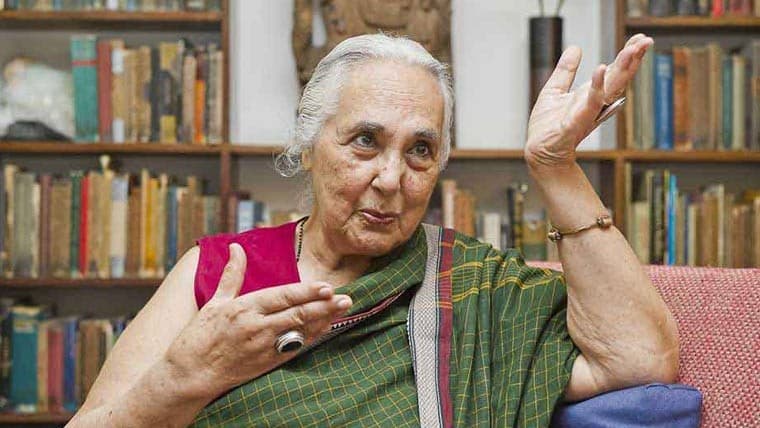
Historian Romila Thapar has sharply criticized the University Grants Commission’s (UGC) Learning Outcomes-based Curriculum Framework (LOCF), warning that it undermines university autonomy and risks weakening academic standards.
Her comments form part of Kerala’s official feedback to the Union Education Ministry and the UGC.

Thapar, who served as a special invitee on the Prabhat Patnaik-led expert panel set up by the Kerala State Higher Education Council, called the framework a step toward reducing higher education to rote learning.
She cautioned that the draft would restrict students to standardized question-and-answer methods rather than encouraging them to think critically.
“The syllabus and what is to be taught and how in each discipline is the concern of the individual university and is not to be dictated to by the government. These are concerns in which specialized and advanced knowledge is required, something that obviously administrators and politicians do not have,” she said, stressing that non-specialists cannot design effective curricula.
On the treatment of modernity in the LOCF draft, Thapar argued for a more layered approach.
She proposed that the first phase of modernity should include European intellectual history from the 17th century, when philosophers debated rational thought.
The second phase, she noted, emerged through the Industrial Revolution and colonialism, both of which had profound consequences for economies, societies, and India’s colonial past.
The historian also questioned the lack of clarity around the concept of the "Indian Knowledge System" in the UGC framework.
She pointed out that the draft provides no clear definition or analytical structure to explain what the term means.
Thapar criticized the uncritical reliance on texts like Kautilya’s Arthashastra as representative of ancient Indian thought, saying they are too often applied across centuries without accounting for shifting political, social, and intellectual contexts.
She further emphasized that knowledge systems in early India cannot be confined to a single tradition.
“Even if some of the texts were composed in Sanskrit, there was, during the first and early second millennia AD, a considerable exchange of ideas on proto-science across India, West Asia, Central Asia, and China. These ideas cannot be given a geographical boundary or a religious origin,” she said.





.jpg&w=256&q=75)