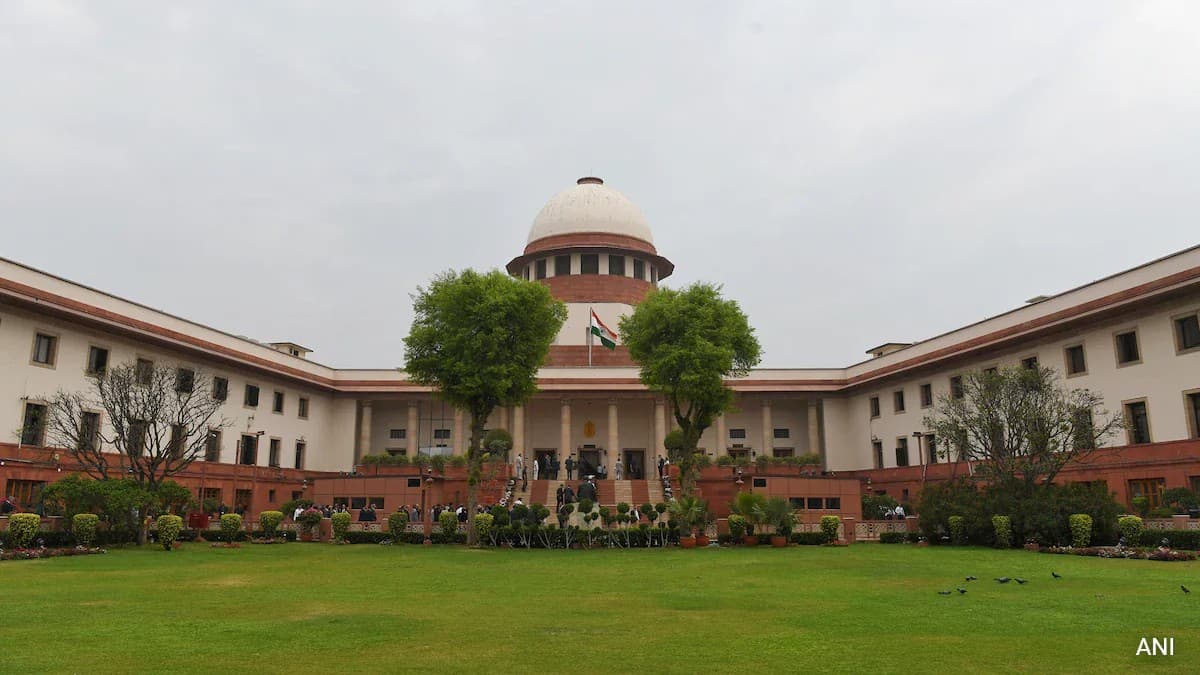
The government has informed the Supreme Court that it is ready to introduce a nationwide adolescent education program in schools and colleges after accepting the recommendations of a national expert committee.
The move will pave the way for age-appropriate lessons on personal safety, health, relationships, and sex education once the apex court grants its approval.

The submission was made before a bench of Justices B V Nagarathna and R Mahadevan. The recommendations were prepared after the Supreme Court directed the Union government to examine the increasing criminalization of consensual adolescent relationships and minor pregnancies under the Protection of Children from Sexual Offences (POCSO) Act, 2012.
To address the issue, a 26-member expert committee was constituted to study adolescents' right to privacy in consensual relationships within the broader child protection framework and propose policy measures.
As part of its recommendations, the committee has proposed introducing adolescent education in a phased and age-appropriate manner.
While structured adolescent education would begin from Class 6, children at the foundational stage would receive lessons on personal safety, body awareness, hygiene, and the distinction between safe and unsafe touch.
The overall framework has been aligned with the National Education Policy (NEP) 2020 and seeks to strengthen existing school-based awareness programs by integrating life skills, critical thinking, holistic development, and safety education.
The committee has recommended that the National Council of Educational Research and Training (NCERT) develop the curriculum for schools.
The proposed syllabus would include gender equality, health and hygiene, emotional well-being, cyber safety, awareness of the POCSO Act, and age-appropriate components of sex education.
Instead of introducing all concepts simultaneously, the report recommends a progressive framework under which topics are expanded as students move through Classes 6-8, 9-10, and 11-12.
Regarding the subject of consent, the committee has advised against introducing the concept to younger children. Instead, it recommended that consent be taught only at the secondary level within a medico-legal framework.
According to the report, each theme, including consent and cyber safety, should be introduced gradually and revisited with greater depth across successive grade bands.
Beyond classroom instruction, the committee has proposed several measures to strengthen awareness among families and communities. It has recommended organizing regular workshops and dialogue sessions for parents to explain the importance of adolescent education.
It also suggested incorporating discussions on the POCSO Act and the Prohibition of Child Marriage Act into parent-teacher meetings so that parents become more familiar with the legal framework affecting children and adolescents.
To further support families, the committee has recommended that the Ministry of Education prepare and publish parent guidebooks outlining age-appropriate ways to answer children's questions in an informed and sensitive manner.
It has also proposed creating community ambassadors who can promote adolescent education and encourage greater public participation.
The report noted that efforts to strengthen health awareness in educational institutions are already underway.
It referred to information provided by the Ministry of Education in the Rajya Sabha in 2024, which stated that nearly seven lakh health and wellness ambassadors had been trained and oriented across 446 districts in 28 states and eight Union Territories.
Recognizing that adolescent education extends beyond schools, the committee has also made recommendations for several other ministries.
It proposed that the Ministry of Social Justice and Empowerment, the Ministry of Tribal Affairs, and the Department of Empowerment of Persons with Disabilities ensure that their welfare schemes adequately address the needs of marginalized groups, including tribal communities, children with disabilities, and LGBTQ+ youth.
The committee further recommended incorporating trauma-informed approaches, gender sensitivity, and digital safety into all related training modules so that frontline workers are better equipped to respond to the challenges faced by young people.
The report places significant emphasis on teacher preparedness before introducing the curriculum in educational institutions. It states that adolescent education modules should only be delivered by teachers who have received appropriate training in age-specific pedagogy.
While trained teachers should remain the primary instructors, the committee has also recommended involving NGOs with demonstrated expertise in child protection to assist in teacher capacity building.
The committee has further proposed a Training of Trainers (ToT) program for counselors working in Child Care Institutions (CCIs).
It observed that strengthening the capacity of counselors and frontline workers is essential for ensuring consistent, high-quality support for adolescents and recommended establishing a national certification program for adolescent counselors.
At the district level, the committee has suggested that District Child Protection Units (DCPUs) conduct training programs for teachers, hostel wardens, caregivers, support persons, and other frontline workers.
These units should also organize calendar-based awareness sessions for school and college students to ensure sustained outreach throughout the academic year.
The report also outlines an expanded role for the National Legal Services Authority (NALSA) and the State Legal Services Authorities (SLSAs).
According to the committee, these institutions will bear significant responsibilities under the existing legal framework, including providing quality legal assistance to children, facilitating interim relief, ensuring victim compensation under the POCSO Act, and maintaining accurate and timely information on the POCSO Tracking Portal.
The committee states that their active involvement is "pivotal to the overall effectiveness and integrity of Pocso-related schemes," particularly with respect to accurate and timely data entry in the Pocso Tracking Portal.
To improve coordination among agencies, the committee has also recommended creating provisions that would allow all child protection stakeholders to access information relating to POCSO cases more easily.
The committee has additionally emphasized the need for large-scale awareness campaigns to improve public understanding of child protection issues and the legal consequences under the POCSO Act. It stated that awareness initiatives should be carried out extensively at both the community and societal levels.
As part of this effort, the report has proposed introducing an Intergenerational Awareness Program that actively involves children, adolescents, parents, and guardians.
According to the committee, parents and guardians play a critical role in shaping children's understanding of sensitive issues, making their participation essential for the success of adolescent education initiatives.
The committee has also recommended directing the Ministry of Panchayati Raj and the Ministry of Housing and Urban Affairs to conduct grassroots awareness campaigns on child sexual abuse and the provisions of the POCSO Act.
These campaigns should use Information, Education, and Communication (IEC) materials such as animation videos, booklets, street plays, and other audio-visual content to maximize outreach.
Finally, the report recommends that all awareness material be designed to be youth-friendly, written in clear and age-appropriate language, translated into regional languages, and displayed prominently in public places, including schools, hospitals, and bus stands to ensure wider visibility and accessibility across the country.



.png&w=256&q=75)




.jpg&w=256&q=75)