
No internet, just voice commands: 16-year-old builds JARVIS-inspired smart home device
The system operates household appliances such as lights and fans through spoken instructions, offering an alternative to internet-dependent smart assistants while highlighting the possibilities of locally controlled home automation.
By Pragya Kumari · Updated
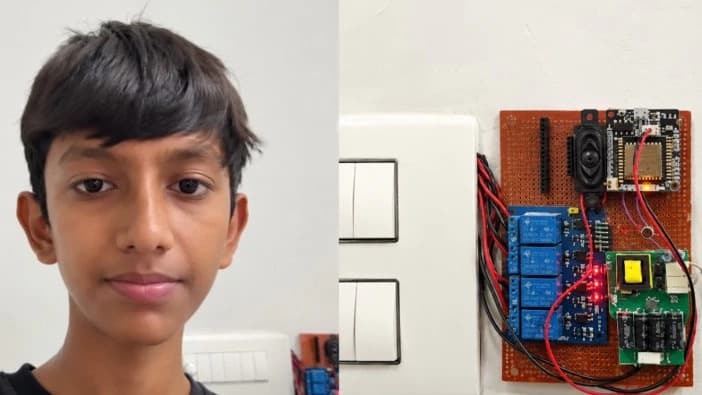
A 16-year-old Indian technology enthusiast has developed an offline, voice-controlled home automation system inspired by JARVIS, the fictional artificial intelligence assistant from the Iron Man movies.
The device allows users to operate household appliances, including lights and fans, through spoken instructions without requiring an internet connection.
The creator, Ridit Kumawat, recently showcased the project in a demonstration video shared on Instagram. The video has attracted attention online, offering a glimpse of how a compact electronic device can bring voice-controlled automation into an ordinary home.
During the demonstration, Ridit introduces the creation as one of his most exciting projects, explaining that the small device can control his entire room.
The system responds to voice commands, allowing him to switch connected appliances on and off without manually operating their switches.
Inspired by Iron Man, 16-year-old builds real-life JARVIS
Tony Stark's JARVIS has long represented the idea of a futuristic home assistant capable of understanding spoken instructions and responding to its owner's needs. Ridit has drawn inspiration from this fictional technology to develop a functional home automation project.
In his demonstration video, he interacts with the device by asking, “Jarvis, what can I do for you?” He then issues commands such as “All lights off” and “Fan off”, prompting the system to operate the connected appliances accordingly.
The demonstration highlights how voice recognition and electronic switching mechanisms can work together to simplify everyday household operations. Instead of walking to a switchboard, users can give spoken instructions to control appliances.
Ridit's project brings elements of the technology portrayed in Iron Man into a practical setting. Although the device does not replicate every feature of the fictional assistant, it demonstrates how voice-based interaction can be used for basic home automation.
How does Ridit's offline JARVIS home automation system work?
Ridit's voice-controlled home automation system follows a series of steps to convert spoken instructions into electrical switching actions. The process begins when the device captures a user's voice through an attached microphone.
The system processes the recorded instruction and identifies the command that needs to be executed. A controller then communicates with the switching mechanism to activate or deactivate the connected household appliance.
For example, when a user says a command to switch off the lights, the system recognizes the instruction and triggers the corresponding switching action. A similar process allows it to control other connected appliances, including fans.
In simple terms, the device listens to a voice command, processes the instruction and performs the associated operation. This eliminates the need for users to operate each connected appliance manually.
The Instagram demonstration also provides a look at the electronic setup behind the project and shows the device responding to different spoken instructions. Ridit identifies its ability to function without an internet connection as one of its key features.
Offline operation and privacy: How is it different from Alexa and Google Home?
One of the major features Ridit highlights is that his home automation system operates completely offline. Unlike several popular smart-home solutions that rely on internet connectivity for certain functions, his device does not require an active internet connection to respond to commands.
Comparing his creation with voice assistants such as Google Home and Alexa, Ridit points to offline functionality as an advantage, particularly from a privacy perspective.
Explaining why he considers this a major advantage, he says, “In the craziest part, this works completely offline unlike other devices like Google Home and Alexa. So, privacy on top.”
Offline operation can make voice-controlled home automation useful in locations where internet connectivity is unreliable or unavailable. Users can potentially operate connected appliances without depending on a continuous internet connection.
It may also reduce the need to transmit voice commands to cloud-based services. However, the actual level of privacy depends on how the device handles voice recordings, processes commands and stores information.
The project highlights an alternative approach to smart-home technology, where essential automation functions can operate locally rather than relying on internet-based services.
Is Ridit's JARVIS system really an artificial intelligence assistant?
Although Ridit's creation takes inspiration from an artificial intelligence assistant, voice-controlled home automation and advanced AI systems are not necessarily the same.
A basic voice-controlled automation device can identify predefined instructions and execute actions assigned to those commands. For instance, a programmed phrase can instruct the system to switch off a particular light or turn off a fan.
Advanced AI assistants have broader capabilities. They can interpret complex instructions, understand conversational context, respond to questions and perform multiple tasks beyond executing predefined commands.
Ridit's project primarily demonstrates the possibilities of offline voice recognition and home automation. Its resemblance to Iron Man's JARVIS comes from the way users interact with technology through spoken instructions.
While it may not possess the reasoning and conversational capabilities of a sophisticated AI assistant, the project demonstrates how voice-based technology can make everyday electronic operations easier.
It also illustrates how relatively compact electronic systems can be used to experiment with smart-home applications without necessarily depending on internet connectivity.
From Iron Man's JARVIS to a working home automation project
Ridit has also encouraged people interested in building or understanding the system to explore the project through GitHub. He has shared information about the repository and invited viewers to follow him for access to the project details.
“If you want the repository link or the complete project details, just follow me on GitHub,” he says in the video.
At 16, Ridit's creation reflects how curiosity about technology and inspiration from popular films can lead to practical experiments. His offline voice-controlled system offers a glimpse of how futuristic ideas can be adapted for everyday applications.
Although the device does not reproduce all the features of Tony Stark's fictional assistant, it brings one aspect of that vision closer to reality: a home where appliances respond to spoken instructions.
The project also highlights the potential of locally operated home automation systems, particularly for users interested in controlling household devices without relying on constant internet access.
Also read