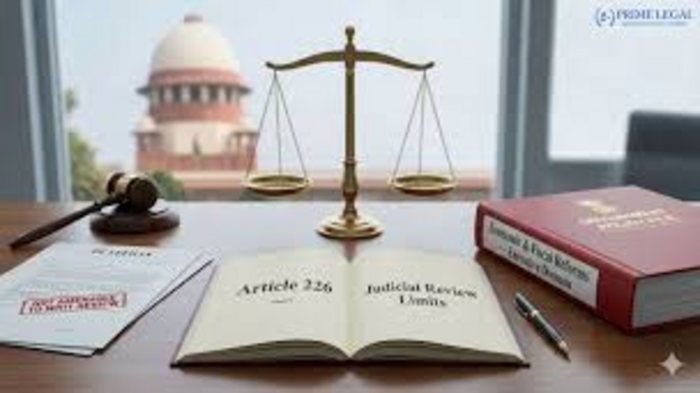
The Supreme Court of India has recently clarified the scope of Article 226 of the Constitution, which empowers High Courts to issue writs for the enforcement of fundamental and legal rights. The ruling addresses a long-standing concern regarding the increasing tendency to invoke writ jurisdiction in contractual disputes involving the State and its instrumentalities.
What the Court Held
The Court held that High Courts may intervene in contractual matters through writ jurisdiction only when the dispute involves a public law element. Such intervention is justified where State action is arbitrary, unreasonable, or violative of Article 14, which guarantees equality before law. The judgment makes it clear that the mere presence of the State as a contracting party does not automatically transform a contractual dispute into a constitutional matter.

Distinction Between Public and Private Law
The Supreme Court drew a sharp distinction between public law remedies and private law disputes. Purely contractual disagreements—such as issues related to payment, breach of terms, or interpretation of clauses—are matters of private law. These must be resolved through civil courts or arbitration, particularly where an alternative statutory or contractual remedy is available. Writ jurisdiction, the Court emphasized, is not meant to bypass established dispute resolution mechanisms.
Significance of the Ruling
This clarification reinforces judicial discipline and prevents the misuse of Article 226 as a shortcut for contractual enforcement. It also strengthens the rule of law in government contracting by ensuring that constitutional courts focus on correcting State arbitrariness rather than acting as forums for routine commercial disputes. At the same time, the judgment preserves the power of High Courts to hold the State accountable when it acts unfairly or abusively.
Broader Implications
The ruling promotes certainty and efficiency in public contracts, reduces the burden on constitutional courts, and encourages parties to rely on appropriate civil or arbitral remedies, thereby improving governance and dispute resolution in India.