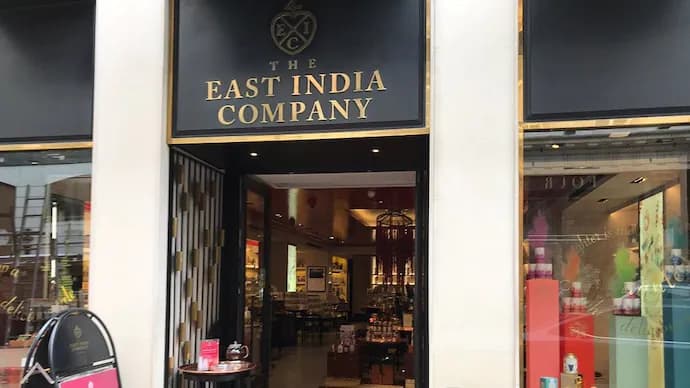
The name that once commanded armies, levied taxes and reshaped continents has fallen silent again. The East India Company — the British trading behemoth that ruled vast swathes of India before the Crown took over — has shut down for a second time, this time as a luxury retailer in London.
Revived in 2010 by Indian entrepreneur Sanjiv Mehta, the company attempted an unlikely reinvention as a Mayfair-based purveyor of premium teas, chocolates and fine foods. But the modern avatar has entered creditors’ voluntary liquidation, burdened by debts exceeding £950,000 (over ₹10 crore).

According to The Sunday Times, liquidators were appointed in October 2025. The company owed more than £600,000 (around ₹6.3 crore) to its parent group registered in the British Virgin Islands, £193,789 (₹2.03 crore) in taxes, and £163,105 (₹1.71 crore) to employees. Several associated firms carrying the “East India” name have also been dissolved. Its website is offline, and its former store at 97 New Bond Street in London’s Mayfair now stands empty, reportedly available for rent.
From empire to empire-branded indulgence
The original East India Company had ceased operations nearly 152 years ago. Founded on December 31, 1600, under a royal charter from Elizabeth I, it began as a joint-stock enterprise chasing spices and trade routes in Asia. Over two centuries, it transformed into something far more formidable — a corporate sovereign that minted money, administered justice and commanded a private army of nearly 250,000 men, at one point twice the size of the British Army.
Its expansion accelerated after the Battle of Plassey in 1757, giving it control over Bengal and paving the way for territorial rule. By the early 1800s, it was driving global trade in cotton, silk, indigo and tea, accounting for a staggering share of the world’s commerce in key commodities.
But its rise came at devastating human cost. Aggressive revenue policies, forced cultivation of cash crops and extractive trade practices deepened poverty and worsened famines. The 1857 uprising — variously called the Indian Rebellion or Sepoy Mutiny — ended the company’s rule. In 1858, the British Crown assumed direct control, marking the beginning of the British Raj. The company was formally dissolved in 1874.
For many, its legacy remains synonymous with exploitation, violence and the economic hollowing of India.
The symbolism of a reversal
When Mehta acquired the rights to the East India Company name in the early 2000s, the move was framed as poetic reversal. A corporation that once ruled India was now owned by an Indian. Headlines celebrated it as symbolic reclamation.
In a 2017 interview with The Guardian, Mehta described the reinvention as an attempt to transform a legacy of aggression into one of compassion. The brand positioned itself alongside heritage retailers such as Fortnum & Mason, offering curated luxury goods from a plush 2,000 sq ft store in Mayfair.
Yet the weight of history proved heavier than branding. The commercial gamble faltered, and the revived enterprise now joins its predecessor in closure.
The end of a strange afterlife
Few companies in history have journeyed from trade to empire, from empire to infamy, and from infamy to boutique luxury. The East India Company’s second collapse closes a curious chapter in that arc.
Its first incarnation altered the destinies of nations. Its second sought to rewrite memory through merchandise. Both have now ended — leaving behind a name that once built an empire and a reminder that history cannot always be repackaged for the marketplace.