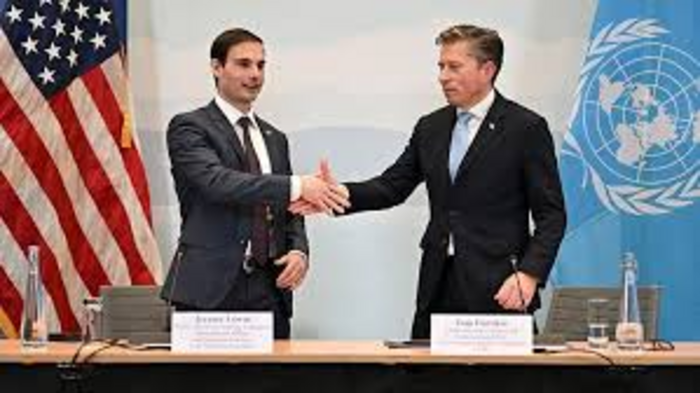
The United States has announced a pledge of $2 billion in humanitarian assistance to the United Nations at a time when the global aid system is facing one of its most severe funding crises in recent years. The commitment comes against the backdrop of sharp reductions in overall U.S. foreign aid allocations in 2025, which had significantly constrained the operational capacity of international humanitarian agencies. While the pledge offers partial relief, it also underscores deeper structural challenges in global humanitarian financing.
In recent years, U.S. contributions to multilateral aid mechanisms have declined due to domestic budgetary pressures and shifting strategic priorities, including increased defence and security spending. These reductions contributed to widening funding gaps across UN-led humanitarian programmes, affecting critical services for refugees, internally displaced persons, and communities impacted by conflict, food insecurity, and climate-related disasters. The UN’s humanitarian appeal for 2026 seeks $23 billion to assist more than 87 million vulnerable people worldwide, a target that remains uncertain amid uneven donor commitments.

The $2 billion pledge signals Washington’s intent to remain a central actor in global humanitarian efforts, even as it recalibrates its foreign policy approach. For key UN agencies such as the UN High Commissioner for Refugees (UNHCR) and the Office for the Coordination of Humanitarian Affairs (OCHA), the funding is expected to support emergency relief operations, protection services, and coordination mechanisms in crisis-hit regions including parts of Africa, the Middle East, and Asia. However, humanitarian officials caution that the scale of current global needs far exceeds available resources.
Beyond immediate relief, the development highlights evolving dynamics in global governance and burden-sharing. Traditional donors are increasingly selective in their funding, while emerging donors and private actors are being encouraged to play a larger role. The U.S. pledge may help stabilize short-term operations, but it also reflects the growing uncertainty surrounding predictable, long-term humanitarian financing.
Overall, the announcement illustrates both the continued importance of U.S. leadership in humanitarian assistance and the fragility of the international aid system, which is struggling to keep pace with the rising frequency and complexity of global crises.