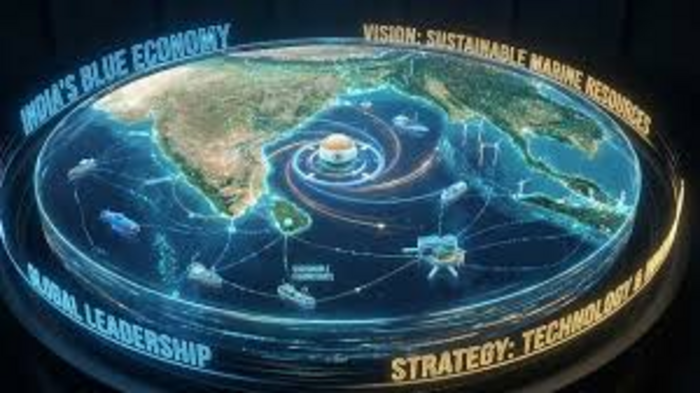
The Union Cabinet on Tuesday approved the National Blue Economy Policy 2026, marking a significant step towards harnessing India’s vast ocean and coastal resources for economic growth while ensuring long-term environmental sustainability. The policy provides a comprehensive framework for the sustainable development of marine sectors and aims to balance economic aspirations with ecological responsibility.
India, with a coastline of over 7,500 kilometres and a large Exclusive Economic Zone (EEZ), possesses immense untapped potential in ocean-based industries. The new policy focuses on key sectors such as fisheries and aquaculture, offshore renewable energy, coastal and marine tourism, marine biotechnology, and port-led development. It seeks to improve productivity, attract investments, generate employment, and enhance livelihoods, particularly for coastal communities and traditional fisherfolk.

A major emphasis of the policy is on sustainable fisheries management, value-chain development, and modernisation of infrastructure. In the energy sector, the policy promotes offshore wind, tidal and wave energy as part of India’s clean energy transition. Coastal tourism is expected to be developed in an environmentally responsible manner, ensuring protection of fragile marine ecosystems.
The policy also underlines the importance of marine research, innovation and data-driven governance, encouraging the use of advanced technologies for ocean mapping, biodiversity conservation and climate resilience. It envisages better coordination between central ministries, state governments and coastal institutions to ensure effective implementation.
Internationally, the National Blue Economy Policy 2026 aligns with India’s commitments under the United Nations Convention on the Law of the Sea (UNCLOS) and supports the objectives of Sustainable Development Goal 14 (Life Below Water). By integrating economic development with environmental protection, the policy strengthens India’s position as a responsible maritime nation.
Experts note that successful implementation will depend on strong regulatory frameworks, community participation and robust environmental safeguards. If executed effectively, the policy has the potential to transform India’s maritime economy while preserving ocean health for future generations.