UPI Charges Explained: What Changes for Payments Above ₹2,000?
A new government notification protects UPI payments up to ₹2,000 from charges, but larger merchant transactions could face a future MDR under a new framework.
Prabhav Anand15 September 2026 06:52
India's most-used digital payment system has entered a new phase, and the change has triggered a simple but important question among users: Will UPI payments above ₹2,000 now attract a charge?
The short answer is no—not automatically, and not for ordinary consumers at present.
The confusion follows a change in the legal framework governing digital payments. The government has now formally specified that banks and payment system providers cannot impose direct or indirect charges on UPI transactions up to ₹2,000. At the same time, the government has repeatedly said that consumers will not be charged for making UPI payments and that person-to-person, or P2P, transactions will remain free.
What has changed, therefore, is less about an immediate UPI transaction fee and more about creating the legal framework through which a Merchant Discount Rate (MDR) could eventually be imposed on a limited category of higher-value merchant transactions.
That distinction is crucial.
What is the new UPI ₹2,000 rule?
The latest notification under the Payment and Settlement Systems Act, 2007 states that banks and system providers cannot impose charges, directly or indirectly, on UPI transactions of up to ₹2,000. The same protection covers payments made using RuPay debit cards.
This means that the ₹2,000 figure should not be interpreted as a new UPI spending limit.
It is also not a rule saying that every UPI payment above ₹2,000 will now be charged.
Instead, the notification establishes a clear statutory protection for transactions up to that amount while leaving room for the government and the payments ecosystem to frame rules for certain higher-value transactions.
Reuters reported on September 14 that the legislative change "paves the way" for charges on larger UPI payments, but also noted that a final decision on whether charges will actually be introduced, and how they would be levied, has not yet been taken.
So, will you be charged for a ₹5,000 UPI payment?
Not simply because it is ₹5,000.
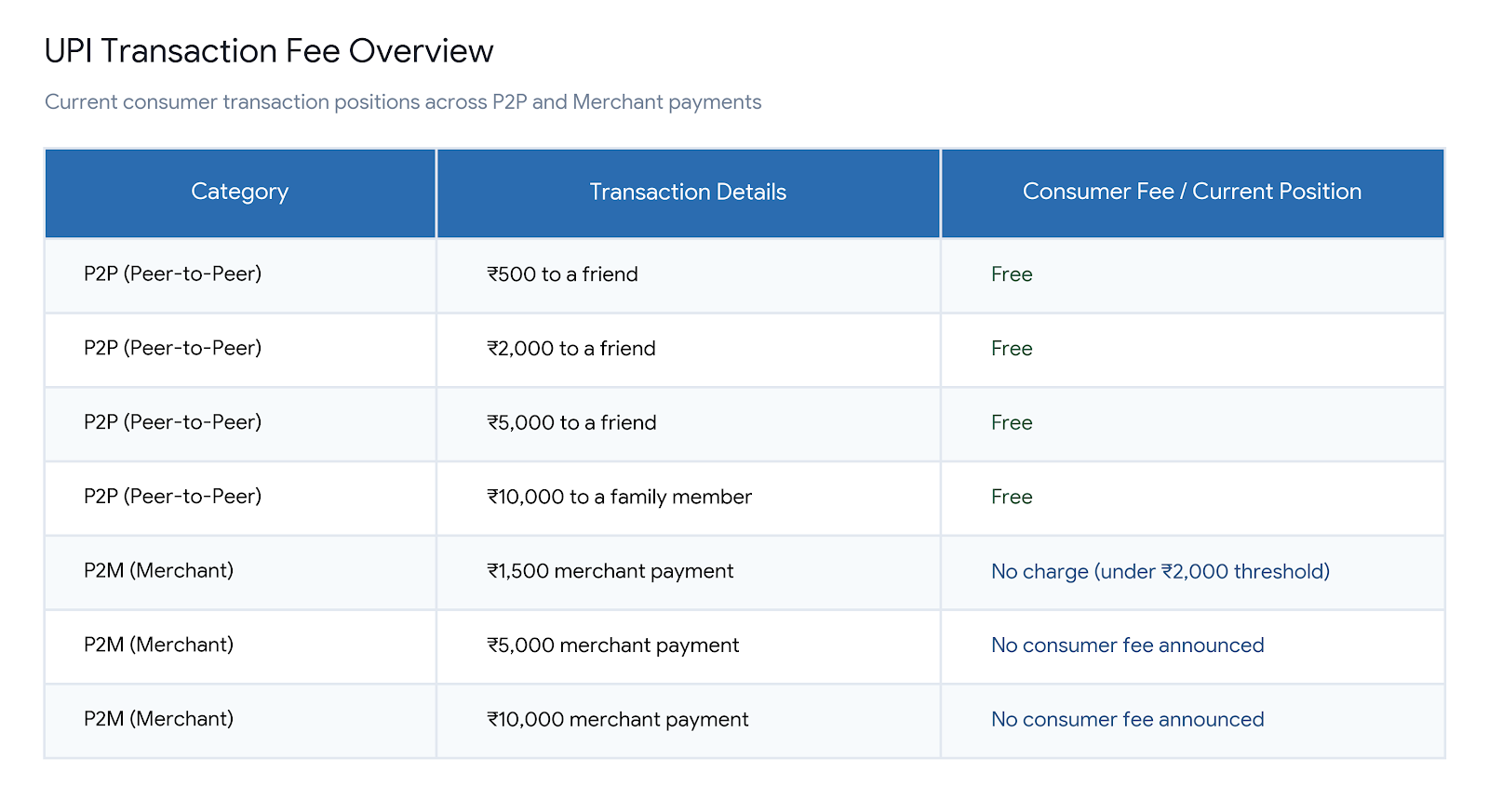
If you transfer ₹5,000 from your bank account to another person's bank account through UPI, it remains a person-to-person transaction, and the government has explicitly said such payments will remain free.
Similarly, there is currently no government-announced consumer transaction fee that automatically applies when someone pays ₹5,000, ₹10,000 or ₹20,000 to a merchant through a normal bank-account-linked UPI transaction.
The Economic Times, citing the government's latest clarification, reported that consumers will not face a transaction fee merely because a UPI payment crosses ₹2,000.
A simple example
The important distinction is who is making the payment, where the money is going and how the transaction is processed—not simply whether the amount is above ₹2,000.
What exactly is MDR?
The term at the centre of the UPI charges debate is MDR, or Merchant Discount Rate.
MDR is a fee associated with processing a digital payment. In a traditional card-payment ecosystem, the merchant pays an MDR to participating financial institutions and payment networks.
The current UPI debate is about whether a similar mechanism should be introduced for certain higher-value merchant payments.
The government has said that, if MDR is introduced, it would apply only to a limited set of merchant transactions above a specified threshold and would be nominal, substantially lower than typical debit- or credit-card MDRs.
This is why describing a possible MDR as a "UPI charge on customers" can be misleading.
The government has specifically maintained that consumers making UPI payments will not face transaction charges.
Why is the government considering MDR on UPI?
The issue is largely about the economics of maintaining India's enormous digital-payment infrastructure.
UPI requires banks, payment companies and technology providers to continuously invest in:
payment infrastructure;
cybersecurity;
fraud prevention;
transaction processing;
system availability;
technology upgrades;
customer support; and
expansion into rural and semi-urban markets.
The Ministry of Finance said the amendment is intended to support UPI's long-term sustainability, technological advancement and resilience against emerging risks. It also argued that relying entirely on subsidies would not be sufficient to support the next phase of UPI's growth.
The scale of the system explains why the issue has become important.
According to the government, UPI processed 2,366 crore transactions worth ₹29.9 lakh crore in July 2026 alone.
NPCI data cited by The Economic Times showed UPI processed about 2,450.9 crore transactions worth nearly ₹29.82 lakh crore in August 2026, with 752 banks live on the network.
Reuters reported that UPI processed 24.51 billion transactions worth ₹29.82 trillion in August 2026.
At that scale, even a very small fee on a carefully selected segment of transactions could create a substantial revenue pool for the payments ecosystem.
What did the government say about UPI charges?
The Ministry of Finance, through a Press Information Bureau release dated August 8, 2026, made several points clear.
The government said:
consumers making UPI payments will not face transaction charges;
all P2P transactions will remain free;
any future MDR would apply only to a limited set of merchant transactions above a threshold;
the MDR, if introduced, would be nominal;
the vast majority of merchant transactions would remain free; and
the proposed amendment was intended as an enabling provision rather than an immediate blanket charge on UPI users.
The government also said that, after the relevant legislative process, the UPI and Services Steering Committee headed by NPCI would decide on MDR, if any.
The Finance Ministry's position has subsequently been reflected in government publications. New India Samachar reported that UPI would remain free for consumers and P2P transactions and that MDR, if applied, would concern only a limited set of merchant transactions above a threshold.
What did the RBI Governor say?
The Reserve Bank of India has also acknowledged the underlying economic question.
RBI Governor Sanjay Malhotra, when asked about possible charges on UPI, said it was premature to discuss the final structure because the government was still working through the amendment.
He also pointed to the basic economics of payment infrastructure, saying that the costs ultimately have to be borne by someone and that the objective should be to strengthen the public payment infrastructure.
That does not amount to an announcement of a UPI fee.
Rather, it highlights the central policy question: how should the infrastructure behind a largely free payment system be funded as transaction volumes continue to expand?
What about merchants?
This is where the impact could eventually be greater.
The government has indicated that a future MDR would be merchant-facing rather than a blanket consumer transaction charge.
Reuters reported in August that policymakers were considering an MDR of around 0.3% to 0.5% for certain transactions above ₹2,000 involving merchants with annual turnover above ₹1.5 crore. However, that was reported as a proposal under consideration—not a final MDR rate.
The report also noted that transactions above ₹2,000 represented only around 4% of merchant-payment volumes but about 67% of transaction value, according to a Jefferies estimate.
That helps explain why policymakers could focus on larger merchant payments rather than introducing a blanket fee across the UPI network.
However, the proposed 0.3%-0.5% range should not be presented as the current UPI charge. It was a reported proposal, and the final structure remains subject to the regulatory framework.
What about the existing 1.1% UPI charge?
This is another major source of confusion.
A 1.1% interchange fee already exists in a specific part of the UPI ecosystem.
In 2023, NPCI introduced an interchange fee of up to 1.1% for certain merchant transactions above ₹2,000 made through Prepaid Payment Instruments (PPIs), such as wallets. NPCI clarified at the time that the interchange fee would not be charged to customers.
That is fundamentally different from saying:
"All UPI payments above ₹2,000 attract a 1.1% charge."
They do not.
The 1.1% figure applies to the relevant PPI-based merchant-payment ecosystem, not ordinary bank-account-to-bank-account UPI payments.
This distinction should be retained when reporting UPI charges, because otherwise consumers could incorrectly assume that every ₹2,000-plus UPI transaction carries a 1.1% fee.
Does the new rule mean UPI payments above ₹2,000 are no longer free?
Not currently.
There are two separate things to understand.
1. Legal protection
The September notification explicitly protects UPI transactions up to ₹2,000 from direct and indirect charges.
2. Government policy assurance
The government has separately stated that consumers will not face transaction charges for UPI payments and that P2P payments will remain free.
Therefore, the new notification should not be interpreted as an announcement that consumers must now pay for every UPI payment above ₹2,000.
Reuters also reported that no final decision had been taken on whether charges would actually be imposed on larger UPI payments or what form such charges would take.
Why did the ₹2,000 figure become so important?
The threshold is important because policymakers are trying to create a way of distinguishing between everyday digital payments and larger-value commercial transactions.
A blanket MDR could affect millions of small merchants and potentially discourage digital payments.
A threshold-based system, by contrast, could theoretically target higher-value transactions while protecting small merchants and everyday users.
The government's August statement specifically said the vast majority of merchant transactions would remain free and that any future MDR would not be imposed across the board.
This is also why the government has repeatedly stressed that the change is about sustainability, not about taxing ordinary UPI users.
Is there a GST or tax on UPI payments above ₹2,000?
No new GST or tax has been announced simply because a UPI payment crosses ₹2,000.
The Economic Times reported that the government had rejected claims of a GST being imposed on UPI transactions above ₹2,000. GST may, where applicable, be associated with a taxable service or charge such as MDR, but that is different from imposing GST directly on the consumer's UPI payment amount.
So a ₹5,000 UPI payment does not become a ₹5,000-plus-GST payment simply because it crossed the ₹2,000 threshold.
Will Google Pay, PhonePe or Paytm charge users?
There is currently no blanket government rule requiring Google Pay, PhonePe, Paytm or other UPI apps to charge users merely because a transaction exceeds ₹2,000.
The underlying UPI infrastructure is operated by NPCI, while banks and payment apps participate in the ecosystem.
If a future MDR framework is implemented, its exact treatment would depend on the rules eventually approved and the category of transaction involved.
The government's present position is that consumers should not face transaction charges and that P2P payments will remain free.
What does this mean for ordinary UPI users?
For most people, very little changes immediately.
If you use UPI to:
send ₹500 to a friend;
transfer ₹5,000 to your parents;
pay ₹10,000 to a family member;
split a restaurant bill;
repay a friend;
make ordinary bank-to-bank transfers;
there is currently no new consumer UPI transaction fee simply because the payment is above ₹2,000.
The potential change matters more to the merchant side of the ecosystem, particularly if a future MDR is introduced for selected higher-value merchant transactions.
What does this mean for small shopkeepers?
The government has repeatedly indicated that it does not intend to impose MDR universally on merchants.
Its August clarification said the vast majority of merchant transactions would remain free, with any future MDR limited to a selected category above a threshold.
Government publications have also stated that small merchants and kirana stores are not intended to bear a blanket MDR under the proposed framework.
That distinction will be important because UPI's success has been driven not only by large retailers but also by India's enormous network of small businesses, street vendors, local stores and service providers.
Why is the government changing the framework now?
UPI has grown far beyond its original role as a convenient mobile-payment system.
It now functions as critical national digital infrastructure.
The government says the ecosystem needs continued spending on cybersecurity, fraud prevention, infrastructure and technological development. At the same time, payment companies and banks need a sustainable economic model if the system is to expand further.
Reuters reported that industry executives have argued that the absence of fees makes it harder for payment firms to generate revenue from UPI despite the enormous transaction volumes passing through the system.
The policy challenge, therefore, is to find a balance between keeping UPI affordable and making the ecosystem financially sustainable.
UPI charges: What changes and what doesn't?
The bottom line
The headline "UPI charges above ₹2,000" needs to be handled carefully.
The latest rule does not mean that every person paying ₹2,001, ₹5,000 or ₹10,000 through UPI will suddenly see a fee deducted from their bank account.
What has happened is that the government has created a legal framework under which certain higher-value merchant transactions could eventually be subjected to MDR, while explicitly protecting UPI transactions up to ₹2,000 from charges.
More importantly, the government has repeatedly said that UPI will remain free for consumers and P2P transfers.
The exact question now is not "Will UPI become chargeable above ₹2,000?"
It is:
Which merchants and transactions, if any, will eventually fall under a future MDR framework—and who will ultimately bear that cost?
Until that framework is formally notified, consumers should not treat ₹2,000 as a new "free UPI limit".