


Seven Gujarati-origin victims this year expose the dark side of the motel business they dominate, where cash-rich operations meet crime, isolation, and rising hostility.
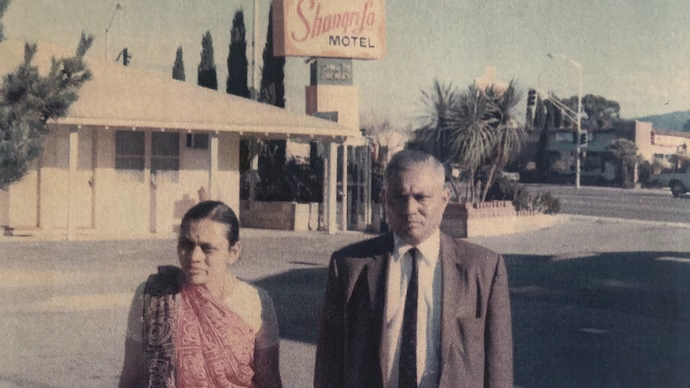
The Patel community of Gujarat has built one of the most remarkable immigrant success stories in US. Controlling more than 60% of the United States’ motels, Gujaratis transformed small, highway-side lodgings into a $52-billion industry. But behind this prosperity lies a dangerous undercurrent — one that has cost seven Gujarati lives in the past year alone.
The latest tragedy struck Allegheny County, Pennsylvania, where Rakesh Patel, 50, a Surat native and motel manager, was shot point-blank in the head. Days earlier, Anil Patel and Pankaj Patel were gunned down at a North Carolina motel. These killings follow earlier incidents in South Carolina and Texas, where Gujarati owners became victims of robberies gone wrong.

For decades, motels and gas stations often located along desolate highways or in crime-ridden neighborhoods have been “magnets for crime,” as a USA Today investigation revealed. Robberies, drug overdoses, trafficking, and violent disputes have repeatedly turned these businesses into hotspots for police intervention.
Gujarati families, who traditionally live on-site to cut costs, often find themselves at the frontline of these dangers. Security lapses, such as faulty locks, missing cameras, and chronic understaffing, further expose owners and workers to risks. In many cases, the very desk where guests check in doubles as the family’s living room.
The Patel grip on the motel industry dates back to the 1960s, when early migrants pooled resources, bought distressed properties, and ran them with family labor. By the 1990s, their presence was so dominant that the New York Times dubbed it a “Patel Motel Cartel.”
Off late, groups like the Asian American Hotel Owners Association, largely Gujarati-run, represent 20,000 members owning more than 33,000 properties. It is a success story built on grit, sacrifice, and reinvestment — but one that has also made Gujaratis highly visible and vulnerable.
While the concentration of wealth in the hands of a single community is celebrated within Indian circles, it has also drawn resentment. Community leaders point to rising anti-immigrant sentiment in smaller towns, with Gujaratis often stereotyped as outsiders profiting off local economies.
This year’s string of killings underscores a harsh reality: for Gujaratis, US’s roadside empire is not just a path to prosperity — it is also a frontline where survival is at stake.

Bihar’s classrooms go digital: 11 IT companies to train teachers in AI and technology
University of Liverpool’s Bengaluru campus eyes biosciences, competitive fees to attract students

Mubadala, Khalifa University launch life sciences research programme in UAE

Birla Open Minds, Burlington English Join Hands to Introduce Digital English Learning for Grades 1–8

Australian universities back student-feedback benchmark for education agents

Centre Amends Motor Vehicle Rules to Allow E100 Ethanol Fuel in Flex-Fuel Vehicles

Study in Malaysia for Indian Students 2026: Universities, Fees, Scholarships, Visa and Career Opportunities
Delhi BS6 Entry Ban From November 1 Could Affect Over 10 Lakh NCR Vehicles

Study in Indonesia for Indian Students 2026: Top Universities, Fees, Scholarships, Visa and Career Opportunities

Study in China 2027: Top Universities, Fees, Scholarships, Visas and Career Options for Indian Students

Bihar’s classrooms go digital: 11 IT companies to train teachers in AI and technology
University of Liverpool’s Bengaluru campus eyes biosciences, competitive fees to attract students
Mubadala, Khalifa University launch life sciences research programme in UAE
Birla Open Minds, Burlington English Join Hands to Introduce Digital English Learning for Grades 1–8
Australian universities back student-feedback benchmark for education agents
Centre Amends Motor Vehicle Rules to Allow E100 Ethanol Fuel in Flex-Fuel Vehicles
Study in Malaysia for Indian Students 2026: Universities, Fees, Scholarships, Visa and Career Opportunities
Delhi BS6 Entry Ban From November 1 Could Affect Over 10 Lakh NCR Vehicles
Study in Indonesia for Indian Students 2026: Top Universities, Fees, Scholarships, Visa and Career Opportunities
Study in China 2027: Top Universities, Fees, Scholarships, Visas and Career Options for Indian Students
Copyright© educationpost.in 2026 All Rights Reserved.