


New admission rules at two state-run universities limit women’s access to most defence and security programmes, prompting criticism from Human Rights Watch. Syria’s Higher Education Ministry says the restrictions apply only to specific courses linked to the requirements of military and security services.
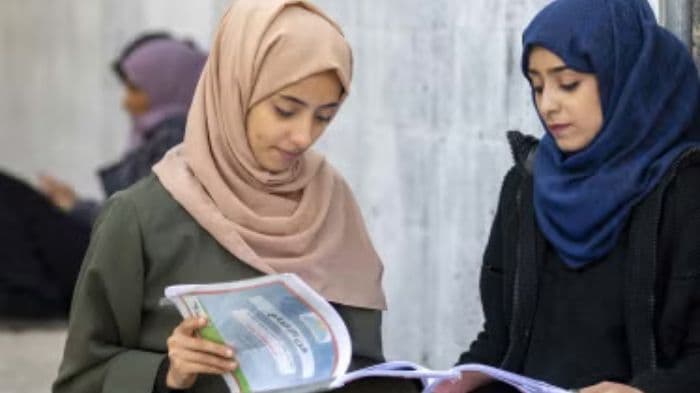
Syria has introduced gender-based admission restrictions at two newly established state universities specialising in defence and security studies, limiting women’s access to most programmes linked to military and internal security careers.
The rules, announced by the Ministry of Higher Education and Scientific Research on Sep 30, reserve several courses at the National University of Defence Sciences for men. At the Syrian University for Security Sciences, women can apply only for cybersecurity programmes, according to Human Rights Watch (HRW).

The restrictions drew criticism from the rights organisation, which said they could prevent women from entering several professional roles within the military and security services. Applications for the programmes closed on October 19.
Which courses are restricted?
At the National University of Defence Sciences, admission to the land, naval and air force military colleges is restricted to men. The university’s College of Humanities and Administrative Sciences, which offers programmes including law, economics and management, and social sciences, also admits men only.
The university’s Higher Institute for Applied Sciences and Technology is open to women. However, unlike the military colleges, it does not require graduates to serve in the armed forces.
At the Syrian University for Security Sciences, the College of Security Sciences and the Technical Institute of Security Sciences admit men only. Women can apply to the cybersecurity programmes.
The distinction is significant because graduates of the security university are required to serve in the Internal Security Forces or another relevant authority. The service commitment is 20 years for college graduates and 10 years for institute graduates, HRW reported.
Women can still study subjects such as law, economics and social sciences at other public and private universities in Syria. The restrictions therefore apply to specific institutions and professional training routes, rather than amounting to a nationwide ban on women studying these subjects.
Human Rights Watch criticises admission rules
HRW said the restrictions discriminate against women and conflict with Syria’s international obligations. It argued that excluding women from defence and security programmes limits their access to careers in the army and state institutions.
Hiba Zayadin, HRW’s senior Syria adviser, said the rules prevent women from training as military officers and from studying for roles such as lawyers and administrators within the army.
The organisation also pointed to Syria’s Constitutional Declaration, signed by President Ahmed al-Sharaa on March 13, 2025. The declaration guarantees equality without gender discrimination and recognises women’s rights to education and work.
HRW urged the Ministry of Higher Education to open the programmes to women on equal terms and remove other gender-based admission restrictions.
Syrian ministry defends the restrictions
The Ministry of Higher Education defended the admission framework in a statement reported by the Syrian Arab News Agency (SANA) on Oct 20.
Nour Habboub, the ministry’s director of student affairs, said the general university admission process for the 2026–27 academic year had not changed and that programmes across public and private universities remained open to men and women without discrimination, except for specified defence and security courses.
She said the restrictions reflected the nature of the work for which graduates were being trained and the requirements of the relevant authorities. According to Habboub, the defence programmes had historically been reserved for men because they prepare officers and non-commissioned officers for service in the Syrian army.
The ministry also said women had other opportunities within the defence and interior ministries, including police-related training. A separate Women’s Police Institute graduated its first batch in September 2026.
Habboub said the subjects restricted at the two universities were available to women at other institutions and described the inclusion of the new universities in the national admissions process as a measure to improve transparency.
What the restrictions mean for women’s participation
The admission rules come as Syria reorganises its military and security institutions following the change of government in December 2024. Access to specialised education at these universities is directly connected to recruitment and professional opportunities in those institutions.
The debate also raises questions about how the transitional authorities will apply their stated commitments to equality and women’s participation in public life.
While the government says the restrictions are based on the nature of specific jobs, HRW argues that excluding women from these programmes limits their access to important public-sector careers.
The disagreement centres on whether the requirements of military and security services justify gender-specific admission criteria, and how those criteria align with Syria’s constitutional and international commitments on equal rights.
UAE makes schoolchildren priority for free flu vaccines across emirates
Syria restricts women’s entry to defence, security university courses under new admission rules

Russia plans to expand university presence in Africa, offers study grants
African languages remain marginalised in education despite push for equity, UNESCO think piece argues

MIT develops snake-inspired soft robot to help diagnose small intestine disorders
UAE makes schoolchildren priority for free flu vaccines across emirates

NTU Singapore, VFT launch joint research lab to develop safer batteries for renewable energy storage

ULLAS 2026: Will B.Ed. Students' Academic Credits Depend on Adults Passing Literacy Tests?

Earth’s life story may not have begun with comets, new study finds

Can India's Biggest Examinations Become Leak-Proof?

UAE makes schoolchildren priority for free flu vaccines across emirates
Syria restricts women’s entry to defence, security university courses under new admission rules
Russia plans to expand university presence in Africa, offers study grants
African languages remain marginalised in education despite push for equity, UNESCO think piece argues
MIT develops snake-inspired soft robot to help diagnose small intestine disorders
UAE makes schoolchildren priority for free flu vaccines across emirates
NTU Singapore, VFT launch joint research lab to develop safer batteries for renewable energy storage
ULLAS 2026: Will B.Ed. Students' Academic Credits Depend on Adults Passing Literacy Tests?
Earth’s life story may not have begun with comets, new study finds
Can India's Biggest Examinations Become Leak-Proof?
Copyright© educationpost.in 2026 All Rights Reserved.