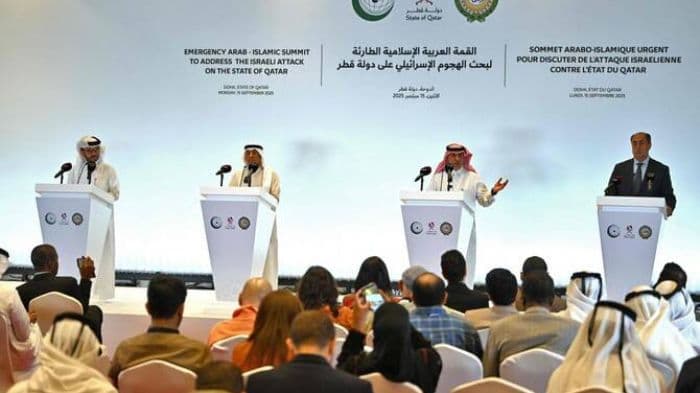
At an emergency Arab-Islamic summit in Doha on Sep 15, leaders from Gulf Cooperation Council (GCC) countries pledged to activate a joint defence mechanism in response to Israel’s recent attack on Qatari territory. The summit, however, delivered few concrete actions beyond its declaration.
Qatari Emir Sheikh Tamim bin Hamad Al Thani condemned the bombing, describing it as “blatant, treacherous, and cowardly,” accusing Israel of targeting the families of Hamas leaders and their negotiating delegation. He argued that the strike undermined ongoing ceasefire negotiations.

The GCC — comprising Bahrain, Kuwait, Oman, Qatar, Saudi Arabia, and the United Arab Emirates — said consultations are underway among their military bodies to build up “Gulf deterrent capabilities,” and announced a forthcoming meeting of the Unified Military Command in Doha to discuss joint security measures. But no detailed operational framework was provided.
Foreign Ministry spokesman Majed Mohammed Al-Ansari stated that the joint statement defines an attack on one GCC member as an attack on all. However, specifics such as deployment, funding, or command structures were not disclosed.
The summit also saw strong diplomatic responses from other Arab and Islamic nations. Turkish President Recep Tayyip Erdogan called for economic pressure on Israel, while Egyptian President Abdel Fattah el-Sisi warned that Israel’s actions risk eroding regional peace.
Pakistan urged that the United Nations suspend Israel and proposed establishing an Arab-Islamic task force.
Despite these calls, the final communique largely consisted of solidarity statements and condemnation of the attack, without any binding resolutions or measures announced.