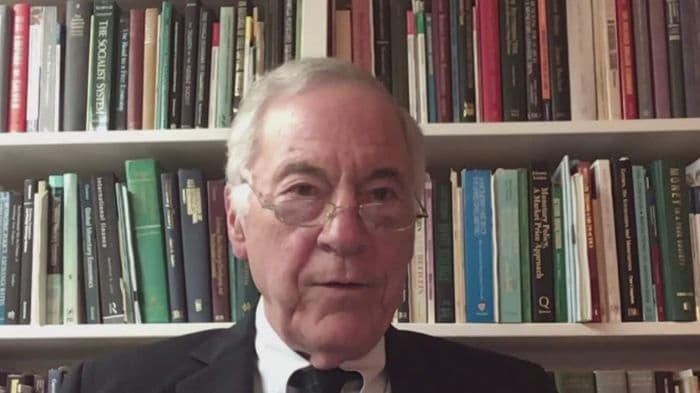
A noted economist from Johns Hopkins University, Lawrence H “Steve” Hanke, has advised India to stay resilient in the face of rising US tariffs, characterizing the Trump administration’s policy as inherently unstable.
Speaking to NDTV, Hanke said, “The economics is just all wrong. Trump’s tariff economics is absolutely rubbish.” He cautioned that the aggressive use of tariffs, including the recent hike on Indian goods from 25% to 50%, places pressure on shaky economic ground.

Hanke argued that it mirrors the warning of Napoleon: let the enemy destroy themselves. In this scenario, he believes Trump’s maneuver is “a house of cards that will fall.”
As such, he urged India’s leaders — Prime Minister Modi and Foreign Minister S Jaishankar — to “keep their cards close to the chest and wait” rather than respond quickly or reciprocate.
Hanke also highlighted structural weaknesses in the US economy. He pointed out the persistent and significant trade deficit, noting that US consumption has grown larger than the gross national product — a risky foundation for imposing sweeping tariffs.
The comment comes at a time when India has denounced the US policy as “unfair, unjustified and unreasonable,” particularly targeting sectors like textiles, leather, and marine exports.
In line with the heightened tensions, US-India trade talks have been suspended, with Trump declaring no trade negotiations will resume until tariff disputes are resolved.
Meanwhile, the economic fallout in India is visible. The rupee has experienced its worst decline in six months, falling steadily under pressure from tariff-related market fears.
The Reserve Bank of India has repeatedly intervened in currency markets, causing more than $9 billion to be drawn from foreign exchange reserves.
Despite mounting pressure, global financial institutions remain cautious. Morgan Stanley has warned that continued implementation of the 50% tariff could shave off up to 0.8% points from India’s GDP growth if prolonged.