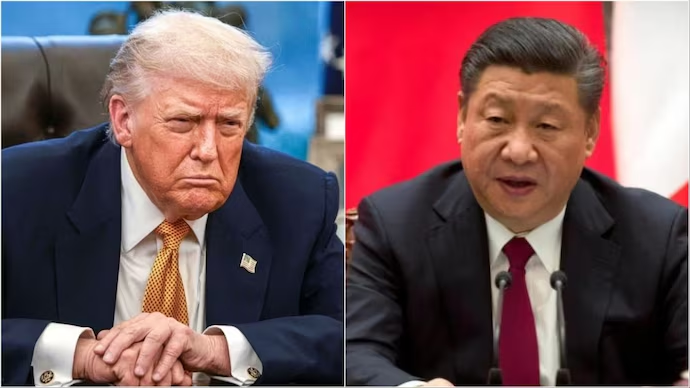
China has issued a sharp warning to the United States against enforcing a blockade in the Strait of Hormuz, signaling rising geopolitical tensions as Washington moved ahead with naval restrictions targeting Iranian ports.
Chinese Defense Minister Admiral Dong Jun cautioned the US not to interfere in Beijing’s bilateral relations with Iran, underscoring China’s strategic and economic stakes in the region. His remarks came as the US naval blockade formally began at 7:30 pm IST on April 13.

“We have trade and energy agreements with Iran; we expect others not to interfere in our affairs,” Jun said, adding that the Strait of Hormuz remains open for China.
The warning reflects the waterway’s critical importance for Beijing. Nearly 40% of China’s oil imports and at least 30% of its LNG supplies pass through the narrow Gulf chokepoint, making uninterrupted access a top priority. Analysts say this dependence has pushed China to advocate a ceasefire to stabilize the region and secure energy flows.
Some experts suggest the US blockade could also be aimed at curbing the use of the Chinese yuan in maritime trade through the strait—seen as a challenge to the long-standing petrodollar system and a potential route to bypass US sanctions.
China backs ceasefire push
China’s Foreign Ministry reiterated its call for de-escalation, emphasizing that the “safety, stability and unimpeded passage” of the Strait serves global interests.
“The root cause of disruptions to navigation through the strait lies in the conflict involving Iran, and the way to resolve this issue is to achieve a ceasefire and end hostilities as soon as possible,” spokesperson Guo Jiakun said.
He added that China is willing to play a “constructive role” in ending the Middle East conflict, where it continues to compete with the US for influence.
US enforces naval blockade
The escalation follows the collapse of high-stakes US-Iran talks on April 11, after which US President Donald Trump announced a naval blockade restricting maritime access to Iranian ports via the Strait of Hormuz.
The US Central Command (Centcom) said the blockade would apply to all vessels entering or exiting Iranian ports and would be “enforced impartially against vessels of all nations” operating in those areas.
While the US military clarified that neutral transit to non-Iranian destinations would not be blocked, it warned that vessels could be subject to inspection for contraband. Ships entering or leaving restricted zones without authorization could face interception, diversion, or seizure.
Washington-Beijing rift deepens
The Hormuz standoff highlights widening divisions between Washington and Beijing over Iran and the broader Middle East conflict.
China has consistently criticized US actions, including earlier strikes linked to the conflict. Foreign Minister Wang Yi had termed such actions unacceptable, calling out attempts at regime change.
In response, Washington has warned of “complications” if China deepens engagement with Iran in ways that undermine US interests. Trump has also threatened tariffs of up to 50% on Beijing if it supplies weapons to Tehran—an allegation China has dismissed as “groundless smears.”
As tensions intensify, China has drawn a clear red line: any disruption to its energy lifelines or strategic partnerships will face strong opposition, even as it continues to push for a ceasefire to stabilize the region.