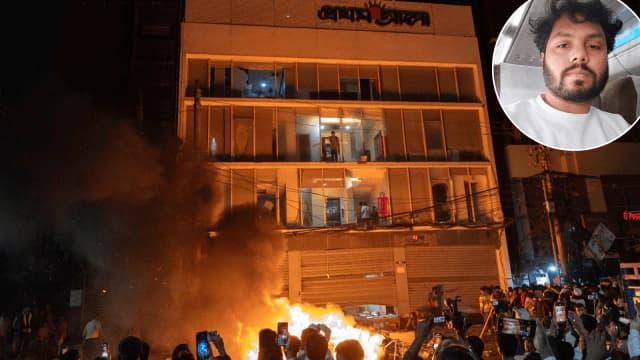
Bangladesh plunged into renewed unrest on December 19 following the death of prominent protest leader Sharif Osman Hadi, with demonstrations erupting across Dhaka, media houses set ablaze, and diplomatic and minority targets coming under attack — even as Chief Adviser Muhammad Yunus issued a strong appeal against mob violence and lawlessness during what he called a defining moment in the country’s democratic transition.
Hadi, a key face of the so-called “July Revolution” and a vocal critic of deposed Prime Minister Sheikh Hasina, succumbed to gunshot injuries, triggering widespread protests and a one-day state mourning announced by the interim government.

Anger over his killing quickly spilled onto the streets, with demonstrators blocking major intersections, including Shahbagh, and demanding justice as well as an end to the interim administration’s rule.
In a firm statement, Yunus condemned what he described as acts of intimidation, arson and destruction carried out by fringe elements. Calling on citizens to reject hatred and incitement, he underlined that the forthcoming elections and a proposed referendum were a “national pledge” rooted in the sacrifice of “Shaheed Sharif Osman Hadi.”
The government assured journalists of justice after attacks on newspaper offices and strongly denounced the lynching of a Hindu man in Mymensingh, asserting that such violence had no place in the vision of a “new Bangladesh.”
The unrest took a sharp turn overnight as at least three incidents of arson were reported in the capital. The offices of leading newspapers Prothom Alo and The Daily Star were set on fire, while the residence of former minister Mohibul Hasan Chowdhury Nowfel, who served under the Hasina government, was also torched. Separately, the Chattogram home of India’s Assistant High Commissioner to Bangladesh was attacked, raising diplomatic alarm in New Delhi.
Student organisations emerged at the forefront of the protests. Groups gathered across Dhaka, including on the Dhaka University campus, where Jatiya Chhatra Shakti organised a mourning procession that marched from Shahbagh to join a larger demonstration.
Protesters burned an effigy of Home Adviser and retired Lieutenant General Jahangir Alam Chowdhury, demanding his resignation over what they termed the failure to arrest those responsible for the attack on Hadi.
Symbolic acts of defiance also unfolded on campus. In a late-night move, students hung a banner renaming Dhaka University’s Sheikh Mujibur Rahman Hall as “Shaheed Osman Hadi Hall,” following what student leaders described as a “students’ vote.” While the act carried no official sanction, reports said a formal proposal would be raised later.
As tensions simmered in Bangladesh, concern mounted in India over growing anti-India sentiment. A parliamentary panel in New Delhi urged the Centre to work towards restoring stability in ties with Dhaka. Congress MP Shashi Tharoor said the developments were deeply worrying, cautioning against the “hostility being drummed up against Indians” and warning that India could not afford to abandon a relationship it had played a historic role in shaping since Bangladesh’s liberation in 1971.
Rajya Sabha MP and former diplomat Harsh Vardhan Shringla echoed the concern, linking the escalation to the run-up to elections expected in February 2026. He said attacks on Indian diplomatic properties and minority communities would not be tolerated, stressing that “any government that wants good relations with India must understand that promoting anti-Indian activities will invite a commensurate response.”
Former ambassador Anil Trigunayat also flagged the deteriorating security situation, saying minorities and the Indian High Commission were under attack at a time when Bangladesh stood at a critical political crossroads.
The unrest has spilled across the border as well. In Agartala, the youth wing of the Tipra Motha Party staged a protest near the Bangladesh Assistant High Commission, alleging an “anti-India campaign” by Bangladeshi leaders. Security around the mission was subsequently tightened.
With protests continuing in Dhaka and political rhetoric sharpening on both sides of the border, Bangladesh’s interim government now faces the twin challenge of restoring law and order at home while navigating a fraught regional and diplomatic landscape ahead of crucial elections next year.