


Experts are investigating the unusual floods near the China-Nepal border after seismic signals initially suggested an earthquake but later analysis pointed to a glacial collapse and debris flow.
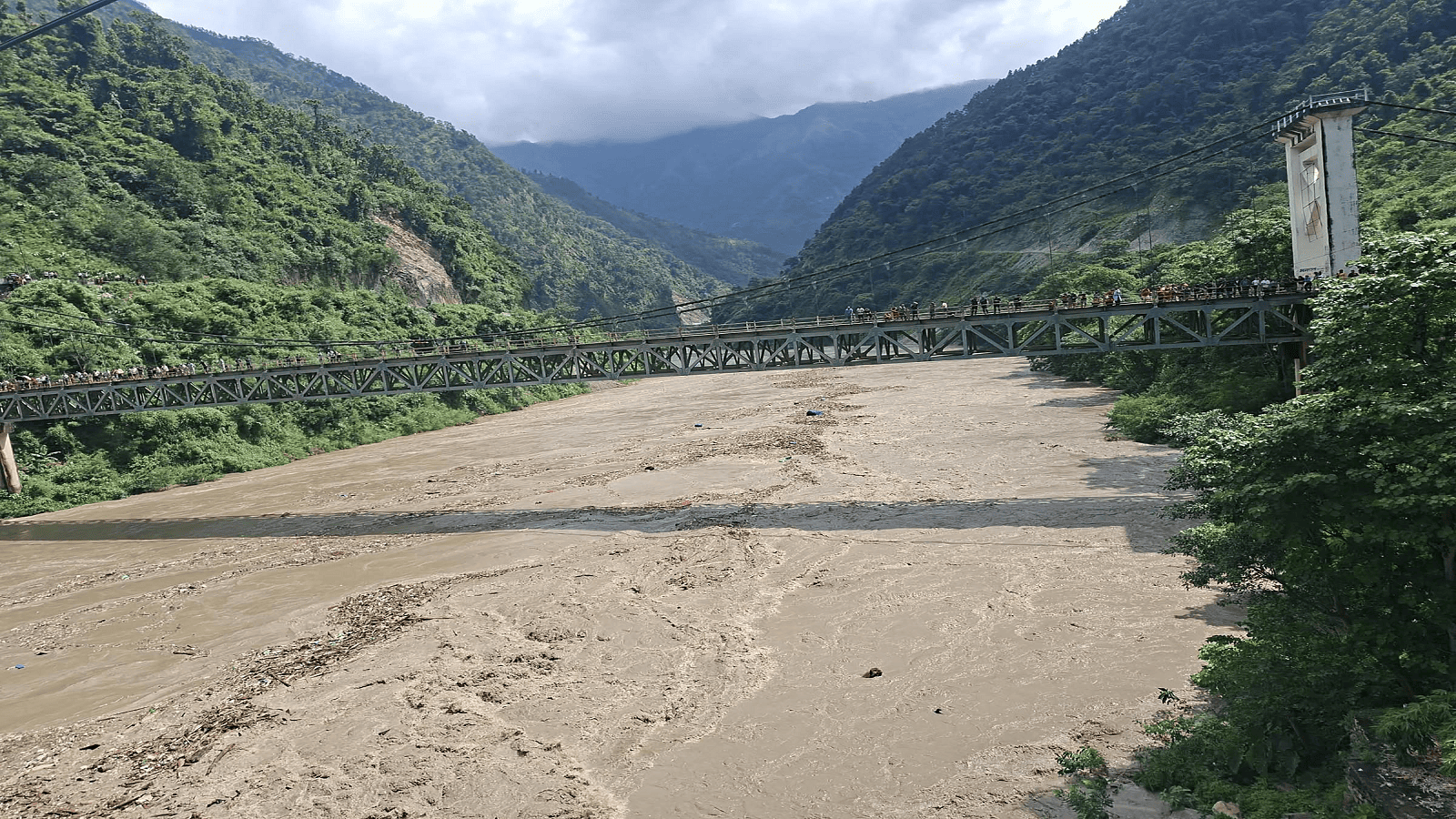
The sudden floods that struck the China-Nepal border on Wednesday have left experts grappling with both the scale of devastation and its origins, according to reports. Nepal Foreign Minister Shisir Khanal told the Parliament on Wednesday that an earthquake struck at 8.37 a.m. local time, and the flash flood was reported three minutes later, adding: "We, however, need to verify this", The Kathmandu Post reported. According to the US Geological Survey (USGS), a magnitude 4.4 earthquake struck the Tibetan territory at that time, it added. It was a plausible theory, given the region’s vulnerability to tectonic shifts.
But as more data emerged, the story began to change. The Kathmandu-based International Centre for Integrated Mountain Development (ICIMOD) reportedly examined satellite imagery and concluded that "a massive rock–ice avalanche occurred in Nepal, blocking the Lhende river and triggering cascading floods downstream". Their assessment pointed not to tectonic activity but to glacial instability, a phenomenon increasingly linked to climate change.

The USGS too issued a revised statement, stating that additional analysis of seismic waves and satellite imagery led to the determination that the seismic event was rather a glacial collapse and debris flow, and that no earthquake had occurred. These underscored the unusual nature of the disaster. The collapse of ice and rock generated seismic signals strong enough to imply an earthquake, misleading early detection systems and officials alike. Beyond the human tragedy, the scientific community has been forced to confront the troubling question: what triggered this disaster?
"It will take weeks to establish the exact causes, but a team of international scientists believes a huge chunk of glacier sheared off a mountain and fell into the valley below," a CNN report said on Thursday. "As the glacier flowed over the cliff and moved down the steep slope, deep crevasses would have formed in the ice. Warm weather in the past day or so may have melted a lot of snow and some glacier ice, with this liquid water weakening the glacier and causing the entire section flowing down the steep slope to collapse," a New Scientist article added. But it quoted experts adding it as perhaps "a part of the story and there’s something else that we can’t see yet".
According to Chinese media reports, a mudslide occurred on Wednesday morning “in Nepal”, causing severe casualties at China's border port of Gyirong in the city of Xigaze in Tibet. Interestingly, the region lies north of the Nepal border. The Chinese Embassy in Nepal reiterated with a clarification on Thursday that the "earthquake or earthquake-like glacier collapse occurred on the Nepal side" and emphasised that accusations of dam collapse were "fake news".
But studies suggest that China’s aggressive dam-building programme in Tibet and downstream regions is creating a dangerous mix of ecological fragility, geopolitical tension, and human vulnerability. The United Nations Framework Convention on Climate Change (UNFCCC) had – recalling last year’s earthquake on the Tibetan Plateau that caused massive damage to human life, ecology, and security – warned that hydrologists, environmental researchers, and geologists have expressed unease regarding China’s mega dam’s feasibility and safety.
Now, the mystery surrounding the floods arose from the uncanny way Wednesday’s disaster mimicked an earthquake. Seismologists are accustomed to distinguishing between tectonic quakes and landslide-induced tremors, yet the sheer magnitude of the glacial collapse blurred those lines. The broader implication is that Himalayan glaciers have been retreating at alarming rates, with studies showing they have lost nearly one-third of their ice in the past three decades.
According to The Kathmandu Post, the disaster has revived concerns over Nepal’s vulnerability to glacial lake outburst floods and the lack of a formal cross-border mechanism for sharing real-time information. China and Nepal had agreed to share cross-border real-time information on floods and landslides and flag potential risks of glacial lake outburst floods, it said. Unfortunately, no formal agreement has been signed to implement such a mechanism despite Khanal having raised the issue during his China visit in May. "The delay has prompted concern among stakeholders over the absence of a functioning early-warning mechanism in a disaster-prone border region," the report added.
Disclaimer: "This story has been published from a syndicated news feed. Only the headline and subtitle have been edited by EPN."
.jfif&w=256&q=75)
AI Emerges as a Research Collaborator in Biology, Opening New Possibilities for Medical Science
Karnataka High Court Upholds SOP for Pregnancy Cases Involving Minor Sexual Assault Survivors
.png&w=256&q=75)
SC Bar Association Seeks CJI’s Intervention Over Detention of Lawyers During Protest

US Midterm Elections 2026: Indian-American Voters Could Influence Key Races

Nobel Prize in Economics 2026: Robert Hall and Michael Woodford Recognised for Research on Economic Policy

UNESCO flags India’s rural education gap: 59 girls for every 100 boys
Madurai Kamaraj University seeks grants for college struggling to pay salaries amid ₹2 crore annual deficit

IISc Study Challenges Chandrasekhar Limit, Finds White Dwarfs Could Grow Far Beyond Expected Mass

Surat medical college ragging case: Two senior doctors arrested after PG student’s death

IIIT Ranchi student death: NHRC to examine allegations of administrative negligence and delayed medical aid

AI Emerges as a Research Collaborator in Biology, Opening New Possibilities for Medical Science
Karnataka High Court Upholds SOP for Pregnancy Cases Involving Minor Sexual Assault Survivors
SC Bar Association Seeks CJI’s Intervention Over Detention of Lawyers During Protest
US Midterm Elections 2026: Indian-American Voters Could Influence Key Races
Nobel Prize in Economics 2026: Robert Hall and Michael Woodford Recognised for Research on Economic Policy
UNESCO flags India’s rural education gap: 59 girls for every 100 boys
Madurai Kamaraj University seeks grants for college struggling to pay salaries amid ₹2 crore annual deficit
IISc Study Challenges Chandrasekhar Limit, Finds White Dwarfs Could Grow Far Beyond Expected Mass
Surat medical college ragging case: Two senior doctors arrested after PG student’s death
IIIT Ranchi student death: NHRC to examine allegations of administrative negligence and delayed medical aid
Copyright© educationpost.in 2026 All Rights Reserved.