


The robotic device can navigate the narrow, winding passage of the small intestine and perform imaging, tissue biopsies and drug delivery, potentially making difficult diagnostic procedures easier to carry out.
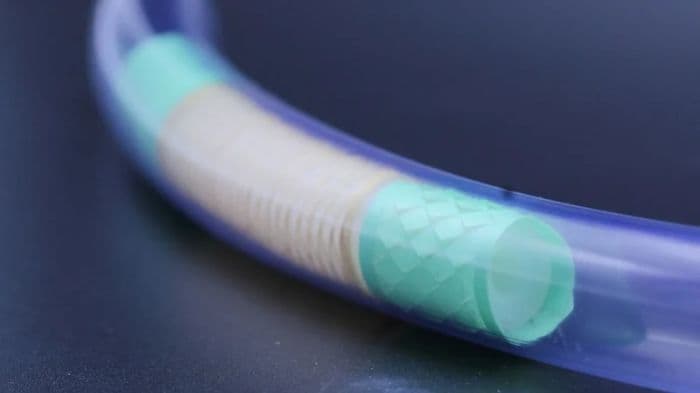
Researchers at the Massachusetts Institute of Technology (MIT) have developed a soft robotic device that could help doctors examine and treat disorders of the small intestine, an organ that is difficult to access using conventional medical instruments.
The device, called a bioinspired soft enteroscopic robot, is designed to move through the intestine using a mechanism inspired by snakes. It can carry out imaging, collect tissue samples for biopsies and deliver drugs to targeted areas, according to research published in the journal Science Robotics on Oct 28.

The technology could eventually help doctors investigate intestinal bleeding, lesions, blockages and other abnormalities. However, it remains at the preclinical research stage and has not yet been tested in humans.
How the snake-inspired robot works
The small intestine is more than 20 feet long, approximately an inch in diameter and located deep within the digestive system. Its narrow passage and slippery inner lining make it challenging for medical instruments to navigate.
The MIT team designed the robot to move through this environment by bending and extending its flexible body. Its movement is controlled by inflatable chambers that can be filled with air in different combinations, allowing the device to change direction.
The robot also has expandable sections at its front and rear that anchor it against the intestinal lining. These sections use specially patterned sleeves inspired by snake scales and kirigami, a technique involving cutting and folding materials to create three-dimensional structures.
When the sections expand, small projections emerge from the sleeves, increasing their grip on the slippery surface. The anchoring mechanism helps the robot move forward without relying on excessive stretching of the delicate intestinal tissue.
An external controller allows an operator to steer the device through narrow passages and around bends. The robot remains connected to external equipment by a cable.
Robot performs biopsies and drug delivery in animal studies
The device contains a camera for imaging, a sprayer for delivering fluids or drugs, and clips that can collect tissue samples or remove small polyps.
During animal studies, researchers demonstrated that the robot could travel approximately 6.5 feet through the small intestine. They also successfully tested its imaging, biopsy and fluid-delivery capabilities.
The researchers are now working to improve its navigation system and explore additional applications within the small intestine.
Giovanni Traverso, an MIT professor of mechanical engineering and a gastroenterologist at Brigham and Women's Hospital, is the study's senior author. The research also involved Binbin Ying, Ahmad Mujtaba Jebran and Sahab Babaee.
Could the robot improve existing intestinal examinations?
Doctors currently use a procedure called double-balloon enteroscopy to examine parts of the small intestine that are difficult to reach. The technique uses two balloons that are alternately inflated and deflated to advance an endoscope through the intestinal tract.
Although effective, the procedure can be slow and technically demanding. The MIT team aims to develop a system that could make examination of the small intestine easier to navigate and more automated.
If further research establishes its safety and effectiveness, the robotic device could eventually assist doctors in diagnosing intestinal conditions and carrying out targeted interventions during the same procedure.
However, additional engineering development and safety testing will be necessary before the technology can be evaluated in human patients.

Russia plans to expand university presence in Africa, offers study grants
MIT develops snake-inspired soft robot to help diagnose small intestine disorders

11-year-old Egyptian girl beats 40 million students in Arab Reading Challenge, wins Dh500,000

Karnataka LKG, UKG Admission 2026-27: 581 Government Schools Approved for Pre-Primary Classes

IIT Gandhinagar to Organise Amalthea 2026 on October 31 and November 1; Check Key Attractions

NTU Singapore, VFT launch joint research lab to develop safer batteries for renewable energy storage

ULLAS 2026: Will B.Ed. Students' Academic Credits Depend on Adults Passing Literacy Tests?

Earth’s life story may not have begun with comets, new study finds

Can India's Biggest Examinations Become Leak-Proof?

Less juggling for parents? Singapore to unite kindergarten learning and after-school care by 2030

Russia plans to expand university presence in Africa, offers study grants
MIT develops snake-inspired soft robot to help diagnose small intestine disorders
11-year-old Egyptian girl beats 40 million students in Arab Reading Challenge, wins Dh500,000
Karnataka LKG, UKG Admission 2026-27: 581 Government Schools Approved for Pre-Primary Classes
IIT Gandhinagar to Organise Amalthea 2026 on October 31 and November 1; Check Key Attractions
NTU Singapore, VFT launch joint research lab to develop safer batteries for renewable energy storage
ULLAS 2026: Will B.Ed. Students' Academic Credits Depend on Adults Passing Literacy Tests?
Earth’s life story may not have begun with comets, new study finds
Can India's Biggest Examinations Become Leak-Proof?
Less juggling for parents? Singapore to unite kindergarten learning and after-school care by 2030
Copyright© educationpost.in 2026 All Rights Reserved.