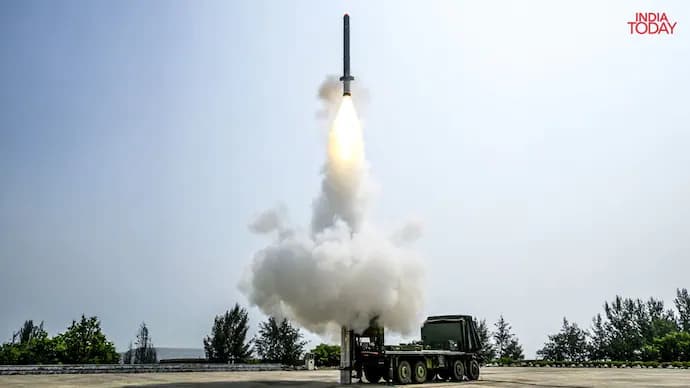
The successful test of India's indigenous Long Range Land Attack Cruise Missile (LRLACM) marks a significant step in strengthening the country's long-range precision strike capabilities. Developed by the Defense Research and Development Organization (DRDO), the missile is already drawing comparisons with the US Tomahawk cruise missile, a weapon that has been central to American military operations for decades.
The first successful flight test of the LRLACM was conducted off the Odisha coast on 16 June. According to the Defense Ministry, the missile achieved all operational and technical objectives during the trial. Although induction into the armed forces is still estimated to be around two years away, the successful test represents a major milestone in the programme's development.

India has not officially disclosed the missile's full specifications. However, defense experts estimate that the LRLACM could have a strike range of 1,000-1,500 km. Such a range would allow India to target strategic military, economic and political assets deep inside hostile territory if the missile is deployed in forward operational areas.
A key highlight of the programme is its indigenous development. The missile and its critical subsystems have been designed by multiple DRDO laboratories in partnership with Indian industry. The Bengaluru-based Aeronautical Development Establishment (ADE) is serving as the nodal agency for the project.
Why the missile could be a game-changer
Recent conflicts, including Operation Sindoor, the Russia-Ukraine war and the Iran conflict, have underscored the growing importance of stand-off weapons that can strike targets from long distances without exposing launch platforms to enemy fire.
The LRLACM is believed to be the advanced successor to the Nirbhay cruise missile programme, which faced several setbacks and test failures after its launch in 2016. The new missile is expected to deliver greater reliability, range and operational flexibility.
One of its biggest strengths is versatility. The missile can reportedly be launched from land-based platforms, warships and submarines, and can carry either conventional or nuclear warheads.
Unlike ballistic missiles that travel on a high-arching trajectory through space before descending toward their targets, cruise missiles fly at extremely low altitudes. This low-level flight profile makes them harder to detect and intercept, allowing them to penetrate enemy air-defense networks more effectively.
Like the US Tomahawk, the LRLACM is expected to employ advanced guidance and navigation systems that enable it to manoeuvre around obstacles and strike designated targets with high precision. Such capabilities significantly enhance India's ability to conduct deep-strike missions against critical infrastructure and military installations.
Had a weapon with similar capabilities been available during recent military tensions with Pakistan, India could have potentially engaged high-value targets far inside enemy territory from launch points located hundreds of kilometres away.
The benchmark: America's Tomahawk missile
Since entering service with the US Navy in 1983, the Tomahawk cruise missile has become one of the most widely used long-range precision weapons in modern warfare. It has featured in nearly every major US military operation since the 1991 Gulf War and was recently used in strikes against targets in Iran.
Different versions of the Tomahawk offer ranges between 1,250 km and 2,500 km. The missile travels at high subsonic speeds of around 880 kmph while maintaining extremely low flight altitudes.
The latest Block IV Tactical Tomahawk can receive updated targeting information while in flight, switch targets, alter its route and remain airborne for extended periods before striking. These advanced capabilities have made it one of the most sought-after cruise missiles in the world.
Each Tomahawk costs approximately $1.3 million, or about ₹11.3 crore. Besides the United States, countries such as the United Kingdom, Japan, Australia and the Netherlands have also acquired the missile.
Potential strategic reach
If the estimated range of the LRLACM is realized, the missile could significantly expand India's strategic reach across both western and northern fronts.
On the Pakistan front, key cities and military centres such as Islamabad, Rawalpindi, Lahore, Faisalabad and Karachi could potentially fall within range, depending on deployment locations.
Along the northern and eastern sectors, deployment near the Line of Actual Control (LAC) could bring several strategically important locations in China within reach. These may include Lhasa, Chengdu, Urumqi and Kunming, all of which hold military, logistical or administrative significance.
As additional trials are conducted and official specifications emerge, the LRLACM is expected to play a crucial role in India's evolving long-range strike doctrine, strengthening deterrence and enhancing operational flexibility across multiple theatres.