


AI is no longer just assisting developers — it is becoming the primary author, forcing software engineers to rethink their role.
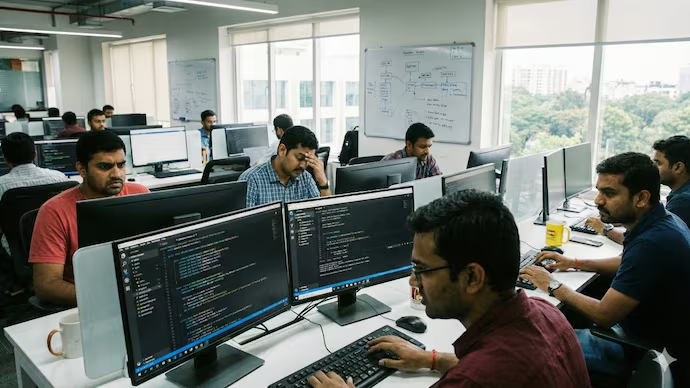
The era of software engineers manually writing code line by line is coming to an end, according to Ryan Dahl, the creator of NodeJS and one of the most influential figures in modern web development.
As AI-powered coding tools grow increasingly sophisticated, Dahl argues that syntax-heavy programming is no longer the core of a developer’s job—and may soon be obsolete altogether.

“The era of humans writing code is over,” Dahl wrote in a recent post on X, adding fresh momentum to an intensifying debate about the future of software development in an AI-driven world.
Few industries are feeling the shockwaves of artificial intelligence as acutely as software development. Tools such as Anthropic’s Claude Code are now capable of generating production-ready software with minimal human input, blurring the line between human and machine authorship. For many developers, this has raised uncomfortable questions about relevance, job security, and identity.
Dahl’s message, however, is not a eulogy for software engineers. Instead, it is a call for reinvention.
He does not argue that AI will make developers redundant. Rather, he believes their role must evolve. Instead of painstakingly writing syntax “word by word and command by command,” engineers should focus on ideation, system design, and decision-making—using AI to handle what he describes as the “boring” parts of the job.
More opportunities, not fewer
Dahl acknowledges that the transition away from manual coding will be deeply unsettling, especially for engineers who see coding as both a craft and a personal identity. But he insists that there will still be ample work for humans—just of a different kind.
Future software engineers, he suggests, will spend more time defining system architecture, reviewing and validating AI-generated code, steering projects at a conceptual level, and deciding what should be built rather than how it should be written.
That shift is already well underway. Major tech companies such as Google and Microsoft have publicly stated that nearly 30 percent of their production code is now generated by AI systems. Anthropic has gone even further, revealing internally that close to 80 percent of the code behind Claude Code is written by AI itself, with humans stepping in mainly for oversight and complex judgment calls.
In other words, AI is no longer merely a productivity booster for developers—it is rapidly becoming the primary producer of code.
A broader labor shock
Dahl’s views echo a growing chorus of influential voices warning of a profound AI-led transformation of work. Geoffrey Hinton, widely known as the “godfather of AI,” has cautioned that the pace of progress could lead to the replacement of millions of jobs as early as 2026, including roles requiring advanced reasoning and long-term planning.
In the context of software development, Hinton believes AI systems will soon be capable of completing projects in days or weeks that currently take human teams months.
Taken together, these signals point to a fundamental reset for the tech industry. Coding, long seen as a future-proof skill, is being reshaped in real time. As AI takes over the keyboard, the value of software engineers may increasingly lie not in writing code—but in thinking beyond it.

Russia prepares stricter rules for private universities amid quality concerns

Philippines audit agency flags lapses in CHEd scholarship programs

Singapore Management University’s Executive MBA enters global top 50 in Financial Times ranking

NUS launches clinical psychology program to expand Singapore’s mental healthcare workforce
DGT Partners with Medhavi Skills University to Expand Industry-Linked ITI Training
Philippines audit agency flags lapses in CHEd scholarship programs
Singapore Management University’s Executive MBA enters global top 50 in Financial Times ranking
NUS launches clinical psychology program to expand Singapore’s mental healthcare workforce

Wits researchers develop light-powered neural network to decode complex signals

How China is expanding vocational education through undergraduate degrees, industry partnerships and financial aid

Russia prepares stricter rules for private universities amid quality concerns
Philippines audit agency flags lapses in CHEd scholarship programs
Singapore Management University’s Executive MBA enters global top 50 in Financial Times ranking
NUS launches clinical psychology program to expand Singapore’s mental healthcare workforce
DGT Partners with Medhavi Skills University to Expand Industry-Linked ITI Training
Philippines audit agency flags lapses in CHEd scholarship programs
Singapore Management University’s Executive MBA enters global top 50 in Financial Times ranking
NUS launches clinical psychology program to expand Singapore’s mental healthcare workforce
Wits researchers develop light-powered neural network to decode complex signals
How China is expanding vocational education through undergraduate degrees, industry partnerships and financial aid
Copyright© educationpost.in 2026 All Rights Reserved.