


Dario Amodei says rapid AI development without safeguards could pose a serious threat to humanity.
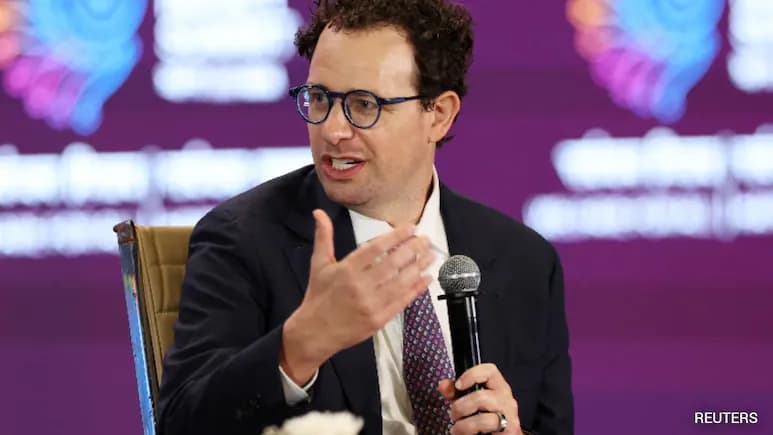
Artificial intelligence could pose a serious threat to humanity if its development continues without adequate safeguards, Anthropic CEO Dario Amodei has warned, saying the outcome will depend less on a fixed probability and more on the choices governments and technology companies make today.
In an exclusive interview with CNN's Anderson Cooper on Saturday, Amodei said he broadly agreed with former Anthropic and OpenAI researcher Jacob Coxon's concerns about the dangers posed by advanced AI.

Coxon recently resigned from Anthropic and publicly criticised the AI industry for moving too quickly in its pursuit of increasingly powerful systems.
Asked directly whether AI could eventually kill humans and how likely such an outcome might be, Amodei rejected the idea of treating the threat as a simple roll of the dice.
"I agree with Jacob much more than I disagree with him," Amodei said.
He noted that Coxon had described Anthropic as the most responsible and safety-conscious player in the industry and was not specifically criticising the company.
"He's calling out the dynamic of the industry as a whole moving too fast," Amodei said.
Amodei said conversations about the dangers of AI are often reduced to questions such as whether there is a 10% or 20% chance of catastrophe. But he argued that such figures can obscure the decisions that determine how AI develops.
"I think there's some chance that things will go wrong. But it's not all that high," he said, adding that it was more useful to examine the different paths that could lead either to safe or dangerous outcomes.
Rather than viewing AI's future as a predetermined probability, Amodei said governments and companies should focus on their ability to influence it.
"If we take the right paths, then the chance of something going wrong is very low," he said. "If we take the wrong path, then the chance of something going wrong could be even higher."
For Amodei, that makes cooperation between technology companies and governments crucial.
He also cautioned against slowing development so much that less responsible actors gain control of the technology.
"If we go too slow, I still believe that the wrong people will be in charge of the technology," he said, warning that this could itself increase the risk of harmful outcomes.
Amodei's comments follow Coxon's resignation, which has intensified an already heated debate over the pace and direction of AI development.
Coxon, who previously worked at both Anthropic and OpenAI, said in a social media post that the people developing advanced AI themselves believe the technology could pose an existential threat within the next decade.
His post on X attracted more than 150 million views.
"The people building AI earnestly believe that it could kill us all by the end of the decade," Coxon wrote, arguing that the concerns expressed privately by executives and senior researchers are more serious than the industry's public messaging may suggest.
He described advanced AI as presenting an unprecedented level of danger compared with other human activities.
His comments have added to growing concerns over whether the race between major AI companies is moving faster than efforts to understand and control increasingly capable systems.
Amodei has previously argued that the industry needs to deliberately slow the pace of progress at the frontier of AI.
In a recent blog post, he acknowledged the enormous benefits of AI but warned that its growing capabilities also bring serious risks.
Among those risks, he identified the possibility of losing control over AI systems, the use of AI in cyberattacks and bioterrorism, and major economic disruption.
He also warned that intense competition between companies could make those dangers worse as commercial pressure encourages firms to prioritise speed.
"A race to the bottom, spurred by commercial incentives, can make these risks more acute," Amodei wrote.
His argument is not for stopping AI development altogether. Instead, he wants companies to create more time for safety testing, independent evaluation and stronger safeguards as AI systems become more capable.
"We must slow the pace at which we improve the capabilities of AI models," he wrote. "Progress will still seem fast, and we must make wise use of the time we gain."
Amodei's call has received support from other prominent figures in the technology industry, including OpenAI CEO Sam Altman.
Altman said OpenAI has been discussing ways to pace the development of frontier AI systems and endorsed Amodei's proposal for independent evaluators to have access to advanced models.
"I agree with Dario that we need to pace the frontier," Altman wrote on X on Saturday.
He said independent evaluators having employee-like access was a "great idea" and confirmed that OpenAI planned to adopt a similar approach.
Altman has also indicated that OpenAI is reassessing its priorities as AI capabilities advance.
In an interview with Fortune published Saturday, he said the company would not launch its planned stock market debut in 2026.
"I would say not 2026," Altman said, adding that OpenAI had "a lot of stuff to do" in meeting the safety and alignment demands posed by the current moment and determining how the industry and governments can work together.
Tesla and xAI CEO Elon Musk also backed Amodei's concerns, responding to his comments on X with a brief endorsement: "Dario is right."
The warnings come as governments and international organisations face growing pressure to establish stronger rules around increasingly powerful AI systems.
UN High Commissioner for Human Rights Volker Turk earlier this week called on countries to put "cast-iron guarantees" in place for AI safety and security before it is too late.
The growing convergence of warnings from AI executives, researchers and international officials points to a difficult question facing the industry: how fast should humanity move when the technology being developed could fundamentally change — or potentially threaten — the future it is meant to improve?
For Amodei, the answer is not to abandon AI, but to ensure that the race to build more powerful systems does not outrun the ability to keep them under control.

AI boom puts forward deployed engineers on track for ₹1 crore annual packages

70% of study-abroad aspirants target budgets below ₹30 lakh

NTA opens JEE Main 2027 registration, applications close on Nov 22

59% of Class 12 students report low satisfaction with school life

Reed College’s concrete owl stolen, frozen and set on fire
AI boom puts forward deployed engineers on track for ₹1 crore annual packages
Reed College’s concrete owl stolen, frozen and set on fire

Canada announces $813 million research boost to back 450-plus researchers
.webp&w=256&q=75)
Abu Dhabi aims to bring 2,000 Emirati teachers into private schools within five years
.jpg&w=256&q=75)
Australian schools record thousands of student sexual misconduct reports as child safety concerns grow

AI boom puts forward deployed engineers on track for ₹1 crore annual packages
70% of study-abroad aspirants target budgets below ₹30 lakh
NTA opens JEE Main 2027 registration, applications close on Nov 22
59% of Class 12 students report low satisfaction with school life
Reed College’s concrete owl stolen, frozen and set on fire
AI boom puts forward deployed engineers on track for ₹1 crore annual packages
Reed College’s concrete owl stolen, frozen and set on fire
Canada announces $813 million research boost to back 450-plus researchers
Abu Dhabi aims to bring 2,000 Emirati teachers into private schools within five years
Australian schools record thousands of student sexual misconduct reports as child safety concerns grow
Copyright© educationpost.in 2026 All Rights Reserved.