


Partnership will explore indigenous quantum technologies, AI and blockchain to strengthen cybersecurity, improve financial decision-making and prepare banks for emerging digital threats.
India is taking steps to prepare its banking sector for the opportunities and security challenges of the quantum era, with the Centre for Development of Advanced Computing (C-DAC) and Bank of India (BOI) joining hands to develop indigenous technology solutions for financial services.
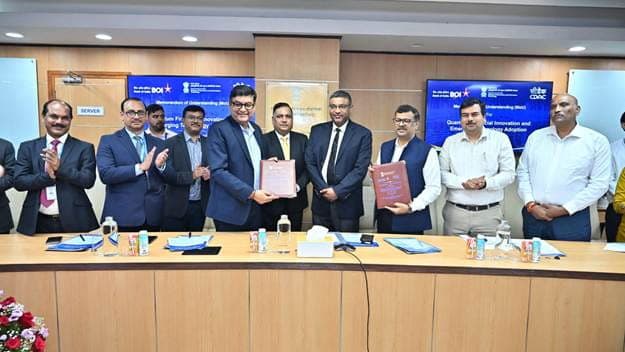
The two organisations signed a Memorandum of Understanding (MoU) recently to advance quantum financial innovation, explore emerging technologies and build capabilities for a more secure, resilient and future-ready banking ecosystem.

The collaboration will bring together C-DAC’s expertise in high-performance computing, artificial intelligence (AI), quantum technologies, blockchain and cybersecurity with Bank of India’s banking experience, nationwide presence and large-scale technology infrastructure.
A central objective of the partnership is to establish a quantum ecosystem for financial innovation, helping the banking sector prepare for emerging technological opportunities while addressing potential cybersecurity risks associated with advances in quantum computing.
The two organisations will explore quantum-inspired and quantum-safe technologies designed to strengthen security, improve decision-making and enhance the resilience of banking systems.
Under the agreement, C-DAC and BOI will identify priority banking applications, conduct joint research and development, and test promising solutions through proofs of concept in secure sandbox environments. They will also assess technical feasibility, evaluate potential benefits for banking operations and compare emerging technologies with existing systems before drawing up roadmaps for further development, pilot projects or adoption.
Shri S. Krishnan, Secretary, Ministry of Electronics and Information Technology (MeitY), congratulated Bank of India on its contribution to technological advancement and welcomed its collaboration with C-DAC to promote indigenous innovation.
He emphasised the importance of building a quantum-resilient financial ecosystem as cybersecurity concerns grow and new technological threats emerge, underlining the need for the banking sector to prepare for both the risks and opportunities of the quantum era.
C-DAC Director General Shri E. Magesh said the partnership would help translate India's indigenous quantum and emerging technology capabilities into practical banking solutions.
He said joint research, development and capacity-building initiatives would support efforts to create a secure, resilient and future-ready financial ecosystem.
Bank of India Executive Director Shri Rajiv Mishra said quantum technologies could reshape several aspects of banking, ranging from cybersecurity to complex financial decision-making.
Through the collaboration, he said, the bank aims to explore and evaluate these emerging possibilities systematically while developing the knowledge and technical capabilities needed to prepare for the next generation of banking technology.
The partnership extends beyond quantum computing to include blockchain, artificial intelligence and other emerging technologies relevant to financial services.
Potential applications include intelligent document processing, AI-powered assistance for customers and employees, fraud analysis, credit assessment, financial analytics and secure AI platforms. The two organisations will also explore responsible AI, smart contracts, digital identity solutions and secure data-sharing mechanisms.
These areas of collaboration could help identify practical ways to improve operational efficiency, strengthen fraud detection and support more secure digital banking services. Their eventual implementation will depend on the outcomes of research, testing and feasibility assessments.
Developing skilled professionals will be another key priority under the MoU. The organisations plan to conduct training and capacity-building programmes in quantum computing, quantum security, artificial intelligence, blockchain and other emerging digital technologies.
The initiative aims to strengthen technical expertise and create a talent ecosystem capable of supporting the banking sector's evolving technology needs.
The MoU was formally exchanged by Shri Aditya Kumar Sinha, Executive Director, C-DAC Mumbai, and Shri Satyendra Singh, Chief General Manager (IT) and Chief Information Officer, Bank of India.
The exchange took place in the presence of MeitY Secretary Shri S. Krishnan, Bank of India Executive Director Shri Rajiv Mishra, MeitY Joint Secretary Shri Sudeep Shrivastava, C-DAC Director General Shri E. Magesh and other senior officials from the ministry, the bank and C-DAC.
Through the partnership, C-DAC and Bank of India aim to establish a structured pathway for translating indigenous research into practical financial applications. The collaboration reflects a broader effort to strengthen India's technological capabilities and prepare its banking infrastructure for an increasingly complex digital and cybersecurity landscape.
C-DAC, Bank of India join forces to build quantum-safe banking ecosystem

Supernova remnant reveals mysterious knots and clumps of gas in unprecedented detail
University of Johannesburg records second-largest rise in global research influence

IUCN launches global strategy to combat invasive species and protect biodiversity

Tamil Nadu: Two Class 11 Students Held in Dalit Student Death Case Linked to Alleged Caste Harassment

Canada announces $813 million research boost to back 450-plus researchers

Abu Dhabi aims to bring 2,000 Emirati teachers into private schools within five years

Australian schools record thousands of student sexual misconduct reports as child safety concerns grow
Egypt insists international schools include Arabic, history in final scores

China’s Chery unveils AI companion robot designed to ease loneliness

C-DAC, Bank of India join forces to build quantum-safe banking ecosystem
Supernova remnant reveals mysterious knots and clumps of gas in unprecedented detail
University of Johannesburg records second-largest rise in global research influence
IUCN launches global strategy to combat invasive species and protect biodiversity
Tamil Nadu: Two Class 11 Students Held in Dalit Student Death Case Linked to Alleged Caste Harassment
Canada announces $813 million research boost to back 450-plus researchers
Abu Dhabi aims to bring 2,000 Emirati teachers into private schools within five years
Australian schools record thousands of student sexual misconduct reports as child safety concerns grow
Egypt insists international schools include Arabic, history in final scores
China’s Chery unveils AI companion robot designed to ease loneliness
Copyright© educationpost.in 2026 All Rights Reserved.