


Black holes are among the universe’s most extreme objects, with gravitational forces so powerful that even light cannot escape them. While scientists have photographed their surroundings and detected collisions between them, what lies inside remains one of physics’ biggest unanswered questions.
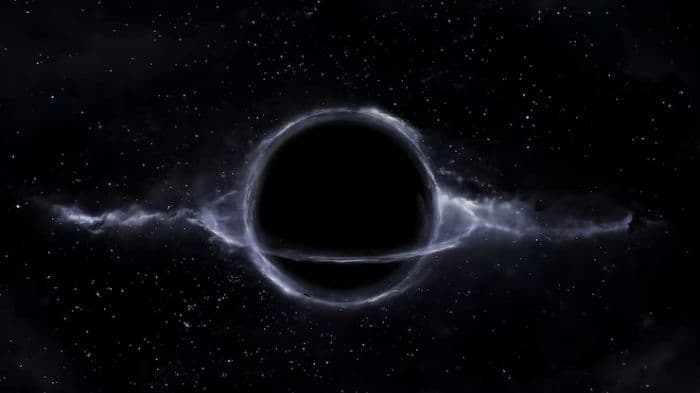
Imagine an object so dense that anything coming too close to it, including light, cannot escape its gravitational pull. It cannot be seen directly, yet its presence can be detected through the movement of nearby stars, glowing matter swirling around it and ripples travelling through space-time.
This is a black hole, one of the most fascinating and least understood objects in the universe.

Black holes are regions of space where an enormous amount of matter is compressed into an extremely small volume. Their gravitational pull is so strong that beyond a particular boundary, nothing can escape. They challenge scientists’ understanding of gravity, matter and the relationship between space and time.
Although astronomers have made significant progress in studying them, several fundamental questions remain unanswered, including what happens to matter that falls inside one.
What exactly is a black hole?
A black hole forms when a large amount of mass is concentrated into an extremely small region, producing an intense gravitational field.
One of the known ways black holes form is through the collapse of massive stars. Stars remain stable for much of their lives because nuclear fusion in their cores produces energy that counteracts the inward pull of gravity. When a sufficiently massive star exhausts its nuclear fuel, it can no longer sustain this balance. Its core collapses under its own gravity, potentially forming a black hole.
The defining feature of a black hole is its event horizon. This is the boundary beyond which neither matter nor light can escape. It is not a solid surface but a point of no return.
An object approaching a black hole may still escape if it has not crossed this boundary. Once it passes the event horizon, however, all possible paths forward lead deeper inside.
If black holes are invisible, how do scientists find them?
Black holes do not emit light that can be observed directly. Scientists therefore study their effects on the surrounding environment.
One way is to observe the hot gas and dust falling towards a black hole. As this material accelerates and heats up, it can produce intense radiation, making the region around the black hole visible.
Astronomers can also identify black holes by observing the movement of nearby stars. If a star appears to orbit an invisible object with an enormous mass, scientists can calculate the properties of the object responsible for its motion.
A third method involves detecting gravitational waves. When two black holes orbit each other and eventually merge, they produce ripples in space-time that travel across the universe. Instruments such as the Laser Interferometer Gravitational-Wave Observatory (LIGO) can detect these signals.
In 2015, LIGO made the first direct detection of gravitational waves from a pair of merging black holes, opening a new way of studying the universe.
What happens if something falls into a black hole?
Black holes are often portrayed in films as cosmic vacuum cleaners that suck in everything around them. In reality, their gravitational pull does not work that way.
Objects can orbit a black hole just as planets orbit stars, provided they remain at a safe distance. Even stars near the supermassive black hole at the centre of the Milky Way follow stable orbits rather than automatically falling inside.
The danger begins when an object gets too close and crosses the event horizon.
The intense difference in gravitational pull between the nearer and farther parts of an object can stretch it apart, a process commonly described as spaghettification. Depending on the black hole's size and the object's trajectory, these tidal forces can become destructive.
Scientists can observe some of the material surrounding black holes as it heats up and emits radiation. However, what happens after matter crosses the event horizon cannot be directly observed from outside.
Are there black holes at the centre of galaxies?
Yes. Scientists believe that most large galaxies, including the Milky Way, contain a supermassive black hole at their centre.
Unlike black holes formed from collapsing stars, supermassive black holes contain millions or even billions of times the mass of the Sun. How they grew to such enormous sizes, particularly in the early universe, remains an important question in astronomy.
The supermassive black hole at the centre of our galaxy is called Sagittarius A*. It contains the equivalent of approximately four million Suns in mass.
Despite its enormous gravitational strength, it poses no threat to Earth because of the vast distance separating it from our solar system.
Scientists have also found that the masses of central black holes are related to the properties of their host galaxies. Understanding this relationship could help explain how galaxies form and evolve.
How did scientists capture the first image of a black hole?
In April 2019, the Event Horizon Telescope collaboration released the first image of a black hole, located in the galaxy Messier 87, around 55 million light-years from Earth.
The image showed a bright ring of glowing material surrounding a dark central region, commonly described as the black hole's shadow.
The image was made possible by linking radio telescopes across the world to create a virtual telescope with an Earth-sized observing capability. The network combined observations from multiple locations to produce the image.
In 2022, the collaboration released an image of Sagittarius A*, the supermassive black hole at the centre of the Milky Way.
These images did not show the black holes themselves emitting light. Instead, they captured the hot material surrounding them and the dark shadow created by the black holes' gravitational effects.
The biggest mystery: What happens to information inside a black hole?
One of the most challenging questions in black hole physics concerns information.
According to the laws of quantum mechanics, information about the physical state of a system should not simply disappear. Even if a notebook is burned, for example, information about its contents remains theoretically encoded in the resulting matter and energy.
Black holes create a problem for this principle. If an object carrying information falls beyond the event horizon and the black hole eventually disappears, what happens to that information?
Physicist Stephen Hawking proposed that black holes can slowly lose energy through a process now known as Hawking radiation. Over an extraordinarily long period, this radiation could cause a black hole to lose mass and eventually evaporate.
However, this raises a difficult question: if the black hole disappears, does the information it swallowed disappear with it?
This conflict between quantum mechanics and our understanding of gravity is known as the black hole information paradox. Scientists have developed several theoretical approaches to resolving it, but a complete explanation remains elusive.
What do black holes tell us about the universe?
Black holes are not simply unusual objects at the edges of the universe. They provide scientists with environments in which the laws of physics can be tested under extreme conditions.
Observations of black hole collisions have helped researchers test Albert Einstein's general theory of relativity, which describes gravity as the curvature of space-time caused by mass and energy.
They may also help scientists understand the evolution of galaxies, the behaviour of matter under extreme gravitational forces and the relationship between general relativity and quantum mechanics.
Despite advances in telescopes and gravitational-wave detectors, black holes continue to raise questions that existing theories cannot fully answer. Their study is therefore not only about understanding mysterious objects in space but also about discovering how the universe itself works.

Facing risk of losing ancient knowledge, China establishes rare disciplines school

From smart classrooms to surveillance concerns: Why China's Nanjing University rolled back AI feature

Screen time concerns shape Japan's digital textbook policy, printed books to remain primary
Black holes: Where space, time and the laws of physics break down

Santa Barbara City College in US sees sharp fall in international student enrolment
Facing risk of losing ancient knowledge, China establishes rare disciplines school
From smart classrooms to surveillance concerns: Why China's Nanjing University rolled back AI feature
Screen time concerns shape Japan's digital textbook policy, printed books to remain primary

From admissions to employment, J&K brings private universities under 25% domicile quota

After NEET paper leak row, NTA moves to expand examination center network

Facing risk of losing ancient knowledge, China establishes rare disciplines school
From smart classrooms to surveillance concerns: Why China's Nanjing University rolled back AI feature
Screen time concerns shape Japan's digital textbook policy, printed books to remain primary
Black holes: Where space, time and the laws of physics break down
Santa Barbara City College in US sees sharp fall in international student enrolment
Facing risk of losing ancient knowledge, China establishes rare disciplines school
From smart classrooms to surveillance concerns: Why China's Nanjing University rolled back AI feature
Screen time concerns shape Japan's digital textbook policy, printed books to remain primary
From admissions to employment, J&K brings private universities under 25% domicile quota
After NEET paper leak row, NTA moves to expand examination center network
Copyright© educationpost.in 2026 All Rights Reserved.