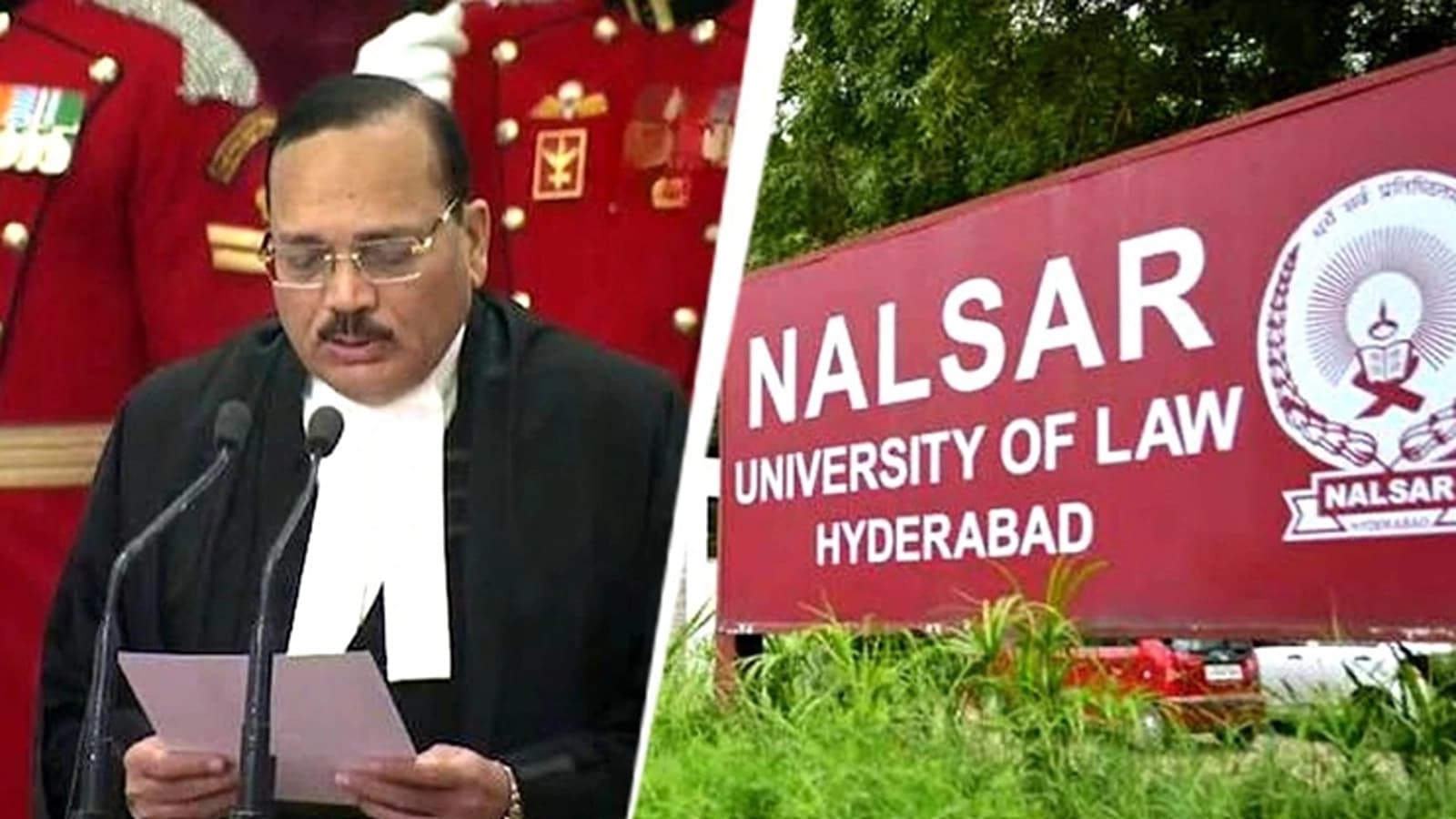
A convocation is ordinarily a moment of ceremony rather than controversy. It marks the culmination of years of study, the transition from classroom to profession and, particularly at a law university, the beginning of a life governed by constitutional principles, professional responsibility and the rule of law.
That is precisely why the controversy at the National Academy of Legal Studies and Research (NALSAR), Hyderabad, deserves more attention than the shorthand now circulating around it: that “students have rejected the Chief Justice of India.”

That description is too simple.
More than 450 students have written to the university asking it to reconsider the reported invitation to Chief Justice of India Surya Kant to be the chief guest at the forthcoming convocation. The students' objection follows a Supreme Court proceeding concerning allegations of police excesses against protesters at Delhi's Jantar Mantar.
But the students have not removed the CJI from the ceremony, nor is there evidence that the university has formally cancelled the invitation. The issue, at present, is a demand for reconsideration. That distinction matters.
So does the other side of the story.
The incident that triggered the objection
The controversy stems from the events surrounding the July 20 “Chalo Sansad” protest in Delhi and the allegations of police excesses during the demonstration. On July 22, a lawyer sought urgent intervention before a bench headed by CJI Surya Kant regarding the alleged police action. During the oral exchange, the CJI reportedly told the lawyer not to “waste” the Court's time. When video evidence was offered, the bench indicated that it was not interested in watching videos at that stage.
For the NALSAR students who objected to the proposed invitation, these remarks became more than an isolated courtroom exchange. They appeared inconsistent with the values they associate with legal education: constitutional rights, access to justice and the protection of citizens' freedoms.
Their objection, therefore, is not merely about whether they like a particular judge. It is an argument about representation.
Who should stand on the stage when students are formally entering the legal profession? And what should that person's presence signify?
Those are legitimate questions for a graduating class to ask.
But the CJI's account cannot be ignored
Yet an opinion that gives only the students' account would be incomplete.
On July 24, CJI Surya Kant publicly clarified that reports suggesting that he had refused to hear a petition concerning the police action were inaccurate. According to his clarification, no writ petition had actually been filed before the Court at that stage; what had been brought before the bench was a representation. He objected to the suggestion that the Court had simply refused to list a formally instituted petition.
That distinction is not a technicality that journalists—or law students—can afford to overlook.
A constitutional court operates through procedures. An oral mentioning, a representation, a formally filed writ petition and an urgent hearing are not interchangeable. A judge's decision not to entertain a particular request at a particular moment cannot automatically be characterised as a refusal to provide justice.
If the students' objection rests on the belief that the CJI simply rejected a properly filed petition, that premise would be open to serious challenge in light of his subsequent clarification.
But that does not necessarily settle the matter.
Procedure and perception are not the same thing
There is an important distinction between “whether the Court acted within procedure and how the Court's conduct was perceived by those seeking justice.”
Both can be true.
The CJI may have been correct that there was no formally filed petition requiring listing. At the same time, students watching a lawyer raise allegations of police excesses against protesters could reasonably have been troubled by the tone of the exchange.
Judicial authority does not rest only upon legal correctness. It also rests upon public confidence.
A judge is not required to agree with every litigant, nor is the Court required to entertain every request placed before it. But courts occupy a unique constitutional position. Their authority depends, in part, on the public's belief that grievances—even unsuccessful ones—are received with seriousness and dignity.
That is why the students' discomfort cannot simply be dismissed as youthful political agitation.
Nor should it automatically be elevated into proof of judicial insensitivity.
The facts require both restraint and scrutiny.
The students have a right to dissent. The judiciary has a right to independence.
This is perhaps the most important distinction in the entire controversy.
Students disagreeing with the CJI over a public episode is not, by itself, an attack on judicial independence.
Judicial independence means that judges must be free to decide cases according to law without political pressure, intimidation or retaliation. A student petition asking a university to reconsider a ceremonial invitation is not the same thing as demanding that a judge decide a case in a particular manner.
At the same time, judicial independence should not become a shield against legitimate public criticism.
Judges, particularly constitutional court judges, exercise enormous public power. Their judgments, courtroom conduct and public statements are inevitably subject to scrutiny. Democratic institutions do not become stronger when those exercising authority become immune from criticism.
The students therefore have every right to say that they do not believe the CJI represents the values they wish associated with their graduation.
But the CJI, and the institution he represents, also deserve to have the factual record judged fairly.
There is another question NALSAR must confront
The university now faces a difficult institutional decision.
Should the choice of a convocation guest be determined partly by students' assessment of that person's recent conduct?
There is a persuasive case for listening to them. A convocation is not merely an administrative event. It is a ceremony with considerable symbolic value. At a premier law university, the person invited to address graduating students inevitably becomes associated with the ideals the institution wishes to celebrate.
Yet there is an equally serious argument on the other side.
If universities begin withdrawing invitations whenever students disagree with a judge's decision, government policy, political position or public statement, ceremonial invitations could gradually become referendums on every controversial public figure.
That would not necessarily strengthen academic freedom.
A judge should be able to deliver an unpopular judgment without fearing that every subsequent university invitation will become an occasion for institutional protest. Likewise, students should be able to criticise a judge without being portrayed as hostile to the judiciary merely because they exercised that right.
The proper answer is not to silence either side.
It is to preserve the space in which both can exist.
The danger of reducing the controversy to “students versus CJI”
There is also a broader journalistic lesson here.
The easiest headline is often the least useful one.
“NALSAR students reject CJI” makes for a dramatic story. But it obscures the facts.
The students have asked the university to reconsider the invitation. More than 450 have reportedly signed the representation. That is significant, but it does not necessarily mean that every graduating student shares the position.
Similarly, saying that the CJI “refused to hear the students' petition” risks repeating a characterisation that he himself has disputed.
The proper journalistic approach is therefore neither to defend the CJI nor to endorse the students.
It is to establish what happened.
What exactly was filed before the Supreme Court? What did the proceedings record? What did the lawyer seek? What did the bench say? What did the students' representation actually demand? How many students signed it? Has the university formally accepted or reconsidered the invitation?
Those questions matter more than the competing slogans.
A law university should be able to withstand disagreement
There is, however, something encouraging in the controversy.
Students of law are not merely being trained to memorise statutes and judgments. They are being trained to question power, examine institutions and understand the tension between rights and authority.
A law school in which students are afraid to criticise a Chief Justice would be a far greater cause for concern than one in which students openly disagree with him.
But critical thinking also requires students to apply the same standards of fairness to institutions that they expect institutions to apply to citizens.
If the judiciary must be judged by facts rather than impressions, students' claims must also be judged by facts rather than assumptions.
That is the real constitutional lesson.
The larger issue is trust
Ultimately, the NALSAR controversy is less about a convocation guest than about trust.
Students are asking whether the person who occupies the highest judicial office embodies the constitutional values they are about to carry into their professional lives.
The CJI, meanwhile, is entitled to insist that judicial proceedings be represented accurately and that criticism not be built upon an incorrect description of what occurred in court.
Neither position is inherently incompatible with the other.
Indeed, a mature constitutional culture requires both.
The judiciary must remain independent, but not beyond criticism. Students must remain free to dissent, but not beyond scrutiny. Universities must protect academic freedom, but also resist turning themselves into arenas where every institutional decision is determined by the loudest faction.
The NALSAR administration would therefore do well to approach the matter neither defensively nor politically. It should make the relevant facts available, listen to the graduating students and explain transparently how the chief guest was selected and whether the invitation remains under consideration.
And the students, for their part, should continue to make their case through reasoned constitutional argument rather than through the language of personal rejection.
That would make the controversy worthy of the institution at its centre.
Because the most important question here is not whether Chief Justice Surya Kant will eventually stand on the NALSAR convocation stage.
It is whether the students leaving that stage will have learned the harder lesson of constitutional democracy: that dissent is indispensable, authority is contestable, procedure matters, facts matter—and none of these principles should have to disappear for another to survive.