For years, the Bharatiya Janata Party (BJP) has positioned itself as the foremost champion of women's political empowerment in India. The passage of the Women's Reservation Act was projected as a historic milestone, one that would finally guarantee women a 33% share in the Lok Sabha and state assemblies.
Prime Minister Narendra Modi and senior BJP leaders repeatedly highlighted the legislation as evidence of the party's commitment to gender justice, often accusing opposition parties of delaying women's representation for decades.
Politically, the BJP has successfully built a narrative that it stands on the right side of history when it comes to women's participation in public life.

But politics is ultimately judged not by narratives, slogans or parliamentary speeches. It is judged by decisions, appointments and the distribution of power.
And nowhere is that contradiction more visible today than in Bihar.
The newly constituted NDA government in Bihar, led by Chief Minister Samrat Choudhary, has reopened a debate that goes beyond party politics and strikes at the heart of a larger question: Is women's political empowerment a governing principle for the BJP, or is it primarily an electoral narrative?
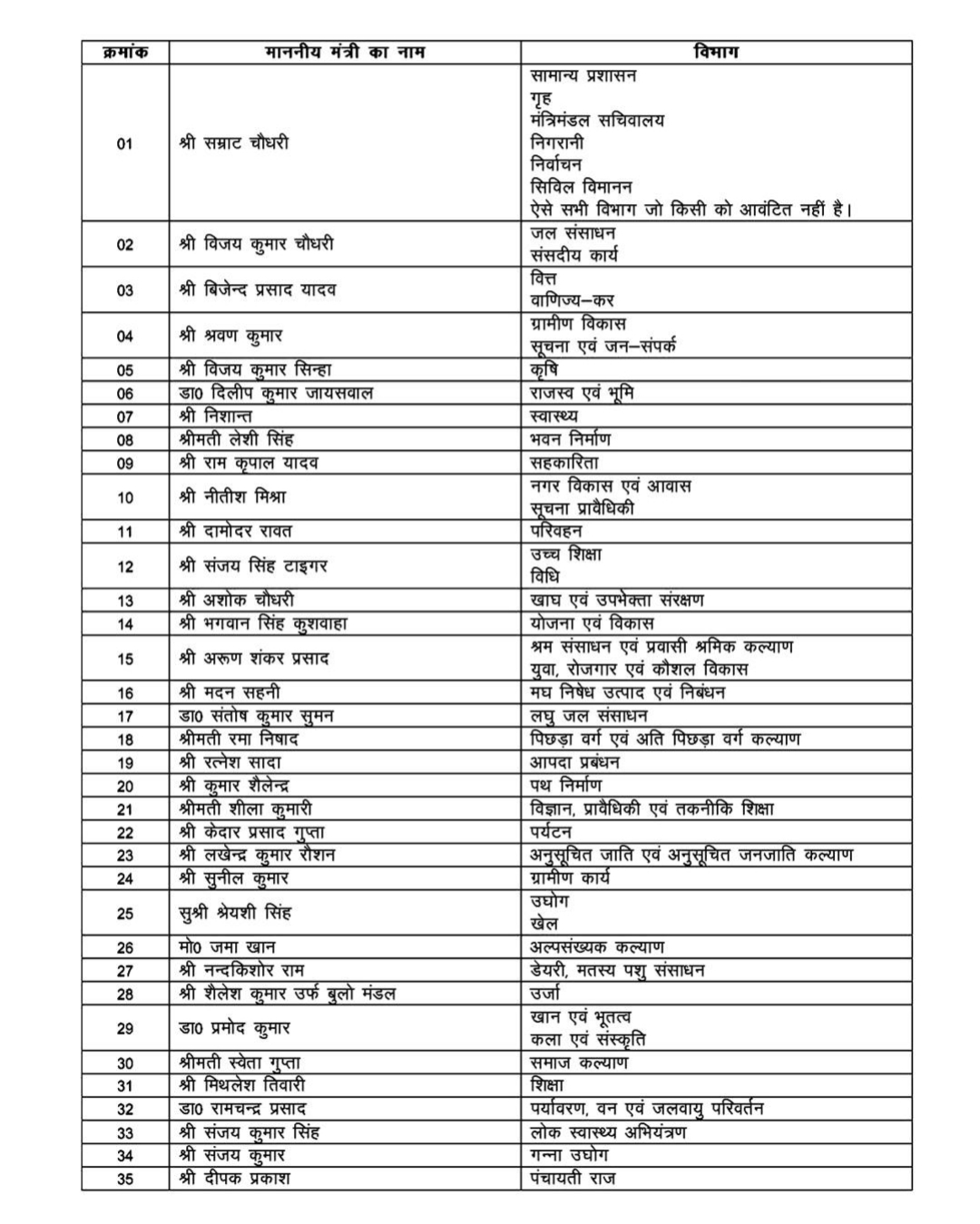
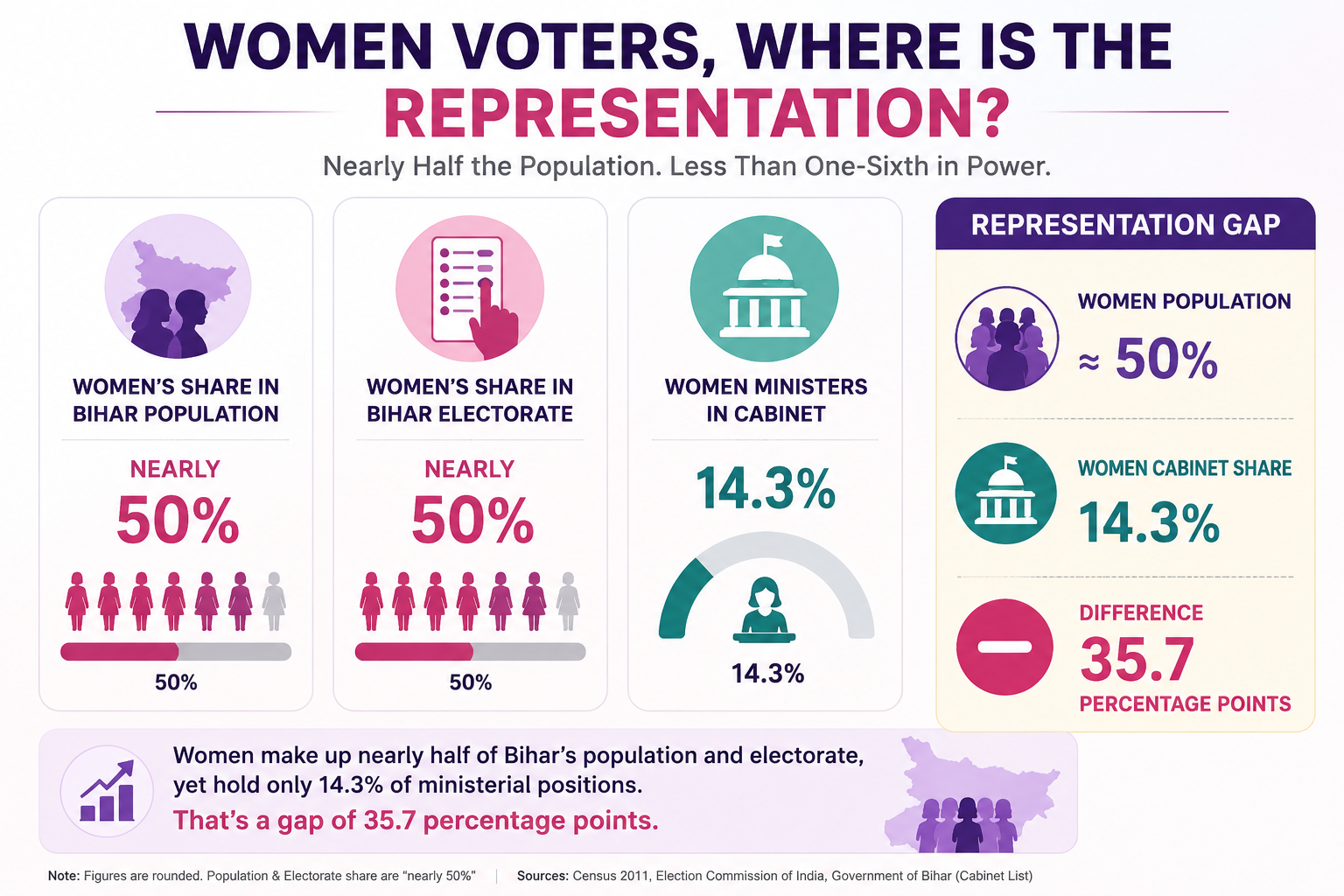
The numbers emerging from Bihar suggest that the gap between rhetoric and reality remains substantial. The Bihar cabinet consists of 35 ministers. Of these, only five are women. In percentage terms, women occupy just 14.3% of positions in the state's highest executive decision-making body. The figure is difficult to ignore because it stands in sharp contrast to the BJP's national advocacy of 33% reservation for women.
.png)
The contradiction becomes even more striking when one looks beyond the cabinet and examines how electoral tickets were distributed before the government was formed. Political representation does not begin inside a cabinet room. It begins much earlier—when political parties decide who gets an opportunity to contest elections.
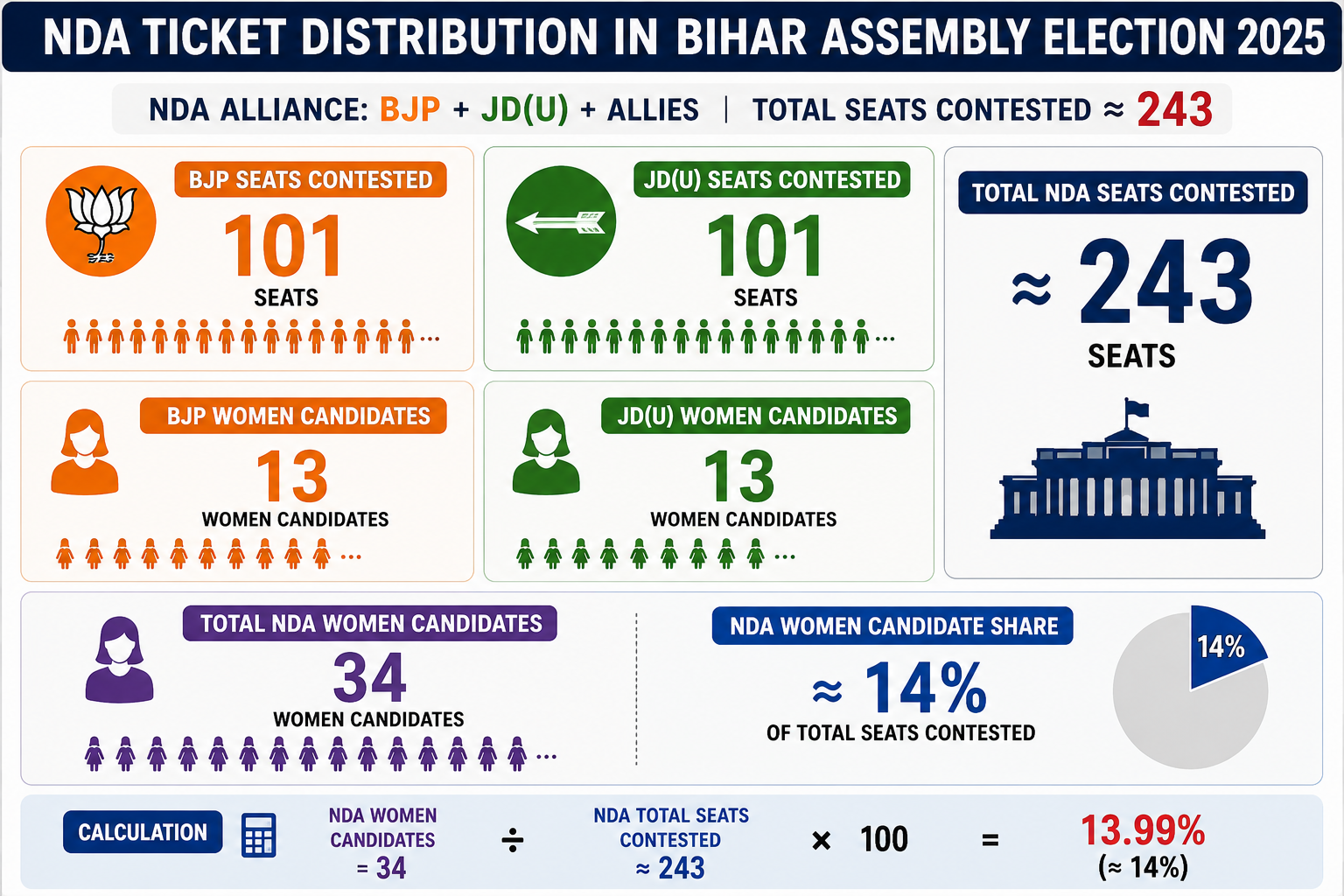
In the 2025 Bihar Assembly elections, both BJP and JD(U), the two principal pillars of the NDA alliance, contested 101 seats each. Yet BJP reportedly fielded only 13 women candidates, while JD(U) also allotted tickets to approximately 13 women candidates. Across the entire NDA alliance, only around 34 women candidates were fielded, amounting to roughly 14% of all NDA candidates. This means that even before voters cast their ballots, women were already significantly underrepresented in the alliance's electoral strategy.
The question naturally follows: If the BJP believes women deserve one-third representation in legislatures, why were women considered suitable for only around one-seventh of the tickets distributed in Bihar?
Supporters of the NDA may argue that candidate selection depends on winnability, caste equations, local political realities and coalition compulsions. Those considerations undoubtedly play a role in Indian elections.
However, the BJP itself has frequently rejected similar justifications when criticizing other parties for inadequate representation of women. If women's political participation is a matter of principle, critics argue, then that principle should shape candidate selection as much as parliamentary legislation.
What makes the issue politically significant is the role women played in the NDA's electoral success. 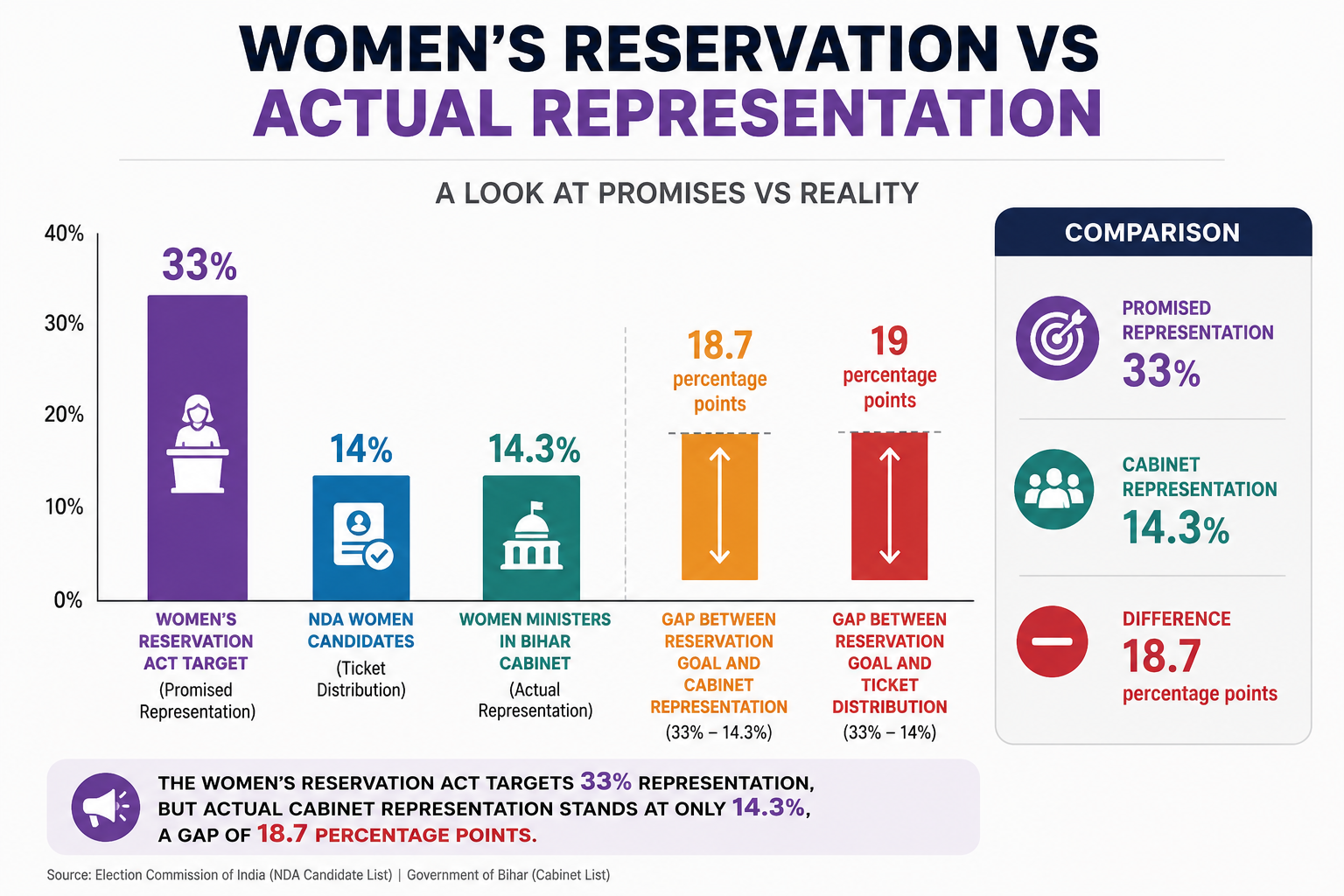
Over the last decade, women have emerged as one of the most decisive voting blocs in Bihar. Female voter turnout has consistently risen, and in several elections women have voted in greater numbers than men. Welfare initiatives targeted at women have become central to the NDA's political strategy. From financial assistance schemes and housing programmes to direct benefit transfers and social welfare initiatives, women have increasingly become the focal point of electoral campaigns.
The NDA understood this reality during the election campaign.
- Women were central to speeches.
- Women were central to welfare promises.
- Women were central to campaign messaging.
Yet when the time came to distribute tickets and ministerial portfolios, their representation remained limited. Women were important enough to mobilise as voters but not proportionately represented as decision-makers.
This is the criticism that the Bihar cabinet now faces. The issue is not merely about the number of women ministers. It is about the broader message conveyed by those numbers.
If women constitute nearly half of Bihar's population and voter base, should they not have a significantly greater presence in the institutions that govern them? The criticism becomes sharper when another set of numbers is brought into the discussion.
According to the latest analysis by the Association for Democratic Reforms (ADR) and Bihar Election Watch, nearly half of the ministers in the current Bihar cabinet have declared criminal cases in their election affidavits.
Out of the ministers analysed, 15 ministers—or 48%—have declared criminal cases. More significantly, nine ministers, representing around 29% of the cabinet, face serious criminal charges. At the same time, ADR's analysis found that 28 ministers are crorepatis.
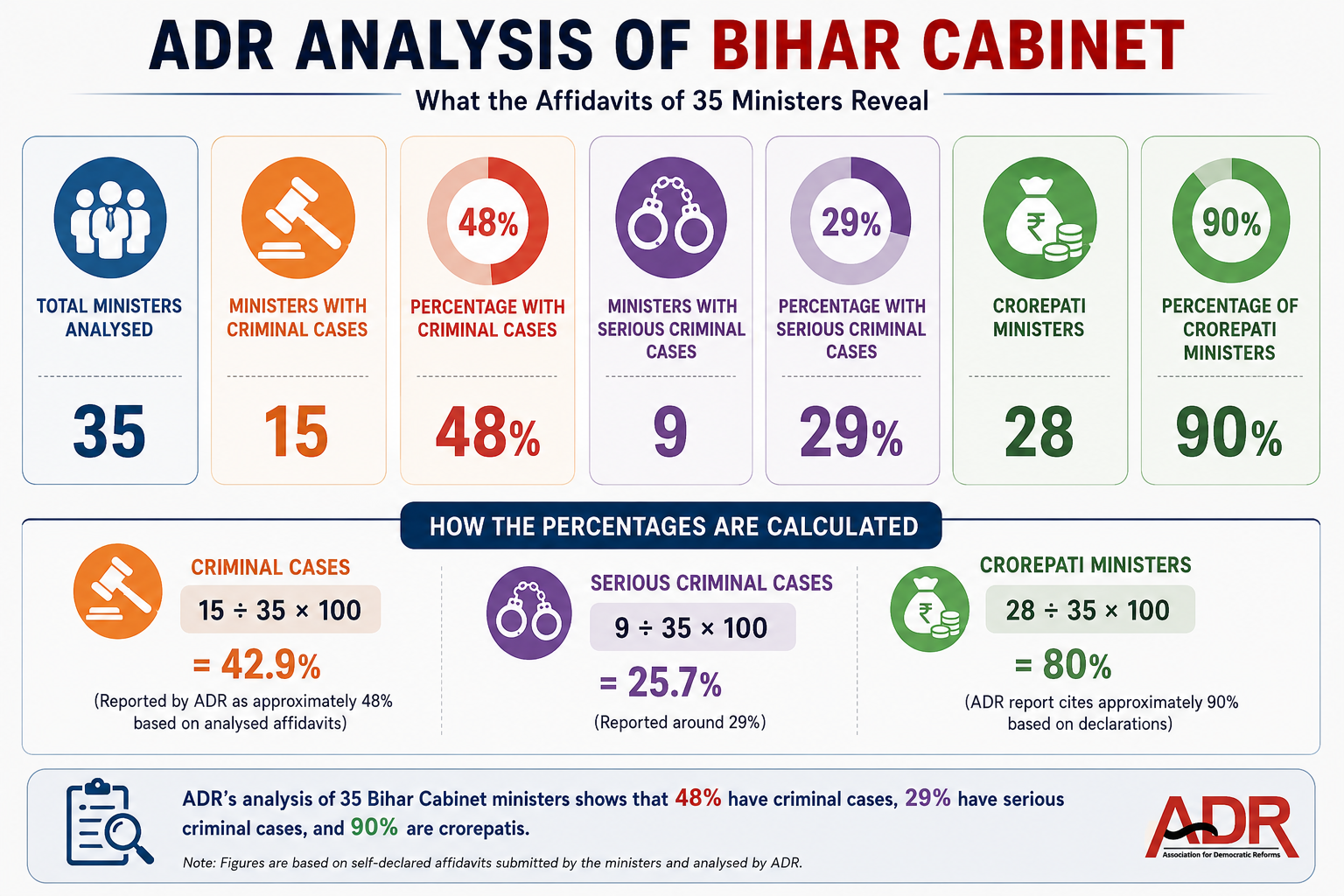
These figures do not establish guilt. Criminal cases mentioned in affidavits remain allegations unless proven in court. Nevertheless, the data raises an important political question. A government that found space in its cabinet for ministers facing serious criminal allegations has allocated only five positions to women.
For critics like us, this comparison highlights a troubling imbalance in political priorities. The issue is not whether ministers with pending cases should automatically be excluded from office. The issue is whether women's representation is receiving the same urgency and importance that political leaders publicly claim it deserves.
Defenders of the government may point out that Bihar's politics has always been shaped by caste arithmetic, coalition balancing and regional representation. Cabinet formation in India is rarely a simple exercise.
That argument has merit. But it is equally true that political leadership is ultimately reflected in the priorities it chooses to pursue despite those constraints. The BJP has repeatedly argued that women's representation should not be postponed because of political convenience. That argument formed the moral foundation of its support for the Women's Reservation Act.
If that principle is genuinely believed, critics contend, then it should be visible not only in future constitutional arrangements but also in present-day governance. The broader significance of Bihar lies in what it reveals about Indian politics as a whole.
Most political parties have historically failed to provide adequate representation to women. The Congress has struggled with the issue. Regional parties have struggled with it. Parties built around social justice and identity politics have struggled with it.
However, the BJP faces a higher level of scrutiny because it has made women's empowerment one of its defining political messages. Political branding inevitably creates political expectations. A party that claims leadership on women's representation cannot reasonably expect to be judged by the standards of its opponents. It will be judged by the standards it has set for itself.
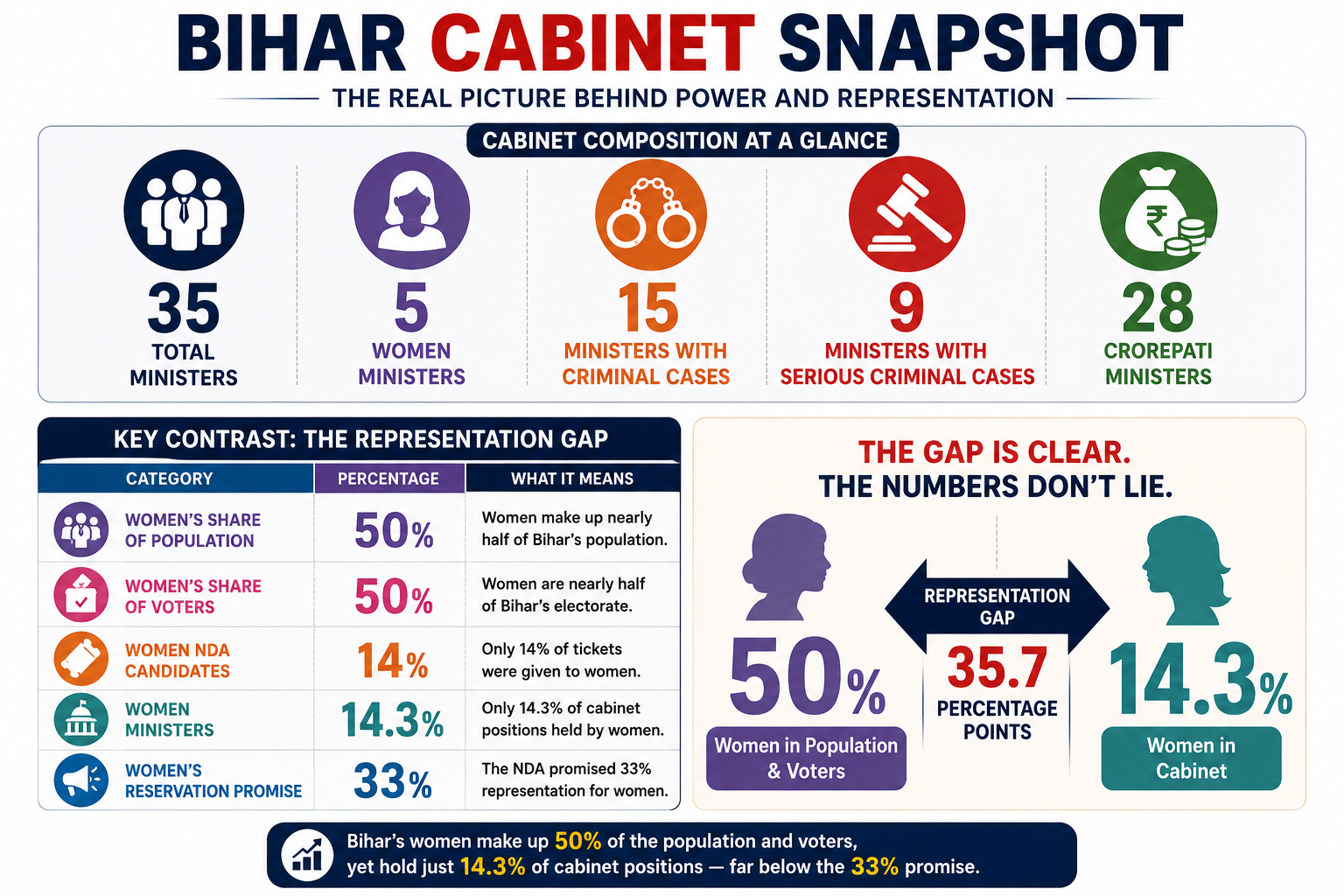
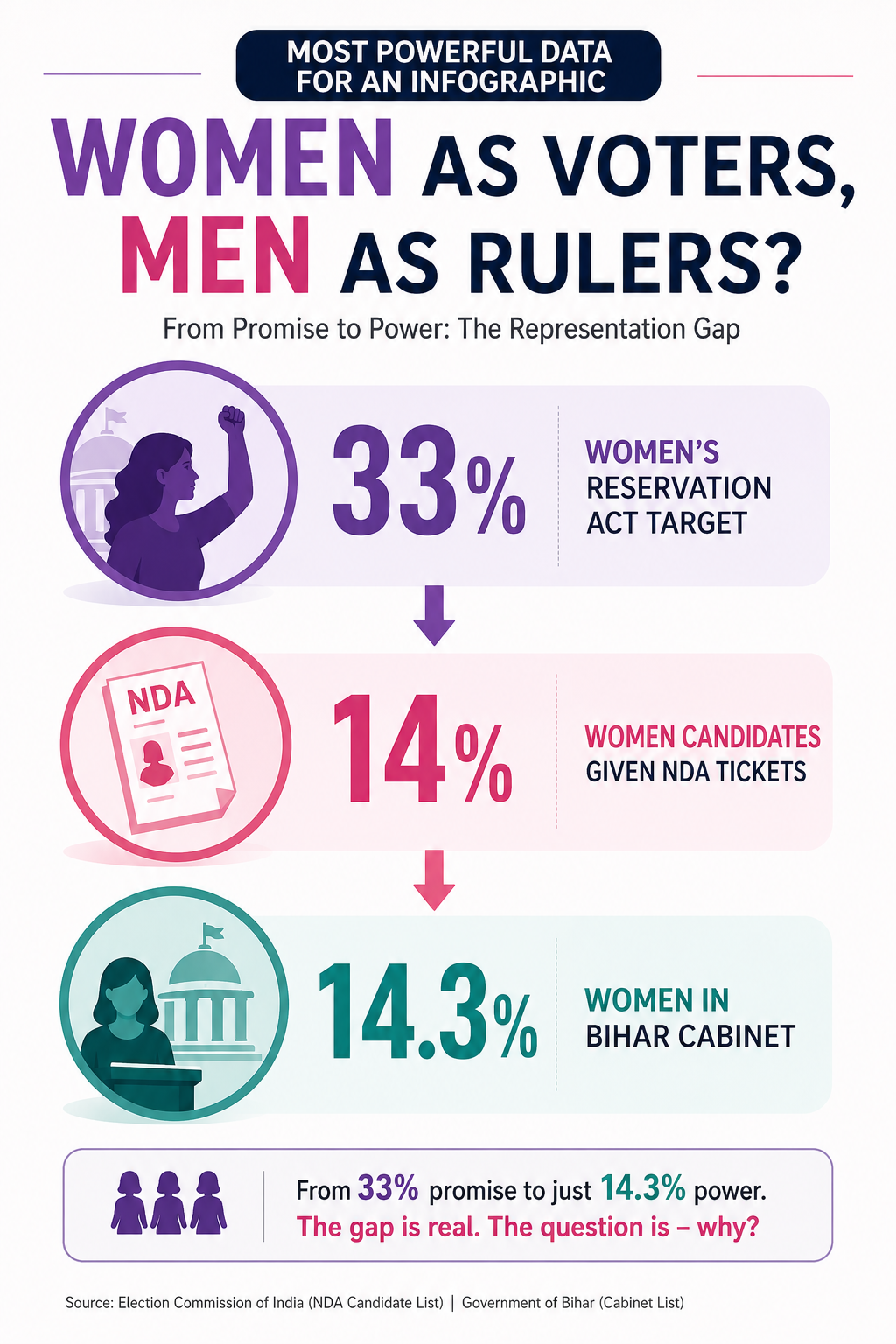
And when those standards are applied to Bihar, difficult questions emerge. The NDA advocates 33% reservation for women. Yet women received only around 14% of the alliance's tickets. Women occupy only around 14% of positions in the state cabinet. Meanwhile, nearly half of the ministers have declared criminal cases in their affidavits.
These are not opposition allegations or partisan talking points. They are figures derived from election data, publicly available candidate information and ADR analyses. The contradiction, therefore, is not ideological. It is numerical. And numbers often reveal what political slogans conceal.
The BJP deserves credit for supporting legislation that promises greater representation for women in the future. But genuine commitment to women's empowerment cannot be measured only through laws whose implementation remains tied to future processes.
It must also be measured by present choices.
In Bihar, those choices suggest that while women have become indispensable to winning elections, they are still far from receiving a proportionate share of political power.
For a party that has made women's representation a central pillar of its political identity, that gap between promise and practice may prove increasingly difficult to explain.