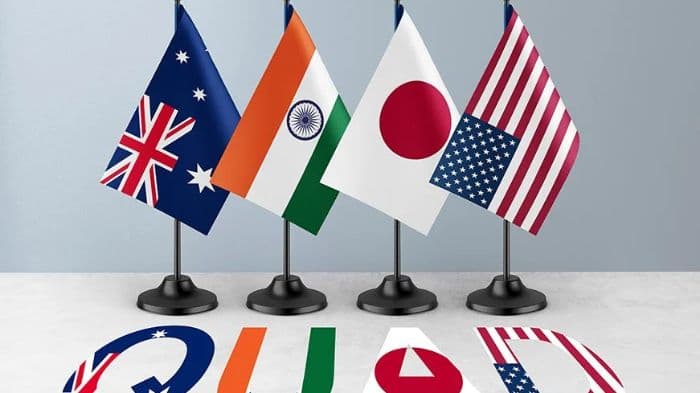
The foreign ministers of India, the US, Japan and Australia reaffirmed cooperation on maritime security, critical minerals, energy resilience and regional stability, signalling the Quad's expanding role in the Indo-Pacific.

The Quad Foreign Ministers’ Meeting held in New Delhi last month shows that the alliance is not becoming obsolete; rather, it has gained further credentials as a needed deterrence and fallback because the very strategic environment that created it has become more militarised and the threats have deepened, according to an article.
Attended by US Secretary of State Marco Rubio and the Foreign Ministers of India, Japan and Australia, the grouping is moving into a more practical phase. The meeting has dispelled doubts that the alliance has weakened due to President Donald Trump’s desire to stabilise trade ties with China and possible ambiguity over Taiwan, according to the article in Eurasia Review.

It further highlights that the joint statement from the meeting reaffirmed cooperation on maritime domain awareness, critical minerals, energy security, infrastructure, counter-terrorism and regional resilience, while expressing concern over coercive actions in the South China Sea and East China Sea and opposing unilateral attempts to change the status quo.
One of the most important outcomes was the decision to mobilise around $20 billion in public and private investment for critical minerals supply chains, including mining and processing, to counter China’s dominance in rare earths and critical mineral processing, the article observed.
"The Quad understands that securing the Indo-Pacific is not only about naval and military assets with aircraft carriers and missiles, but also increasingly about human capital for the control of logistics, who finances infrastructure, who sees maritime movement first, who processes the minerals needed for defence and technology, and who can keep sea lanes open during a crisis," the article added.
--IANS


AI investments set to propel global IT spending to $6.37 trillion

Govt acts to shield economy from West Asia crisis, says Minister

India has taken firm steps to shield economy from West Asia crisis

Timely utilisation of funds makes Maharashtra first to secure second RKVY instalment

Digital technology to drive shark conservation initiatives

Govt rolls out ‘Corporate Mitra’ initiative to empower MSMEs and young professionals

India's first indigenous hydrogen fuel cell train unveiled: Route, speed and key features

IIT Gandhinagar researchers develop new fluorescent technology to improve plant tissue imaging

CAT 2026 notification released, registration opens from Aug 3

IAS TK Anil Kumar appointed Secretary of School Education and Literacy Department

AI investments set to propel global IT spending to $6.37 trillion

Govt acts to shield economy from West Asia crisis, says Minister

India has taken firm steps to shield economy from West Asia crisis

Timely utilisation of funds makes Maharashtra first to secure second RKVY instalment

Digital technology to drive shark conservation initiatives

Govt rolls out ‘Corporate Mitra’ initiative to empower MSMEs and young professionals

India's first indigenous hydrogen fuel cell train unveiled: Route, speed and key features

IIT Gandhinagar researchers develop new fluorescent technology to improve plant tissue imaging

CAT 2026 notification released, registration opens from Aug 3

IAS TK Anil Kumar appointed Secretary of School Education and Literacy Department
Copyright© educationpost.in 2024 All Rights Reserved.
Designed and Developed by @Pyndertech